

Strategic Management Model Powerpoint Ppt Template Bundles





Try Before you Buy Download Free Sample Product
 Impress Your
Audience
 100%
Editable
 Save Hours
of Time


Our Strategic Management Model Powerpoint Ppt Template Bundles are topically designed to provide an attractive backdrop to any subject. Use them to look like a presentation pro.
People who downloaded this PowerPoint presentation also viewed the following :
Strategic Management Model Powerpoint Ppt Template Bundles with all 17 slides:
Use our Strategic Management Model Powerpoint Ppt Template Bundles to effectively help you save your valuable time. They are readymade to fit into any presentation structure.











FAQs for Strategic Management Model Powerpoint
Strategic management models include environmental analysis, strategy formulation, implementation planning, performance measurement, and continuous evaluation processes. These components work together by assessing market conditions, defining competitive positioning, and allocating resources effectively, with many organizations finding that this systematic approach ultimately delivers sustainable competitive advantage and improved operational efficiency.
Strategic management models differ from traditional management approaches by emphasizing long-term vision, competitive positioning, and environmental analysis rather than focusing solely on internal operations and short-term efficiency. While traditional management prioritizes day-to-day processes and immediate results, strategic models enable organizations to anticipate market changes, adapt to disruption, and maintain sustainable competitive advantage, with many companies finding that this forward-thinking approach delivers superior performance in increasingly dynamic business environments.
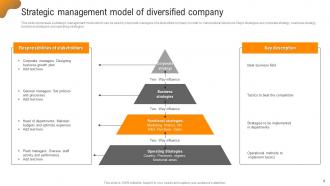
Stakeholder analysis enhances strategic management by identifying key influencers, assessing their interests and power dynamics, mapping potential conflicts, and aligning organizational objectives with stakeholder expectations. This systematic approach enables companies to anticipate resistance, build stronger partnerships, and make more informed decisions, with many organizations finding that comprehensive stakeholder mapping ultimately delivers smoother strategy implementation and sustainable competitive advantage.
Competitive analysis serves as a foundational element in strategic management models, enabling organizations to identify market opportunities, assess threats, benchmark performance, and understand industry dynamics. Through systematic competitor evaluation, businesses can refine their positioning strategies, anticipate market shifts, and develop sustainable competitive advantages, with many companies finding that regular competitive intelligence ultimately drives more informed strategic decisions and improved market performance.
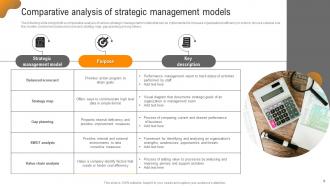
SWOT analysis integrates into strategic management models by informing goal setting, strategy formulation, and resource allocation through systematic evaluation of strengths, weaknesses, opportunities, and threats. This strategic combination enables organizations to leverage internal capabilities while addressing market challenges, with many companies finding that regular SWOT assessments enhance decision-making and deliver sustainable competitive advantage.
The balanced scorecard enhances strategic management by aligning organizational activities with vision and strategy, providing comprehensive performance measurement across financial, customer, internal process, and learning perspectives. This framework enables companies to translate strategy into actionable objectives, improve communication throughout the organization, and monitor both leading and lagging indicators, ultimately delivering better strategic execution and sustainable competitive advantage.
Technology enhances strategic management through data analytics platforms, AI-powered forecasting tools, cloud-based collaboration systems, automated performance dashboards, and real-time market intelligence solutions. These technologies streamline decision-making by providing actionable insights, accelerating strategic planning cycles, and enabling cross-functional collaboration, with many organizations finding that integrated digital platforms deliver faster strategic responses and improved competitive positioning.
Essential metrics for measuring strategic management model effectiveness include financial performance indicators, market share growth, customer satisfaction scores, operational efficiency ratios, and employee engagement levels. These metrics enable organizations to track progress across multiple dimensions, with many companies finding that balanced scorecards combining financial, customer, internal process, and learning perspectives deliver comprehensive insights for strategic decision-making and competitive advantage.
Organizational culture significantly influences strategic management success by shaping employee behaviors, decision-making processes, and change acceptance throughout implementation. Companies with collaborative cultures often find that strategic initiatives gain faster adoption and smoother execution, while misaligned cultures can create resistance, ultimately requiring cultural transformation alongside strategic planning to achieve sustainable competitive advantage.
Common pitfalls include lack of employee buy-in, insufficient communication, unrealistic timelines, inadequate resource allocation, and resistance to change management. These challenges often derail implementation across organizations, with many companies finding that successful strategic execution requires clear accountability structures, regular progress monitoring, and adaptive leadership approaches that address cultural dynamics while maintaining strategic focus.
Scenario planning enhances strategic management by analyzing multiple future possibilities, identifying potential risks and opportunities, and developing flexible response strategies for different outcomes. Through systematic evaluation of various business environments, organizations can strengthen decision-making processes, improve resource allocation, and build adaptive capabilities, ultimately delivering greater resilience and competitive advantage in uncertain markets.
Strategic management supports long-term organizational sustainability by establishing clear vision alignment, enabling proactive risk assessment, optimizing resource allocation, and fostering adaptive capability development. Through systematic planning frameworks, organizations streamline decision-making processes, enhance competitive positioning, and build resilience against market disruptions, with many enterprises finding that strategic frameworks ultimately deliver sustained growth and operational excellence.
External factors like economic shifts significantly influence strategic management by altering market conditions, consumer behavior, competitive landscapes, and resource availability, requiring organizations to reassess priorities and adapt approaches. Through scenario planning, risk assessment, and agile frameworks, companies in sectors like retail, manufacturing, and financial services can pivot strategies, reallocate resources, and capitalize on emerging opportunities, ultimately maintaining competitive advantage.
Aligning strategic management models with organizational mission and vision ensures coherent decision-making, resource allocation, and goal achievement across all operational levels. This strategic alignment enables companies to maintain focus during market changes, enhances employee engagement through clear purpose, and ultimately delivers sustainable competitive advantage, with many organizations finding that misalignment leads to inefficiencies and missed opportunities.
Continuous improvement integrates into strategic management through regular performance reviews, feedback loops, stakeholder input analysis, and adaptive planning cycles that respond to market changes. Organizations like Toyota and Amazon embed improvement processes into their strategic frameworks, enabling real-time adjustments to goals, resource allocation, and operational methods, ultimately delivering enhanced competitiveness and sustainable growth.
-
SlideTeam is a great place for PPT templates. They have many templates on a single topic. It has made my life a lot easier.
-
SlideTeam is very efficient when it comes to saving time. I am happy that I chose them for my presentation.