

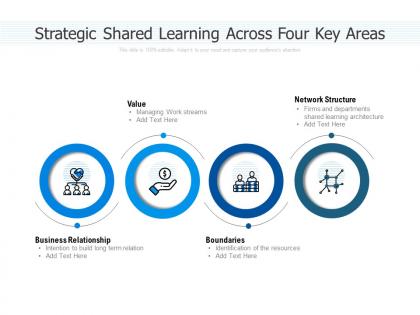
Strategic shared learning across four key areas




Try Before you Buy Download Free Sample Product
 Impress Your
Audience
 100%
Editable
 Save Hours
of Time


Our Strategic Shared Learning Across Four Key Areas bring a lot to the table. Their alluring flavours will make your audience salivate.
People who downloaded this PowerPoint presentation also viewed the following :
Strategic shared learning across four key areas with all 5 slides:
Use our Strategic Shared Learning Across Four Key Areas get your audience in sync. Grab their eyeballs they wont even blink.


FAQs for Strategic shared learning across
Key elements that foster effective collaboration include clear communication channels, defined roles and responsibilities, shared goals and objectives, trust-building activities, and regular feedback mechanisms. These components work together by streamlining decision-making processes, minimizing conflicts, and enhancing productivity, with many project teams finding that structured collaboration frameworks ultimately deliver faster project completion and improved team satisfaction.
Collaboration tools enhance remote team communication by providing real-time messaging, video conferencing, file sharing, and project management capabilities in unified platforms. These technologies streamline workflows by eliminating email bottlenecks, enabling instant feedback, and maintaining transparent progress tracking, with many organizations finding that integrated collaboration solutions ultimately deliver faster decision-making and stronger team cohesion.
Leadership plays a pivotal role in fostering collaborative cultures by establishing clear communication channels, modeling cooperative behaviors, breaking down departmental silos, and creating incentive systems that reward teamwork over individual achievements. Effective leaders in organizations like tech companies and healthcare institutions facilitate cross-functional collaboration through transparent decision-making processes, shared goal-setting, and resource allocation strategies, ultimately delivering enhanced innovation and operational efficiency.
Collaboration success can be measured through project completion rates, timeline adherence, team satisfaction scores, quality of deliverables, and cross-functional engagement levels. These metrics enable organizations to track communication effectiveness, resource optimization, and knowledge sharing outcomes, with many project managers finding that regular collaboration assessments ultimately enhance team performance and deliver measurable competitive advantages.
Common barriers to collaboration include poor communication channels, conflicting priorities, lack of trust between teams, inadequate technology infrastructure, and unclear role definitions. Organizations overcome these challenges by implementing unified communication platforms, establishing shared objectives and accountability frameworks, fostering cross-functional relationships through regular interaction, and providing collaborative tools that streamline workflows, ultimately delivering enhanced productivity and stronger team cohesion.
Diverse perspectives enhance collaborative outcomes by introducing varied problem-solving approaches, challenging assumptions, and uncovering blind spots that homogeneous teams might miss. This diversity enables teams to generate more innovative solutions, make better-informed decisions, and anticipate market needs across different demographics, ultimately delivering stronger competitive advantage and comprehensive strategic outcomes.
Presentation templates facilitate clearer collaboration by providing standardized formats, consistent visual hierarchies, predefined content sections, shared design elements, and unified messaging frameworks. These structured approaches streamline meeting preparation, eliminate formatting distractions, and ensure all participants focus on content rather than design decisions, ultimately delivering more productive discussions and faster consensus-building across teams.
Organizations ensure inclusive collaboration by establishing clear communication protocols, implementing diverse team structures, providing equal access to resources and decision-making processes, and creating psychological safety environments. Through regular check-ins, rotating leadership roles, and structured feedback mechanisms, companies across sectors like healthcare and financial services enhance participation rates, reduce team conflicts, and ultimately deliver stronger project outcomes while building more engaged workforces.
Technology has revolutionized collaborative practices by enabling real-time communication, cloud-based document sharing, virtual team coordination, and seamless project management across geographical boundaries. These digital tools streamline workflows, enhance productivity, and facilitate instant feedback loops, with many organizations finding that remote collaboration now delivers faster decision-making, reduced operational costs, and broader talent access.
Visual aids like infographics and charts enhance collaborative discussions by making complex data more accessible, reducing misinterpretation, and accelerating decision-making processes. These tools enable teams to identify patterns quickly, align on key insights, and maintain focus during meetings, with many organizations finding that visual presentations increase engagement and reduce meeting times while improving consensus-building across departments.
Teams can implement clear role definitions, shared goal-setting with individual metrics, regular check-ins that review both team progress and personal contributions, and collaborative tools that track individual input within group projects. This strategic combination enables organizations to maintain team synergy while ensuring personal ownership, with many companies finding that structured accountability frameworks enhance both collective outcomes and individual performance, ultimately delivering stronger project results and employee engagement.
Different collaboration styles significantly impact team dynamics by influencing communication patterns, decision-making processes, and conflict resolution approaches, ultimately affecting overall productivity and innovation outcomes. While directive styles can accelerate decision-making in time-sensitive projects, collaborative approaches often enhance creativity and team buy-in, with many organizations finding that matching collaboration styles to specific project requirements delivers optimal results.
Feedback serves as the cornerstone for optimizing team collaboration by identifying communication gaps, workflow inefficiencies, and process bottlenecks that hinder productivity. Through regular feedback cycles, organizations streamline decision-making, enhance resource allocation, and strengthen cross-functional coordination, with many teams finding that structured feedback ultimately delivers faster project completion and improved innovation outcomes.
Cross-departmental collaboration drives innovation by combining diverse perspectives, expertise, and resources from different functional areas, breaking down silos that often limit creative problem-solving. Through strategic cross-functional teams, organizations streamline product development, enhance customer experiences, and accelerate time-to-market, with many companies finding that integrated approaches deliver breakthrough solutions and sustainable competitive advantages.
Collaboration training improves team effectiveness by enhancing communication skills, establishing clear workflows, building trust among members, and creating shared problem-solving methodologies. These programs enable teams to resolve conflicts more efficiently, streamline decision-making processes, and leverage diverse perspectives, with many organizations finding that structured collaboration approaches ultimately deliver higher productivity and employee satisfaction.
No Reviews