

Strategies For Bank Data Quality Management




Try Before you Buy Download Free Sample Product
 Impress Your
Audience
 100%
Editable
 Save Hours
of Time


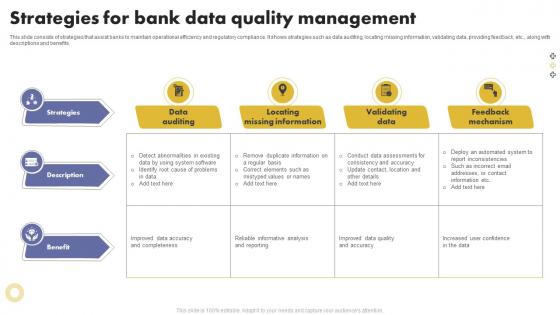
This slide consists of strategies that assist banks to maintain operational efficiency and regulatory compliance. It shows strategies such as data auditing, locating missing information, validating data, providing feedback, etc., along with descriptions and benefits.
People who downloaded this PowerPoint presentation also viewed the following :
Strategies For Bank Data Quality Management with all 9 slides:
Use our Strategies For Bank Data Quality Management to effectively help you save your valuable time. They are readymade to fit into any presentation structure.









FAQs for Strategies For Bank
Key components include data governance policies, automated validation systems, master data management, real-time monitoring tools, and comprehensive audit trails. These frameworks streamline regulatory compliance, enhance risk assessment accuracy, and improve customer service delivery, with many financial institutions finding that integrated approaches reduce operational costs while strengthening decision-making capabilities across lending, fraud detection, and customer relationship management.
Regulatory requirements establish stringent data quality standards in banking through compliance mandates, accuracy thresholds, audit trails, and reporting protocols that ensure customer protection and systemic stability. These frameworks compel financial institutions to implement robust data governance systems, automated validation processes, and comprehensive monitoring capabilities, ultimately delivering enhanced operational efficiency, reduced compliance costs, and stronger customer trust in an increasingly regulated environment.
Banks face implementation challenges including legacy system integration complexities, regulatory compliance requirements, data silos across departments, inconsistent data formats, and resource allocation constraints. These obstacles often stem from outdated infrastructure and fragmented operations, with many financial institutions finding that strategic phased approaches, cross-departmental collaboration, and automated data governance tools ultimately streamline the transition while delivering improved operational efficiency.
Banks can enhance data quality management through automated data validation tools, real-time monitoring systems, machine learning algorithms for anomaly detection, and integrated data governance platforms. These technologies streamline compliance reporting, minimize manual errors, and accelerate risk assessments, with many financial institutions finding that automated processes deliver significantly faster regulatory reporting and improved customer experiences while reducing operational costs.
Data governance establishes the frameworks, policies, and accountability structures that ensure consistent data quality across banking operations through standardized processes, clear ownership responsibilities, and regulatory compliance measures. With proper governance, banks can streamline risk management, enhance customer experiences, and maintain regulatory adherence, ultimately delivering operational efficiency and competitive advantage in an increasingly data-driven financial landscape.
Poor data quality significantly undermines decision-making in financial institutions by creating inaccurate risk assessments, flawed credit evaluations, and unreliable regulatory reporting that can lead to substantial financial losses. These data inconsistencies result in missed opportunities, increased operational costs, and compromised customer experiences, with many banks finding that poor data quality ultimately erodes competitive advantage and regulatory compliance.
Best practices for conducting a bank data quality assessment include establishing clear data governance frameworks, implementing automated validation rules, conducting regular audits across all systems, defining quality metrics and thresholds, and ensuring regulatory compliance standards. These practices enable banks to identify inconsistencies, reduce operational risks, and enhance decision-making accuracy, with many financial institutions finding that systematic assessments ultimately deliver improved customer experiences and regulatory confidence.
Banks can measure data quality management effectiveness through key performance indicators like data accuracy rates, completeness percentages, consistency scores, and timeliness metrics, alongside operational measures such as error reduction rates and compliance audit results. These measurements enable financial institutions to track improvements in loan processing times, regulatory reporting accuracy, and customer satisfaction scores, while demonstrating tangible returns on data quality investments through reduced operational costs and enhanced decision-making capabilities.
Banks can ensure data accuracy and consistency through data governance frameworks, automated validation rules, master data management systems, real-time monitoring tools, and regular data audits. These strategies work together by establishing standardized data definitions, detecting anomalies immediately, and maintaining single sources of truth, with many financial institutions finding that integrated approaches reduce operational risks while enhancing regulatory compliance and customer experiences.
Data quality issues significantly undermine customer relationship management in banking by creating inaccurate customer profiles, duplicate records, inconsistent communication preferences, and fragmented transaction histories. These problems lead to poor personalization, mistargeted offers, and frustrated customer experiences, with many financial institutions finding that investing in comprehensive data quality frameworks ultimately delivers improved customer satisfaction, increased cross-selling success, and stronger long-term relationships.
Essential skills for bank data quality management staff include data analytics, regulatory compliance knowledge, SQL proficiency, statistical analysis, and understanding of banking operations like loan processing and risk assessment. These professionals benefit from training in data governance frameworks, quality assessment tools, and regulatory requirements, with many banks finding that cross-functional expertise in both technology and banking operations delivers the most effective data quality outcomes.
Advanced analytics leverages machine learning algorithms, pattern recognition, statistical modeling, and anomaly detection to automatically identify inconsistencies, duplicates, and errors across banking datasets. Through predictive analytics and real-time monitoring, financial institutions can proactively address data quality issues, streamline compliance reporting, and enhance customer risk assessments, ultimately delivering improved operational efficiency and regulatory adherence.
Machine learning and AI significantly enhance banking data quality management by automating error detection, standardizing data formats, and identifying inconsistencies across multiple systems in real-time. These technologies enable banks to streamline compliance reporting, accelerate loan processing, and deliver more accurate risk assessments, with many financial institutions finding that AI-driven data quality delivers faster customer services and reduced operational costs.
Banks can balance data quality and accessibility through automated data governance platforms, role-based access controls, real-time validation systems, and tiered data access frameworks. These strategic approaches enable financial institutions to maintain rigorous quality standards while streamlining access for authorized users, with many banks finding that this combination ultimately delivers faster decision-making and enhanced regulatory compliance.
Poor data quality in banking creates substantial financial burdens through regulatory fines, operational inefficiencies, failed compliance audits, increased manual processing costs, and customer attrition from service errors. These impacts compound across lending decisions, risk assessments, and customer onboarding processes, with many financial institutions finding that proactive data governance ultimately delivers significant cost savings and competitive advantage.
-
I discovered this website through a google search, the services matched my needs perfectly and the pricing was very reasonable. I was thrilled with the product and the customer service. I will definitely use their slides again for my presentations and recommend them to other colleagues.
-
A big thanks to SlideTeam! An incredible and diverse library of templates helped me with my business project presentation.