

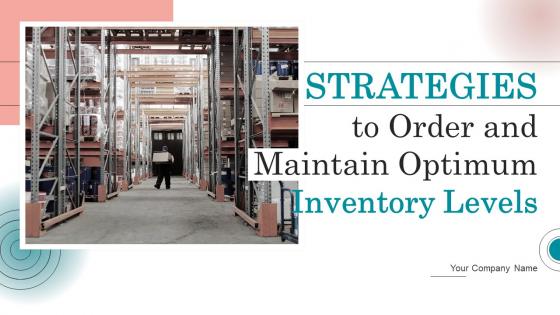
Strategies to Order and Maintain Optimum Inventory Levels powerpoint presentation slides




Try Before you Buy Download Free Sample Product
 Impress Your
 Audience
 100%
100% Editable
 Save Hours
 of Time


Improve your stock procurement and management processes with our comprehensive Strategies to Order and Maintain Optimum Inventory Levels PowerPoint presentation. This professionally designed template enables organizations to track inventory in real time and efficiently procure goods from suppliers, leading to reduced operational costs and minimized inventory wastage. The Warehouse Management deck provides an overview of processes for maintaining optimal stock levels by accurately purchasing merchandise from suppliers. It also delves into demand forecasting techniques, such as historical sales data analysis, to determine the ideal inventory quantity. The presentation covers methods like economic order quantity and reorder point calculation to ensure sufficient inventory levels. Additionally, it showcases warehouse optimization strategies, including ABC analysis and warehouse automation, to minimize inventory waste. The Stock Inventory Procurement presentation emphasizes the importance of an automated tracking system to reduce stock wastage and determine the optimal time for inventory reordering. It also highlights strategies for accurate order fulfillment and avoiding stock-outs. The PPT addresses the costs and challenges associated with inventory management, while providing dashboards and key performance indicators KPIs to track warehouse operations and inventory effectively. Dont miss out on optimizing your inventory management processes download this template now and streamline your stock procurement and management strategies.
People who downloaded this PowerPoint presentation also viewed the following :
Content of this Powerpoint Presentation
Slide 1: This slide introduces Strategies to Order and Maintain Optimum Inventory Levels. State your company name and begin.
Slide 2: This is an Agenda slide. State your agendas here.
Slide 3: This slide shows Table of Content for the presentation.
Slide 4: This slide shows title for topics that are to be covered next in the template.
Slide 5: This slide showcases issues faced by organization due to inefficient inventory management process with the help of bar graphs.
Slide 6: This slide showcases problems face by organization in managing the inventory and warehouse.
Slide 7: This slide shows title for topics that are to be covered next in the template.
Slide 8: This slide presents solutions that can be implemented by organization to tackle inventory management issues.
Slide 9: This slide shows title for topics that are to be covered next in the template.
Slide 10: This slide displays process that can help organization in inventory control and management.
Slide 11: This slide shows title for topics that are to be covered next in the template.
Slide 12: This slide presents benefits of forecasting demand for inventory.
Slide 13: This slide displays time periods that can be determined by organization for forecasting the inventory requirements.
Slide 14: This slide presents graph that can help organization to forecast the inventory requirement on the basis of sales data of previous financial years.
Slide 15: This slide showcases graphs that can help organization in forecasting of different type of products on the basis of previous data.
Slide 16: This slide presents graph that can help organization to determine demand for seasonal products on the basis past sales data.
Slide 17: This slide shows title for topics that are to be covered next in the template.
Slide 18: This slide presents methods that can be used by organization for purchasing raw material or finished goods from suppliers.
Slide 19: This slide displays overview of reorder point method that can help organization to determine ideal quantity of inventory order.
Slide 20: This slide showcases EOQ model that can help organization to determine ideal quantity of inventory to be orders.
Slide 21: This slide depicts plan that can help organization to purchase inventory from suppliers.
Slide 22: This slide shows title for topics that are to be covered next in the template.
Slide 23: This slide presents strategies that can be implemented by organization for improving warehousing operations.
Slide 24: This slide showcases process flow that can help organization to manage and optimize the warehouse.
Slide 25: This slide displays structure of warehouse that can help organization in managing the inventory.
Slide 26: This slide showcases ABC analysis that can help organization in arranging inventory for warehouse.
Slide 27: This slide presents labelling that can help organization in inventory management and reduce the time needed for locating the inventory.
Slide 28: This slide describes benefits of automating warehousing operations in organization.
Slide 29: This slide showcases technologies that can be implemented in organization to automate the warehousing operations.
Slide 30: This slide presents physical and digital process automation for warehouse management.
Slide 31: This slide shows title for topics that are to be covered next in the template.
Slide 32: This slide presents comparison of manual and automated inventory tracking system.
Slide 33: This slide depicts sheet that can help organization to track inventory.
Slide 34: This slide presents automated inventory system overview that can help organization track stock through automation software.
Slide 35: This slide showcases tools that can help organization in automated inventory management and reduce wastage of resources.
Slide 36: This slide shows title for topics that are to be covered next in the template.
Slide 37: This slide presents ABC analysis method that can help organization in inventory management.
Slide 38: This slide showcases VED analysis method that can help organization in inventory management.
Slide 39: This slide showcases LIFO and FIFO method that can help organization in inventory management.
Slide 40: This slide describes HML analysis method that can help organization in inventory management.
Slide 41: This slide shows title for topics that are to be covered next in the template.
Slide 42: This slide describes challenges that are faced by organization in inventory and stock management process.
Slide 43: This slide shows title for topics that are to be covered next in the template.
Slide 44: This slide displays cost incurred by organization in managing the inventory and warehouse.
Slide 45: This slide shows title for topics that are to be covered next in the template.
Slide 46: This slide describes KPIs that can help organization to measure the effectiveness of inventory management system in organization.
Slide 47: This slide shows title for topics that are to be covered next in the template.
Slide 48: This slide presents importance of implementing inventory and warehouse management plan in organization.
Slide 49: This slide shows title for topics that are to be covered next in the template.
Slide 50: This slide showcases dashboard that can help organization to manage and track the warehouse operations.
Slide 51: This slide displays KPIs that can help organization to evaluate the efficiency of inventory management process.
Slide 52: This slide shows all the icons included in the presentation.
Slide 53: This slide is titled as Additional Slides for moving forward.
Slide 54: This slide presents comparing inventory management metrics with competitors.
Slide 55: This slide provides Clustered Column chart with two products comparison.
Slide 56: This is an Idea Generation slide to state a new idea or highlight information, specifications etc.
Slide 57: This is About Us slide to show company specifications etc.
Slide 58: This is Our Target slide. State your targets here.
Slide 59: This is a Timeline slide. Show data related to time intervals here.
Slide 60: This slide shows SWOT analysis describing- Strength, Weakness, Opportunity, and Threat.
Slide 61: This is Our Team slide with names and designation.
Slide 62: This slide provides 30 60 90 Days Plan with text boxes.
Slide 63: This slide also provides 30 60 90 Days Plan with text boxes.
Slide 64: This slide also provides 30 60 90 Days Plan with text boxes.
Slide 65: This slide presents Roadmap with additional textboxes.
Slide 66: This is a Thank You slide with address, contact numbers and email address.
Strategies to Order and Maintain Optimum Inventory Levels powerpoint presentation slides with all 71 slides:
Use our Strategies to Order and Maintain Optimum Inventory Levels powerpoint presentation slides to effectively help you save your valuable time. They are readymade to fit into any presentation structure.







FAQs for Strategies to Order and Maintain Optimum Inventory Levels
Honestly, start with demand forecasting and tracking what you've actually got in stock. Real-time monitoring is huge - you don't want those "shit, we're completely out" panic moments. Figure out your reorder points and safety stock levels first. Good supplier relationships make this way easier too, especially when they actually stick to their lead times (which, let's be real, doesn't always happen). I'd audit whatever tracking system you're using now. Focus on your best-sellers initially since those mess you up the most when you run out. Build better forecasting around those items, then expand from there.
Honestly, the tech route is a game-changer for cutting out human mistakes. Barcode scanners and RFID tags basically eliminate those manual counting errors we all hate. Your data actually syncs in real-time, so what the system says matches what's actually there. Automated reorder points are clutch too - no more scrambling when you run out of stuff unexpectedly. Everything integrates with whatever systems you're already using, which is nice because nobody wants to overhaul everything. If you haven't done barcode scanning yet, start there. It's literally the easiest way to see immediate improvements without going crazy with complexity.
So demand forecasting is basically trying to predict what you'll sell and when - like having a crystal ball for your inventory. Look at your sales data from the past year or so to spot patterns. Seasonal stuff is huge here, trust me. You want to figure out how much stock you actually need so you're not stuck with a warehouse full of junk or constantly running out of popular items. Both scenarios suck for business. Use trends, past sales, upcoming promotions - whatever data you can get your hands on. Gets way easier once you dial in those patterns.
Honestly, demand forecasting is your biggest enemy - you're constantly playing this guessing game of how much to order. Cash flow gets murdered because all your money's tied up in inventory just sitting there. Storage becomes insane once you start growing (learned that the hard way). Don't even think about tracking stuff manually - that's how you lose your mind and your profit margins. Suppliers will screw up your timing no matter what. Get some basic inventory software right away, even the cheap stuff. It'll save you from making those expensive ordering mistakes that'll bite you later.
So basically, JIT cuts your storage costs by keeping way less inventory around. You're not hoarding stuff "just in case" anymore - you order things right when you actually need them. Saves a ton on warehouse space, insurance, all that expensive storage stuff. Your cash isn't just sitting there tied up in products gathering dust either, which is honestly pretty nice. The catch? You need suppliers you can actually count on and solid forecasting. Otherwise you'll get slammed when demand jumps and you're sitting there with nothing to sell.
Track your inventory turnover ratio - just divide cost of goods sold by average inventory value. Higher numbers mean you're moving stuff efficiently without tying up cash. Days sales in inventory (DSI) is useful too. Shows how long it takes to sell through your average stock level. Don't stress about hitting some perfect number you found on Google though - every industry's different. I'd focus more on watching your own trends month to month. Maybe peek at what similar businesses are doing if you can find that data. That'll give you a better sense of whether you're actually doing well or not.
Honestly, seasonal demand is such a pain because it throws your whole ordering routine out the window. You can't just stick to your regular amounts - I learned that the hard way! Look at last year's sales data first to spot those crazy spike periods. Then you've got to place bigger orders way earlier than usual since suppliers don't speed up just because you're busy. The worst part? Finding that sweet spot between having enough stock and not drowning in leftovers afterward. Start by figuring out when your peak hits, then count backwards to nail your ordering timing.
Dude, inventory software is a game changer. No more "oops we're out" conversations with annoyed customers because you'll actually know what's in stock. It handles reordering automatically and shows you which products actually make money - super helpful for buying decisions. I used to waste so much time counting everything by hand and fixing spreadsheet mistakes. The reporting stuff is solid too, though honestly I wish the dashboards were prettier. Now I just glance at my phone and know exactly what's happening. Way better than the manual chaos I dealt with before.
Ugh, slow inventory is the worst! Bundle stuff together or slash prices - whatever gets it moving. Check if your suppliers will take returns first though, that's usually easiest. Online marketplaces work great for liquidating too. Honestly? Sometimes donating is your best bet, at least you get the tax write-off instead of paying storage costs forever. You could try marketing to different customer groups too. Just don't let it sit there - those holding costs add up fast and before you know it you're throwing good money after bad.
Focus on three things: shared info, matching goals, and talking regularly. Get everyone looking at the same real-time inventory and demand data - this fixes most problems honestly. Your KPIs need to match what your suppliers and distributors want too, otherwise you're all pulling different directions. Weekly check-ins help catch stuff early. Oh and treat these people like teammates, not just random vendors you pay. I'd probably start with your biggest 3 suppliers first since they move the needle most. Scale it out once you've got the process down.
Dude, bad inventory planning is an environmental nightmare. Products sit around until they expire - total waste. Food stuff is the worst since it rots in landfills making methane. Also, poor planning means tons of small shipments instead of fewer big ones, which obviously cranks up emissions. My friend works at this warehouse that's basically a graveyard for overordered junk, all sitting there using energy for climate control. You end up burning through way more packaging too. The silver lining? Better forecasting actually saves money AND helps the planet. Just-in-time ordering is clutch.
Honestly, both are game-changers for cutting down mistakes in inventory. Barcodes stop you from fat-fingering SKU numbers when you're doing counts - just scan instead of typing. RFID's where it gets really cool though. You can zap multiple items without even seeing them directly, makes cycle counts super quick. Real-time location tracking too, so you're not wandering around looking for stuff. I'd say start with barcodes if money's tight (we all know how that goes), but definitely spring for RFID on your expensive inventory where screwing up actually hurts.
Honestly, just make it a regular thing - monthly for your expensive stuff, quarterly for the rest. Pick a slow day because doing inventory when you're swamped is absolutely miserable. Cycle counting beats those massive full audits every time since you're not shutting everything down. Get two people to double-check the numbers and write down any weird discrepancies right away. Look into anything over your threshold immediately. I swear, once you get into a rhythm with it, it's not nearly as bad as people make it out to be. Just track your accuracy on a simple spreadsheet so you can see how you're improving.
Honestly, keeping good track of your inventory is huge for keeping customers happy. You avoid those awful "sorry, we're out" moments that make people bounce to your competitors. Most popular items? Track how fast they move - that's where running out really stings. Poor inventory control just leads to backorders and pissed off customers who won't return. It's one of those unsexy backend things that actually makes a massive difference. Plus you can give people real availability info instead of guessing. Delivery delays drop too when you've got your stock levels dialed in.
Honestly, AI is crushing it for inventory predictions - way better than the old spreadsheet guesswork. You can track stuff in real-time now from warehouse to doorstep, which is pretty wild. Customers actually give a damn about sustainability these days, so that circular inventory thing isn't just trendy anymore. Your system has to work everywhere - online, stores, curbside, the whole deal. Those automated replenishment systems? They basically babysit themselves once you set them up. I'd start with demand forecasting tools first though. That's where you'll actually see money come back fast, and it's not as overwhelming as overhauling everything at once.
-
If you have visited their site and failed to find the products, try reaching the customer service because it will be the case that you didn't use the search bar well.
-
It makes easy work of my work presentations. I’ve never had to be nervous about my presentations for meetings.