

Strawman proposal for business problem solving powerpoint presentation slides





Try Before you Buy Download Free Sample Product
 Impress Your
Audience
 100%
Editable
 Save Hours
of Time


Management usually discusses critical concerns areas of improvement by analyzing crucial information. The template is considered a solution space for management to brainstorm various solutions provided for organizational progress. Here is a competently designed Strawman Proposal for Business Problem Solving that comprises details about company overview with key people involved, firms product portfolio, and firm strategic objectives. It will cover the firms present scenario by analyzing financial summary, capital funding, financial ratios, and assessing several overheads essential for business operations. The template will cover details about financial statements. The template will cover details about critical concerns firms face in corporate failures, quality-related problems, and operational issues. The organizational improvement initiative addresses functional considerations vital for firm growth, determines three cases future scenario analysis, assesses business priorities crucial for development, analyzes brand building strategies, etc. It implements organizational change by analyzing employees skills, workforce upskilling plan, coordination activities to improve stakeholder communication. This insightful proposal will help users improve marketing effectiveness by potential prospect nurturing, etc. Get access to this 100 percent editable proposal now.
People who downloaded this PowerPoint presentation also viewed the following :
Content of this Powerpoint Presentation
Slide 1: This slide displays title i.e. 'Strawman Proposal for Business Problem Solving' and your Company Name.
Slide 2: This slide presents agenda.
Slide 3: This slide exhibits table of contents.
Slide 4: This slide also shows table of contents.
Slide 5: This slide depicts title for four topics that are to be covered next in the template.
Slide 6: This slide covers details about the overview of firm’s present situation.
Slide 7: This slide presents the organizational structure of the firm with key people involved in managing firm.
Slide 8: This slide provides information regarding the product and services portfolio of firm with various products.
Slide 9: This slide provides information regarding the firm strategic objectives which firm need to achieve in order to attain profitability.
Slide 10: This slide depicts title for four topics that are to be covered next in the template.
Slide 11: This slide covers details about the overview of firm’s present situation.
Slide 12: This slide provides information regarding the capital structure of firm by analyzing different funding sources of firm.
Slide 13: This slide portrays information regarding the assessment of financial ratios of firm.
Slide 14: This slide provides details about the overheads that considered essential for operating a business.
Slide 15: This slide depicts title for three topics that are to be covered next in the template.
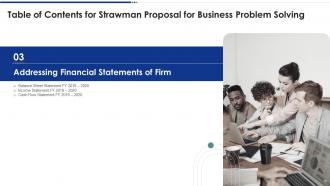
Slide 16: This slide provide glimpse about the balance sheet of the firm with information about assets, liabilities and shareholder’s equity for current year.
Slide 17: This slide provide glimpse about the firm’s ability to generate sales, managing expenses, and ultimately creating profits.
Slide 18: This slide provide glimpse about the firm’s ability to create value for shareholders by generating positive cash flows for current year.
Slide 19: This slide depicts title for four topics that are to be covered next in the template.
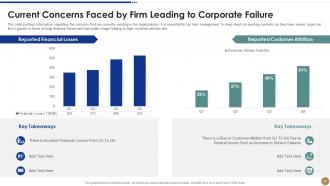
Slide 20: This slide portrays information regarding the concerns that are currently existing in the organizations.
Slide 21: This slide provides information regarding the present situation firm with employee productivity and ROI (per1$ spent).
Slide 22: This slide provides information regarding the key issues firm is facing regarding quality at present with defects(parts per million).
Slide 23: This slide explains the present operational issues that firm is facing which leads to high costs, poor agility, etc.
Slide 24: This slide depicts title for six topics that are to be covered next in the template.
Slide 25: This slide covers information regarding the key functional areas that are considered such as organizational change, etc.
Slide 26: This slide displays 'Determine Three Case Future Scenarios Analysis'.
Slide 27: This slide presents 'Assessing Business Priorities Crucial for Growth'.
Slide 28: This slide provides information regarding the business core processes transformation timeline with key initiatives and activities mentioned.
Slide 29: This slide provide the information regarding various ways (three options) through which firm can increase its profitability.
Slide 30: This slide provides information regarding various brand building strategies with initiatives for achieving goals associated to them.
Slide 31: This slide depicts title for five topics that are to be covered next in the template.
Slide 32: This slide exhibits 'Skills Level Analysis of Employees by Department'.
Slide 33: This slide showcases 'Workforce Planning of Existing Employees'.
Slide 34: This slide illsutrates 'Workforce Upskilling Training Plan'.
Slide 35: This slide provides details about necessary training of the specific employees in various departments.
Slide 36: This slide covers information regarding the different coordination activities that firm will conduct.
Slide 37: This slide depicts title for two topics that are to be covered next in the template.
Slide 38: The slide provides information regarding the technological advancement adapted by firm.
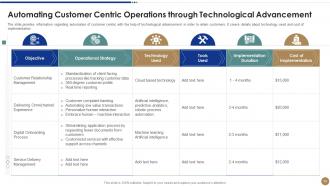
Slide 39: The slide provides information regarding automation of customer centric with the help of technological advancement.
Slide 40: This slide depicts title for six topics that are to be covered next in the template.
Slide 41: This slide provides information regarding the quality standards that are ensured in order to manage overall quality.
Slide 42: This slide provides information regarding the quality assurance and control initiatives.
Slide 43: This slide provides information regarding different testing techniques that are analyzed on certain parameters such as cost, operator skill, defect type, etc.
Slide 44: This slide presents 'Tracking Weekly Quality Defects Occurrence with Check Sheet'.
Slide 45: This slide provides information regarding the quality check register that is to be maintained in order to keep track of quality improvement of product.
Slide 46: This slide exhibits 'Quality Check Schedule'.
Slide 47: This slide depicts title for two topics that are to be covered next in the template.
Slide 48: This slide covers information regarding the balance restructuring process.
Slide 49: This slide covers information regarding how firm can optimize its financial debt in order to reduce its borrowings and improve its profitability.
Slide 50: This slide depicts title for eight topics that are to be covered next in the template.
Slide 51: This slide provides information regarding key areas which firm needs to address.
Slide 52: The slide provides information regarding marketing strategies used by firm for better customer experience.
Slide 53: This slide displays 'Several Marketing Campaigns to Accelerate Sales'.
Slide 54: This slide presents 'Loyalty Programs Initiated for Customer Engagement'.
Slide 55: This slide exhibits 'Potential Prospects Nurturing Content Program'.
Slide 56: This slide provides information regarding the email marketing worksheet that is prepared to keep track on different email marketing campaigns.
Slide 57: This slide showcases 'How to Nurture Potential Prospect in Three Months'.
Slide 58: This slide highlights 'Analyzing Different Marketing Campaigns Firm Organized'.
Slide 59: This slide depicts title for two topics that are to be covered next in the template.
Slide 60: This slide provides information regarding the costs associated to various segments in terms of base salaries, etc.
Slide 61: This slide displays 'Budget for Functional Areas Optimization'.
Slide 62: This slide depicts title for one topic that is to be covered next in the template.
Slide 63: This slide will help firm in choosing the suitable system by analyzing them on several parameters with cost associated to it.
Slide 64: This slide depicts title for three topics that are to be covered next in the template.
Slide 65: This slide depicts the impact of successful implementation of overall process automation for better customer satisfaction.
Slide 66: This slide depicts information regarding the impact of turnaround strategy implantation on firm growth.
Slide 67: This slide depicts information regarding the impact of upgrading the skillset of the workforce.
Slide 68: This slide depicts title for two topics that are to be covered next in the template.
Slide 69: This slide presents the dashboard which will help firm in tracking the financial performance.
Slide 70: This slide will provide overall scenario of all accounts and track new leads, top campaigns, expected revenue earned, etc.
Slide 71: This is the icons slide.
Slide 72: This slide presents title for additional slides.
Slide 73: This slide depicts 30-60-90 days plan for projects.
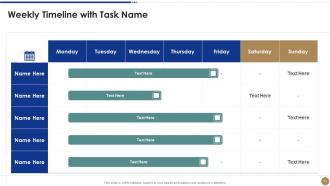
Slide 74: This slide exhibits weekly timeline.
Slide 75: This slide shows roadmap.
Slide 76: This slide shows about your company, target audience and its client's values.
Slide 77: This slide depicts posts for past experiences of clients.
Slide 78: This slide presents your company's vision, mission and goals.
Slide 79: This slide exhibits yearly column charts for different products. The charts are linked to Excel.
Slide 80: This slide shows details of team members like name, designation, etc.
Slide 81: This slide displays Venn.
Slide 82: This slide exhibits yearly timeline.
Slide 83: This slide exhibits ideas generated.
Slide 84: This is thank you slide & contains contact details of company like office address, phone no., etc.
Strawman proposal for business problem solving powerpoint presentation slides with all 92 slides:
Use our Strawman Proposal For Business Problem Solving Powerpoint Presentation Slides to effectively help you save your valuable time. They are readymade to fit into any presentation structure.


















FAQs for Strawman proposal for business problem solving
A strawman proposal is an initial, deliberately incomplete draft designed to stimulate discussion and feedback rather than serve as a final solution. Unlike polished proposals that present refined recommendations, strawman proposals intentionally include gaps, assumptions, and rough concepts to encourage stakeholder input. This approach accelerates development cycles by enabling early collaboration, identifying potential issues before significant resources are invested, and ultimately delivering more robust final proposals through iterative refinement.
Strawman proposals are most effective when teams face complex decisions, unclear requirements, or multiple stakeholder perspectives that need alignment. They work particularly well in strategic planning sessions, product development meetings, and organizational restructuring discussions, where the initial framework sparks productive debate, reveals hidden assumptions, and accelerates consensus-building by giving participants something concrete to critique and improve.
A well-structured strawman proposal includes a clear problem statement, proposed solution framework, implementation timeline, resource requirements, and success metrics. These components work together by establishing scope, defining methodology, and setting measurable outcomes, with many organizations finding that comprehensive strawman proposals accelerate decision-making processes and facilitate stakeholder alignment across departments.
A strawman proposal helps overcome objections by providing a concrete starting point that transforms abstract concerns into specific, addressable issues, enabling negotiators to identify precise sticking points and systematically work through them. This approach streamlines discussions by giving all parties something tangible to critique and modify, ultimately accelerating consensus-building while ensuring concerns are directly incorporated into evolving solutions.
Strawman proposals can backfire when stakeholders perceive them as predetermined solutions rather than discussion starters, potentially creating resistance, reducing buy-in, and stifling creative input from team members. Organizations mitigate these risks by clearly framing strawmans as preliminary concepts, actively soliciting diverse feedback, and demonstrating genuine willingness to modify or abandon initial ideas, ultimately fostering collaborative decision-making and stronger consensus.
Audience analysis enables strawman proposals to address specific stakeholder concerns, priorities, and decision-making criteria through targeted messaging, relevant examples, and appropriate technical depth. By understanding executives, technical teams, and end-users differently, organizations craft proposals that resonate with each group's interests, ultimately accelerating feedback cycles and increasing proposal acceptance rates.
Visual aids in strawman proposals enhance understanding by simplifying complex concepts, illustrating relationships between components, and making abstract ideas tangible through charts, diagrams, and flowcharts. These visual elements significantly increase stakeholder engagement and comprehension, with many organizations finding that well-designed graphics accelerate decision-making processes and foster more productive discussions during strategic planning sessions.
Common pitfalls include over-engineering the initial draft, getting attached to specific details, failing to clearly communicate its preliminary nature, and not gathering diverse stakeholder input early enough. Many organizations find that successful strawman proposals focus on broad framework concepts rather than intricate specifics, enabling productive discussions while avoiding premature commitment to potentially flawed approaches.
Feedback can be gathered effectively through structured workshops, one-on-one stakeholder interviews, anonymous digital surveys, and cross-functional review sessions that encourage open dialogue. These approaches enable organizations to capture diverse perspectives, identify blind spots, and refine proposals systematically, with many finding that combining formal feedback sessions with informal discussions ultimately delivers more comprehensive insights and stronger stakeholder buy-in.
**INPUT**: What techniques can be used to anticipate counterarguments in a strawman proposal? **OUTPUT**: Effective techniques include stakeholder analysis, devil's advocate sessions, scenario planning, cross-functional reviews, and historical precedent analysis. These approaches enable organizations to identify potential objections early, strengthen proposal foundations through comprehensive risk assessment, and develop compelling counter-responses, with many teams finding that proactive counterargument planning significantly improves proposal acceptance rates. [Word count: 55]
Strawman proposals can be adapted across industries by adjusting scope, compliance requirements, stakeholder engagement methods, and implementation timelines to match sector-specific needs. In healthcare, proposals might emphasize regulatory compliance and patient outcomes, while manufacturing versions focus on operational efficiency and safety protocols, with financial services adaptations prioritizing risk management and customer experience enhancements.
Success of a strawman proposal is measured through stakeholder feedback quality, consensus level achieved, and decision-making acceleration it generates. Organizations typically evaluate whether the proposal sparked productive discussions, identified key issues, and moved teams closer to viable solutions, with many finding that successful strawman proposals ultimately streamline project timelines and enhance collaborative outcomes.
When drafting strawman proposals, key ethical considerations include ensuring transparent communication about the proposal's preliminary nature, avoiding manipulation or deception, respecting stakeholder input, and maintaining objectivity without predetermined outcomes. These principles help organizations build trust, encourage genuine participation, and foster collaborative decision-making processes, while ensuring that initial frameworks serve as authentic starting points rather than disguised final decisions.
A strawman proposal facilitates collaborative problem-solving by providing a concrete starting point for discussion, encouraging open critique and refinement, and accelerating decision-making processes through structured feedback. Teams across industries, from product development to strategic planning, use these initial frameworks to surface concerns, generate alternatives, and build consensus more efficiently, ultimately delivering faster solutions and stronger stakeholder alignment.
Strawman proposals have driven successful outcomes in software development roadmaps, merger negotiations, and policy framework creation. Companies like Microsoft use initial feature proposals to guide product development, while financial institutions leverage preliminary merger terms to streamline complex negotiations, ultimately delivering faster decision-making and more comprehensive final solutions.
-
Informative design.
-
It saves your time and decrease your efforts in half.
-
Amazing product with appealing content and design.
-
Out of the box and creative design.