

Streamlining Facility Management Best Practices And Maintenance Planning Guide Complete Deck




Try Before you Buy Download Free Sample Product
 Impress Your
 Audience
 100%
100% Editable
 Save Hours
 of Time


Grab our professionally crafted Guide on Streamlining Facility Management and Maintenance Planning. This comprehensive resource offers a wealth of techniques and tools to optimize facility management processes. Our Space Management presentation delves into critical areas like occupancy, maintenance, and asset management, providing invaluable insights. Additionally, we emphasize the importance of effective occupancy management, which entails overseeing space allocation and usage. Our Facility Planning Design presentation advocates strategies such as space planning, utilization tracking, and occupancy monitoring to enhance this aspect. The guide also advocates for asset tracking, maintenance planning, and data analytics to maximize asset utilization. In our Building Maintenance module, we address cleaning and janitorial management, recommending approaches like cleaning schedules, sanitation protocols, and inventory management. Furthermore, our Facility Operations template outlines the key functionalities of facility planning software, including space planning, scheduling, asset tracking, and data analytics. By implementing these strategies and utilizing cutting-edge facility planning software, facility managers can boost efficiency, reduce costs, and elevate the overall occupant experience. Get access now.
People who downloaded this PowerPoint presentation also viewed the following :
Content of this Powerpoint Presentation
Slide 1: This slide introduces Streamlining Facility Management Best Practices and Maintenance Planning Guide. Commence by stating Your Company Name.
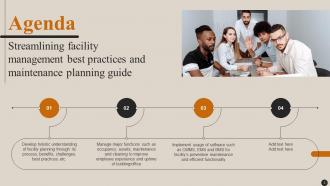
Slide 2: This slide depicts the Agenda of the presentation.
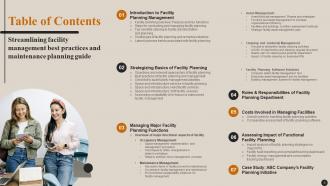
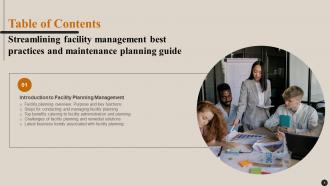
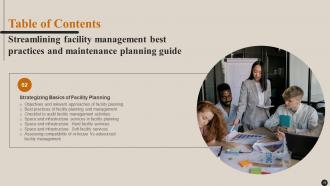
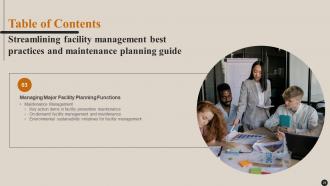
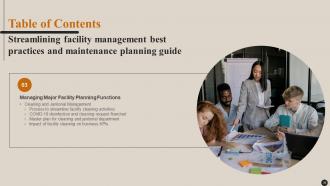
Slide 3: This slide includes the Table of contents.
Slide 4: This slide highlights the Title for the Topics to be discussed further.
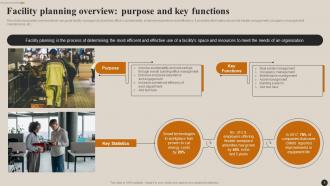
Slide 5: This slide showcases an overview that can guide facility managers in planning their office’s sustainability, employee experience and efficiency.
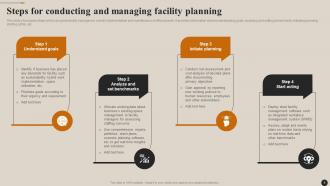
Slide 6: This slide states the steps that can guide facility managers in the overall implementation and maintenance of office spaces.
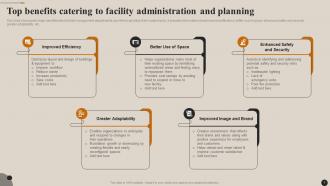
Slide 7: This slide includes the major benefits that facility management departments can refer to prioritize their routine tasks.
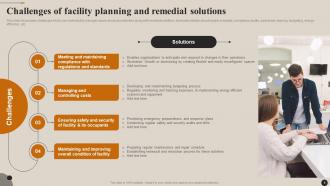
Slide 8: This slide highlights the challenges which can make facility manager aware about uncertainties along with remedial solutions.
Slide 9: This slide reveals latest business trends which can be referred by companies to fine-tune and upgrade their facility operations.
Slide 10: This slide presents the Heading for the Contents to be further covered.
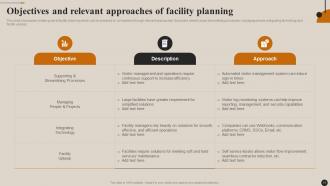
Slide 11: This slide showcases certain goals of facility planning which can be achieved by companies through relevant approaches.
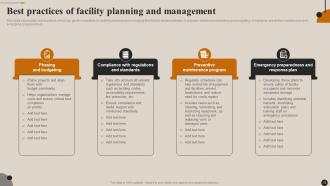
Slide 12: This slide presents best practices which can guide companies in carefully planning and managing their facility related activities.
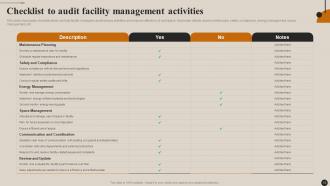
Slide 13: This slide indicates the checklist which can help facility managers audit various activities and improve efficiency of workplace.
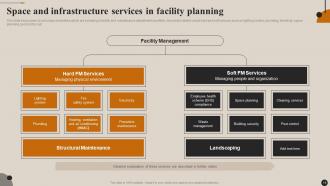
Slide 14: This slide portrays the broad scope of activities which are including in facility and maintenance department’s portfolio.
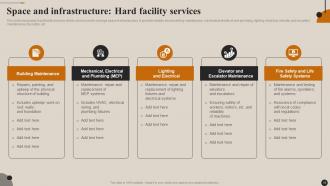
Slide 15: This slide hgihlights hard facility services which can be used to manage space & infrastructure.
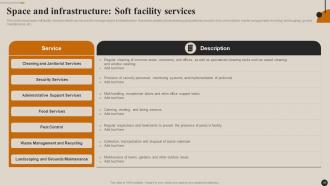
Slide 16: This slide mentions about the soft facility services which can be used to manage space & infrastructure.
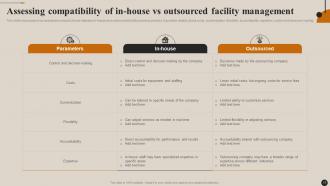
Slide 17: This slide includes how businesses should choose between in-house and outsourced facility planning services.
Slide 18: This slide exhibits the Title for the Ideas to be discussed further.
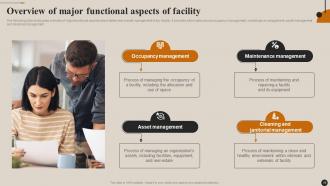
Slide 19: The following slide showcases overview of major functional aspects which determine overall management of any facility.
Slide 20: This slide contains the Heading for the Ideas to be covered in the upcoming template.
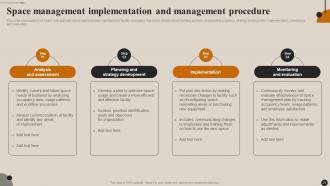
Slide 21: This slide states how space management can be deployed and maintained by facility managers.
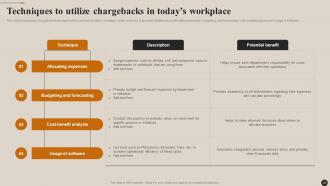
Slide 22: This slide depicts chargeback techniques which can help facilities monetize certain services.
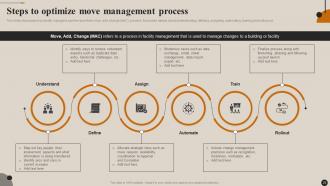
Slide 23: This slide highlights the Steps to optimize move management process.
Slide 24: This slide exhibits the Title for the Ideas to be discussed further.
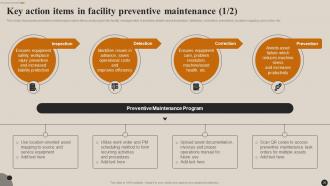
Slide 25: This slide showcases preventive maintenance action items and program for facility management.
Slide 26: This slide continues preventive maintenance action items and program for facility management.
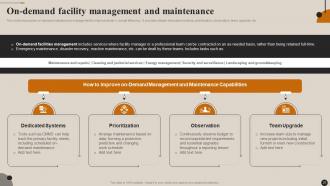
Slide 27: This slide portrays on-demand maintenance management to improve facility’s overall efficiency.
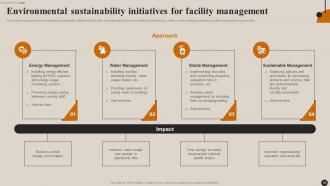
Slide 28: This slide includes environmental sustainability initiatives for facility management.
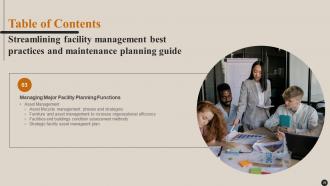
Slide 29: This slide highlights the Heading for the Ideas to be covered next.
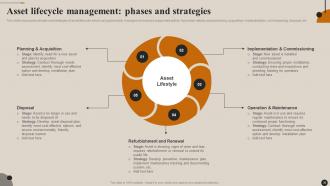
Slide 30: This slide showcases phases and strategies of asset lifecycle which can guide facility managers to increase equipment uptime.
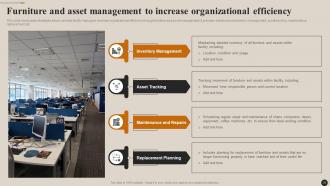
Slide 31: This slide displays strategies which can help facility managers increase organizational efficiency through furniture and asset management.
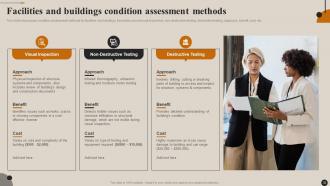
Slide 32: This slide showcases condition assessment methods for facilities and buildings.
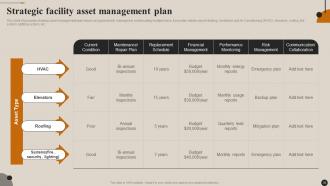
Slide 33: This slide represents strategic asset management plan which can guide facility managers in collaborating multiple tasks.
Slide 34: This slide contains the Title for the Contents to be further discussed.
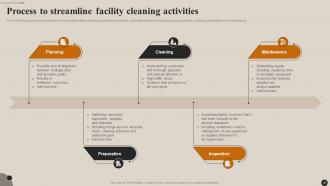
Slide 35: This slide showcases process which can help streamline cleaning and janitorial activities.
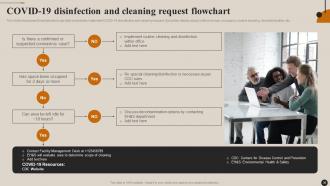
Slide 36: This slide presents flowchart which can help businesses implement COVID-19 disinfection and cleaning request.
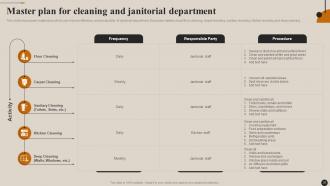
Slide 37: This slide reveals the master plan which can improve efficiency and productivity of janitorial department.
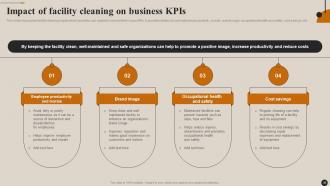
Slide 38: This slide highlights facility cleaning impact which business can realize to improve their major KPIs.
Slide 39: This slide contains the Heading for the Topics to be covered next.
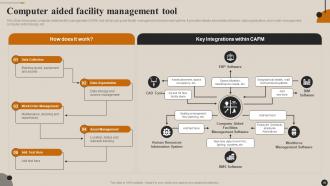
Slide 40: This slide showcases computer aided facility management (CAFM) tool which can guide facility managers to increase work uptime.
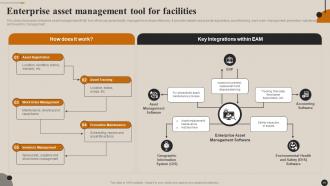
Slide 41: This slide presents enterprise asset management (EAM) tool which can guide facility managers to increase efficiency.
Slide 42: This slide highlights enterprise building management system (BMS) for overall facility administration.
Slide 43: This slide exhibits the Title for the Topics to be discussed further.
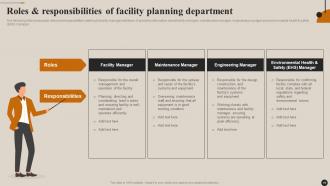
Slide 44: This slide highlights the Roles & responsibilities of facility planning department.
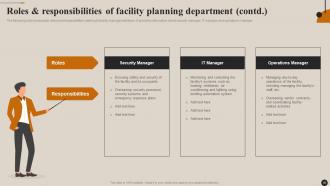
Slide 45: The following slide showcases roles and responsibilities catering to facility management team.
Slide 46: This slide contains the Heading for the Contents to be covered further.
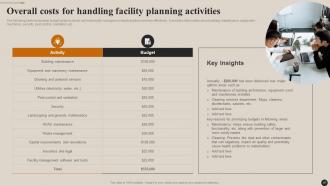
Slide 47: The following slide showcases budget analysis which can help facility managers in deploying their services effectively.
Slide 48: This slide mentions the comparative analysis of multiple facility management software.
Slide 49: This slide portrays the Title for the Ideas to be discussed next.
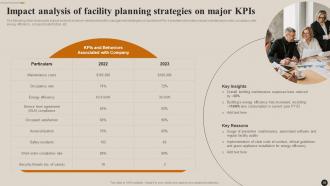
Slide 50: The following slide showcases impact analysis of above mentioned facility management strategies on business KPIs.
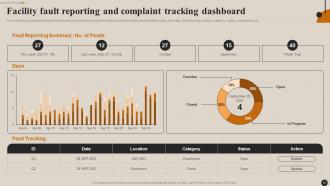
Slide 51: This slide presents facility fault reporting and complaint tracking dashboard.
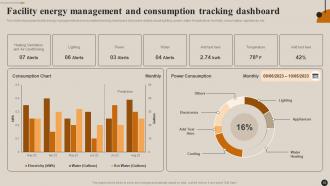
Slide 52: This slide illustrates facility energy management and consumption tracking dashboard.
Slide 53: This slide contains the Heading for the Ideas to be covered further.
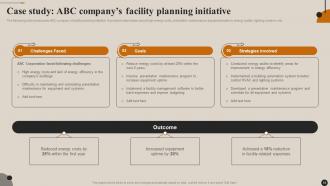
Slide 54: The following slide illustrates the ABC company’s facility planning initiative.
Slide 55: This is the Icons slide containing all the Icons used in the plan.
Slide 56: This slide is used for depicting some Additional information.
Slide 57: This slide exhibits the company's mission, vision, and goals.
Slide 58: This slide contains the company-related information.
Slide 59: This slide showcases the Mind map.
Slide 60: This is the Venn diagram slide.
Slide 61: This slide contains the Posts it notes for reminders and deadlines.
Slide 62: This is Meet our team slide. State your team-related information here.
Slide 63: This slide displays the Timeline of the company.
Slide 64: This is the Clustered column slide.
Slide 65: This slide elucidates the Pie chart.
Slide 66: This is the Thank You slide for acknowledgement.
Streamlining Facility Management Best Practices And Maintenance Planning Guide Complete Deck with all 69 slides:
Use our Streamlining Facility Management Best Practices And Maintenance Planning Guide Complete Deck to effectively help you save your valuable time. They are readymade to fit into any presentation structure.

















FAQs for Streamlining Facility Management Best Practices And Maintenance Planning
So you're basically the person who keeps everything from falling apart! You'll be managing all the building stuff - HVAC, lights, security systems, the works. Maintenance and repairs are huge too, plus coordinating with vendors (some are great, others... good luck). Space planning is another big one when teams expand or move around - honestly feels like playing Tetris sometimes. Oh, and you're handling budgets, dealing with whatever emergencies pop up, making sure everyone's workspace actually functions. Safety regulations are obviously important too. I'd start by figuring out what systems and vendor contracts you're inheriting first.
Honestly, tech makes facility management way less painful. IoT sensors track your HVAC and space usage - catches problems before they get expensive. CMMS software is huge for work orders (seriously beats the hell out of spreadsheets). Your team can report stuff instantly through mobile apps, which is clutch. Predictive analytics tells you when equipment's gonna fail. Oh, and don't try to do everything at once - that's a recipe for chaos. Pick whatever's driving you crazy right now and start there.
Dude, sustainability isn't optional anymore in facility management. Everyone's chasing LEED certifications and energy-efficient systems because it actually cuts costs while making them look good. Employees want to work in green buildings now too - honestly didn't see that coming a few years ago. You'll handle smart HVAC, recycling programs, water conservation, all that stuff. Do an energy audit first though. Shows you where the biggest savings are hiding. My cousin's company saved like 30% on utilities just from upgrading their lighting and fixing leaky pipes.
Ugh, budget constraints are the worst - there's never enough money for what actually needs fixing. Your equipment will definitely break at the most inconvenient times possible. Balancing emergency repairs with regular maintenance is like juggling fire. Contractors? Half of them don't show up when they say they will, which honestly drives me nuts. You'll be dealing with compliance stuff, trying to maximize space, and just keeping track of a million different building systems. Track your maintenance patterns from day one though - it'll help you see what's coming and budget better. Good vendor relationships are honestly a lifesaver.
Ugh, safety regs basically run your whole show in facilities - they're not just paperwork you file away. Your maintenance schedules? Compliance deadlines. Budget planning? Required upgrades everywhere. Even your daily workflows get shaped by keeping people safe. It's pretty overwhelming when you're starting out, honestly. But here's the thing - once you figure it out, these regulations actually make choices easier since they tell you what matters most. Don't treat compliance like some separate thing you deal with later. Build it right into your regular processes from day one. Figure out which regs apply to your specific type of facility first.
Sustainability and smart tech are everywhere right now. Most buildings are cramming in IoT sensors for energy stuff and using AI to predict when equipment's gonna break. Hybrid workspaces are big too - spaces that actually work whether people are remote or in the office. The occupancy tracking dashboards honestly blow my mind, like you can see exactly how people move through buildings. Oh, and everyone's obsessed with employee wellness now. Air quality sensors, plants everywhere, fancy wellness rooms. If you're not digitally tracking who's using what space and how much energy you're burning, start there. That's your easiest win for getting modern.
Communication is honestly everything for keeping facilities running smoothly. When maintenance teams, vendors, and building users stay connected, problems get spotted and fixed way faster. You'll avoid those annoying duplicate work orders too - nobody wants to deal with that mess. Regular check-ins with your main people make a huge difference. Also, good communication helps you schedule maintenance during quiet hours and coordinate different service providers without chaos. My advice? Set up simple reporting processes that people will actually want to use, not some complicated system they'll ignore.
Start with cost per square foot and space utilization - those are your bread and butter. Energy consumption too, obviously. Response times for maintenance requests matter way more than people think. I'd throw in tenant satisfaction scores and safety incidents (trust me, one bad safety issue and you're screwed). Occupancy rates are a no-brainer. Oh, and track how much preventive maintenance you're actually completing vs what you planned. Pick like 3-4 that make sense for your building first. Adding too many metrics right away just makes everything messy and you won't know what actually matters.
Honestly, getting the basics right makes such a difference - decent lighting, temps that don't make you miserable, clean bathrooms. People just work better when they're not constantly annoyed by their environment. You know how you feel sluggish in that one conference room that's always too hot? Same principle everywhere. Break areas matter too, and having actual quiet spots helps a ton. I'd start by just walking around and noting what bugs people daily. Seriously, sometimes it's the simplest stuff - like that one flickering light everyone complains about but nobody ever fixes. Fix the obvious problems first, then worry about the fancy stuff.
Start with clear expectations upfront - nobody's a mind reader. Document everything and set detailed SLAs. Regular performance reviews help catch problems early. Most vendor headaches? Poor communication, not bad service. Quarterly business reviews are clutch for staying on top of things. Oh, and definitely don't rely on just one vendor for critical stuff - backup relationships save your butt when things go sideways. I'd audit your current agreements first. Look for gaps in performance metrics. Standardize your work orders and invoicing too. Honestly, once you get systems in place, managing vendors becomes way less stressful.
Dude, you're way more important than you think. Building managers know where everything actually is - the utility shutoffs, backup generators, all that critical stuff. Most disaster plans are total garbage because desk people write them without ever walking the building during chaos. Your vendor contacts are gonna be lifesavers too - HVAC guys, electricians, security people. They trust you already. Start by writing down key contacts and system locations somewhere you can grab even if computers are fried. Keep those floor plans current because when things go sideways, you'll be the one everyone turns to for answers.
Honestly, space data is everything for FM decisions - it shows what's really going on vs what you assume. Like when conference rooms are empty 70% of the time but everyone's fighting over desks? Time to reconfigure. I've watched places keep dead zones just because "we've always had them there." Such a waste. Occupancy sensors work great, or booking systems, even basic headcounts. The data thing sounds boring but once you've got real numbers, you can actually make smart calls about expanding or shrinking spaces that match how people really work.
Dude, you're literally the person keeping everything from falling apart when emergencies hit. Your job covers evacuation routes, backup power, emergency lighting - all that critical stuff. Fire suppression systems and alarms need constant maintenance (which nobody thinks about until they don't work, obviously). You'll also coordinate with first responders and handle business continuity plans. Communication networks are huge too. My advice? Do quarterly audits of your emergency systems and keep updated building plans handy for emergency teams. Honestly, most people have no clue how much behind-the-scenes work goes into this.
Honestly, those green certifications are pretty solid investments. LEED and ENERGY STAR will cut your utility costs and make everything run smoother. Tenants actually care about this stuff now - makes leasing way easier when you've got the paperwork to back it up. The whole certification thing forces you to really dig into how your building operates, which sounds annoying but saves you from random equipment failures later. Better air quality is a nice bonus too. I'd start with an energy audit first - see what you're working with before picking which route makes sense for your building.
So data analytics basically makes your building smart enough to warn you before stuff breaks. Track your energy patterns and you'll see exactly where you're bleeding money - honestly shocked me how much we were wasting on empty floors. Equipment maintenance becomes predictable instead of those surprise "oh crap the boiler died" moments. Space utilization data beats guessing every time. You can finally figure out why that one HVAC zone always sucks or when your peak usage hits. My advice? Pick maybe two metrics to start with, don't go crazy trying to track everything at once.
-
The PPTs are extremely simple to modify. Thank you for providing the slides that are ready to be used. They assist me in saving a lot of time.
-
It makes easy work of my work presentations. I’ve never had to be nervous about my presentations for meetings.