

Structural Elements Of Strategic Planning Model




Try Before you Buy Download Free Sample Product
 Impress Your
Audience
 100%
Editable
 Save Hours
of Time


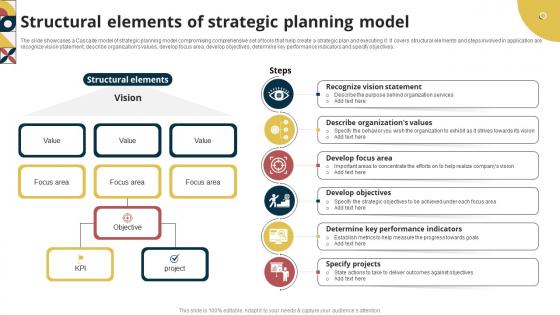
The slide showcases a Cascade model of strategic planning model compromising comprehensive set of tools that help create a strategic plan and executing it. It covers structural elements and steps involved in application are recognize vision statement, describe organizations values, develop focus area, develop objectives, determine key performance indicators and specify objectives.
People who downloaded this PowerPoint presentation also viewed the following :
Structural Elements Of Strategic Planning Model with all 6 slides:
Use our Structural Elements Of Strategic Planning Model to effectively help you save your valuable time. They are readymade to fit into any presentation structure.






FAQs for Structural Elements Of
Critical components of effective strategic planning include comprehensive market analysis, clear vision and mission statements, SWOT assessments, measurable objectives, resource allocation frameworks, and implementation timelines. These elements work together by aligning organizational goals with market realities, enabling systematic decision-making, and creating accountability structures, with many organizations finding that this integrated approach delivers sustainable competitive advantage and operational clarity.
Organizations align strategic goals with operational capabilities through comprehensive capability assessments, resource mapping, and systematic gap analysis to identify misalignments. By establishing clear performance metrics, implementing cross-functional teams, and regularly reviewing strategic initiatives against operational realities, companies streamline execution while ensuring resources support strategic priorities, ultimately delivering enhanced efficiency and competitive advantage.
Market analysis serves as the foundation for strategic planning by providing comprehensive insights into customer needs, competitive landscapes, industry trends, regulatory changes, and emerging opportunities. Through detailed market research, organizations identify growth segments, assess competitive positioning, and anticipate market shifts, ultimately enabling data-driven strategic decisions that enhance competitive advantage and optimize resource allocation in an increasingly dynamic business environment.
Strategic plan success is measured through key performance indicators, financial metrics, milestone achievements, stakeholder feedback, and market position analysis. Organizations typically track revenue growth, operational efficiency improvements, customer satisfaction scores, and competitive advantage gains, with many companies finding that regular quarterly reviews and balanced scorecards deliver the most comprehensive performance insights.
**INPUT**: What tools and frameworks are most effective for strategic planning? **OUTPUT**: Effective strategic planning frameworks include SWOT analysis, Porter's Five Forces, Balanced Scorecard, OKRs, and scenario planning methodologies. These tools enhance decision-making by identifying competitive advantages, measuring performance outcomes, and aligning organizational resources, with many enterprises finding that combining multiple frameworks delivers greater strategic clarity and operational efficiency.
Organizations should typically revisit their strategic plans quarterly for progress assessment and annually for comprehensive revisions, though dynamic industries may require more frequent updates. This regular cadence enables companies to adapt to market shifts, technological changes, and competitive pressures, with many successful organizations finding that structured review cycles ultimately deliver enhanced agility and sustained competitive advantage.
Common strategic planning pitfalls include lack of stakeholder buy-in, unrealistic timelines, insufficient market research, poor communication, and failure to adapt plans based on changing conditions. Organizations avoid these by engaging cross-functional teams early, conducting thorough competitive analysis, establishing clear communication channels, and building flexibility into implementation phases, ultimately delivering more resilient strategies and sustainable competitive advantage.
Incorporating stakeholder input involves conducting surveys, focus groups, interviews, and collaborative workshops to gather diverse perspectives on organizational priorities and market opportunities. These engagement methods enable leaders to identify blind spots, validate strategic assumptions, and build broader buy-in, with many organizations finding that inclusive planning processes deliver more robust strategies and smoother implementation across all levels.
Technology enhances strategic planning through advanced analytics, AI-driven forecasting, collaborative platforms, real-time data integration, and automated scenario modeling. These digital tools streamline decision-making by enabling faster data analysis, improving cross-departmental collaboration, and providing dynamic strategic insights, with many organizations finding that technology-enhanced planning delivers more agile responses to market changes and competitive advantages.
SWOT analysis provides a comprehensive framework for strategic planning by systematically evaluating internal strengths and weaknesses alongside external opportunities and threats. This structured assessment enables organizations to align their capabilities with market conditions, identify competitive advantages, and develop strategies that leverage strengths while addressing vulnerabilities, ultimately delivering more informed decision-making and strategic focus.
Scenario planning enables organizations to prepare for uncertainties by developing multiple plausible future scenarios, identifying key risk factors, assessing potential impacts, and creating flexible response strategies. Through systematic analysis, companies can stress-test strategic decisions, allocate resources more effectively, and build adaptive capabilities, with many financial institutions and healthcare systems finding that structured scenario planning ultimately delivers greater organizational resilience and competitive advantage.
Effective strategic plan implementation requires clear communication of objectives, defined accountability structures, regular progress monitoring, resource allocation alignment, and stakeholder engagement throughout the process. Organizations achieve success by establishing measurable milestones, creating cross-functional implementation teams, and maintaining flexibility to adapt strategies based on market feedback, ultimately delivering sustained competitive advantage.
Organizational culture and values significantly shape strategic planning by influencing decision-making frameworks, resource allocation priorities, and implementation approaches that align with company beliefs and behavioral norms. Through cultural integration, organizations streamline strategic execution, enhance employee engagement, and minimize resistance to change, with many companies finding that values-driven planning ultimately delivers greater consistency, stakeholder buy-in, and sustainable competitive advantage.
Strategic plan communication best practices include creating tailored messaging for different stakeholder groups, establishing regular update cycles, using visual dashboards and progress metrics, conducting leadership alignment sessions, and maintaining transparent two-way feedback channels. Successful organizations enhance internal buy-in through departmental cascades and town halls, while strengthening external confidence via investor briefings and customer communications, ultimately delivering organizational coherence and stakeholder trust.
Strategic planning adapts to rapidly changing market conditions through scenario planning, agile frameworks, continuous market monitoring, and flexible resource allocation strategies. Organizations increasingly implement quarterly reviews, real-time data analytics, and modular strategic components, enabling rapid pivots while maintaining long-term vision, ultimately delivering competitive resilience and sustainable growth.
-
“Superb. What a great finding. Thankful for SlideTeam. We were paying people to make slides which went all in vain. We are so happy to have found you.”
-
The quality of PowerPoint templates I found here is unique and unbeatable. Keep up the good work and continue providing us with the best slides!