

Summary Of Hospital Project Feasibility Study Templates For Different Projects




Try Before you Buy Download Free Sample Product
 Impress Your
 Audience
 100%
100% Editable
 Save Hours
 of Time


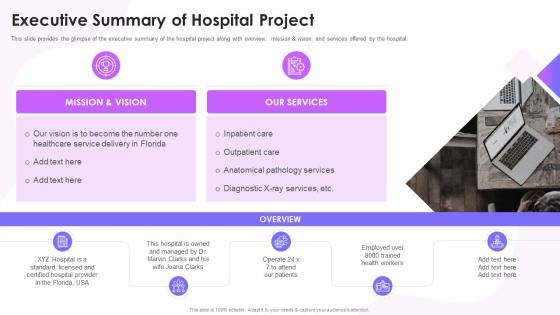
This slide provides the glimpse of the executive summary of the hospital project along with overview, mission and vision, and services offered by the hospital.
People who downloaded this PowerPoint presentation also viewed the following :
Summary Of Hospital Project Feasibility Study Templates For Different Projects with all 6 slides:
Use our Summary Of Hospital Project Feasibility Study Templates For Different Projects to effectively help you save your valuable time. They are readymade to fit into any presentation structure.





FAQs for Summary Of Hospital Project Feasibility Study Templates
So for your hospital feasibility study, you'll want four main sections: market analysis, financial projections, operational stuff, and regulatory compliance. Demographics and patient demand first. Then hit the money side - capital costs, revenue forecasts, ROI calculations. Staffing models and equipment needs are huge too since hospitals are basically small cities. Oh, and don't skip the boring but crucial licensing and zoning requirements. I'd throw in a risk assessment matrix because things always go sideways somehow. Make sure you've got clear decision points throughout so everyone knows when to keep going or bail out.
Focus on three big things for your feasibility study: projected revenue, operating costs, and upfront capital needs. Model out different patient volumes and payer scenarios - yeah it's tedious but you gotta get detailed here. Build cash flow projections for 5-7 years minimum, plus break-even analysis. Don't forget sensitivity testing for reimbursement rates and construction costs. Always add contingencies because hospital projects go over budget like clockwork. Here's the thing though - the real test is running conservative scenarios to see if it still works when everything goes sideways.
So market analysis and demographic studies? They're literally what make or break your feasibility study. You gotta look at population growth, age breakdowns, income data, plus what healthcare competition already exists nearby. Building without this info is honestly terrifying when you think about it. These studies show you which services to offer, how many patients you'll realistically see, and what revenue to expect. I'd start with census data and health department stats - boring stuff but super necessary. Then dig into competitor analysis to find gaps in current services. Trust me, this groundwork saves you from major headaches later.
Build a risk section right into your template covering financial, regulatory, operational, and market stuff. SWOT analysis is your friend here - super simple but catches most issues. Then do risk matrices where you rate probability vs impact for everything that could tank your project. Construction delays, staffing problems, regulatory changes - whatever. Honestly, this is where you need to be a total pessimist and think through all the ways things could go sideways. Don't just list problems though. Include your actual game plan for dealing with each risk when it hits.
Start with census data for a 30-mile radius - that's your baseline. Population growth and aging demographics are key, plus you'll need hospital occupancy rates in the area. Disease trends matter too, especially chronic stuff that keeps bringing people back. Honestly, the data dump part is overwhelming but you gotta push through it. Check out what competitors are doing capacity-wise and how doctors refer patients around there. Insurance coverage in your target area is huge. Oh, and don't forget seasonal patterns - some places get slammed in winter, others in summer. Referral patterns from local physicians will tell you a lot about potential demand.
So basically, a feasibility study template gives you this whole structured way to compare hospital locations without missing anything major. You'll cover demographics, competition, how accessible each spot is - all that stuff. Honestly, there are way too many moving parts to just eyeball it. The template breaks down patient catchment areas, emergency coverage, zoning headaches, infrastructure costs. Most have these scoring matrices so you can actually rank your options objectively instead of going with your gut. Find one with decent demographic tools built in. I'd start by mapping out your top three spots and see what the data tells you.
Oh man, hospitals are a legal nightmare honestly. First thing - check your zoning and building codes, plus ADA stuff is super strict for medical facilities. Your state might have certificate of need requirements too, which can totally kill a project if you don't plan ahead. Healthcare licensing is obvious but don't forget each service line has different rules. Environmental regs are massive - medical waste alone will give you headaches. Employment law gets tricky with all the clinical credentialing requirements. Definitely loop in your lawyers early, like way earlier than you think you need to.
So basically, templates force everyone to use the same format when they pitch hospital projects. Financial stuff, patient numbers, costs, timelines, risks - all laid out the same way. Makes it way easier to compare proposals since you're not trying to decipher totally different formats (trust me, that's a headache you don't want). You can actually see which projects have better ROI or lower risk without hunting through random presentation styles. My advice? Set up template sections for your non-negotiables first, then just score each proposal the same way. It's honestly the only sane approach.
Honestly, you can't skip stakeholder engagement - it'll tank your whole study. Get doctors, nurses, administrators, and community leaders talking to you early. Patients too. They're the ones who know what's actually needed operationally and staffing-wise. Without their input, you're just guessing at demand numbers. I mean, these same people will decide if your hospital thrives once it opens, so involving them from the start is obvious, right? Too many projects crash because someone thought they could wing this part. Map out who matters first, then book those conversations before you get lost in spreadsheets.
Yeah so tech trends totally change how you do hospital feasibility studies. Your upfront costs get way higher - AI diagnostic tools, telemedicine setups, electronic health records. Patients just expect this stuff now, honestly. But here's what's cool: those same expensive technologies actually make your operations way more efficient and improve patient outcomes. That helps your long-term money situation. Oh and don't just look at current tech - figure out what'll be standard in like 5-10 years or you'll be behind before you even open.
For your hospital feasibility study, you'll need revenue projections first - patient volumes, payer mix, service line profits. Capital expenditure models come next for equipment and construction costs. Operating expenses are huge too, especially staffing (labor costs are honestly brutal right now). Cash flow projections and break-even analysis round it out. Oh, and definitely do sensitivity testing. I always tell people to run three scenarios - conservative, base case, and optimistic. That way stakeholders aren't surprised if things don't go perfectly. The technology infrastructure piece can get expensive fast, so don't lowball that part.
Look, operational costs will make or break your whole hospital project. Once you open, you're looking at massive staffing expenses - honestly the biggest chunk of your budget. Then there's utilities, medical supplies, equipment upkeep, insurance... it adds up insanely fast over 5-10 years. Compare all that against what you'll actually bring in from patients, insurance payments, other revenue. Here's the thing though - be realistic about both sides. Don't let anyone BS you on staffing ratios or what insurance actually pays out. I've seen too many projects fail because someone was overly optimistic about reimbursement rates.
Okay so community health assessments are literally the backbone of your whole feasibility study. They show you what services people actually need instead of what you're guessing they want. Think of it like opening a restaurant without knowing if your neighborhood wants sushi or burgers - total disaster waiting to happen. You'll need this data to back up your service lines and project patient volumes. Plus it shows care gaps and health trends in your area. Honestly, skip this part and your financial projections will be built on wishful thinking. Make sure it's solid in your template.
Honestly, templates save you from missing obvious stuff. They make you think through everything upfront - money, permits, hiring, how it affects the neighborhood. Without one, you'll probably get obsessed with the cool parts (like equipment) and totally forget boring things like zoning laws. Templates also help when you're comparing different locations since everything's organized the same way. Your board will actually understand what you're thinking too. Oh, and definitely don't build one from scratch - there's already good ones out there that'll catch things you'd never think of.
Honestly, most hospital projects that crash and burn? They skip all the boring stuff upfront. Market research gets half-assed. Financial projections are way too optimistic - like, embarrassingly so. And nobody bothers getting key stakeholders actually aligned before moving forward. I've seen this same pattern in tons of case studies. Everyone gets pumped about the shiny new building but forgets to check if there's real demand. Plus they don't lock down solid funding commitments early enough. Oh, and community buy-in matters more than people think. Skip that and you'll face serious pushback later. Do the unglamorous groundwork first, even though designing the facility is way more fun.
-
Great product with highly impressive and engaging designs.
-
Great quality slides in rapid time.