

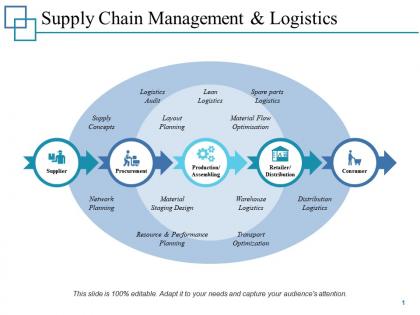
Supply chain management and logistics consumer ppt powerpoint presentation portfolio




Try Before you Buy Download Free Sample Product
 Impress Your
 Audience
 100%
100% Editable
 Save Hours
 of Time


Avoid journalese with our Supply Chain Management And Logistics Consumer Ppt Powerpoint Presentation Portfolio. Employ expressions easy to comprehend.
People who downloaded this PowerPoint presentation also viewed the following :
Supply chain management and logistics consumer ppt powerpoint presentation portfolio with all 5 slides:
Our Supply Chain Management And Logistics Consumer Ppt Powerpoint Presentation Portfolio employ expressions easy to comprehend. It helps avoid journalese.



FAQs for Supply chain management and logistics consumer ppt
Key components include demand forecasting, supplier relationship management, inventory optimization, logistics coordination, and performance analytics. These elements work together by streamlining operations, reducing costs, and enhancing visibility across the entire network, with many manufacturing and retail organizations finding that integrated systems ultimately deliver faster response times and significant competitive advantage.
Technology enhances supply chain visibility through IoT sensors, blockchain tracking, AI-powered analytics, cloud-based platforms, and real-time monitoring systems. These solutions streamline operations by automating inventory management, predicting demand fluctuations, and enabling proactive decision-making, with manufacturing and retail companies finding significantly improved efficiency and reduced operational costs.
Demand forecasting serves as the foundation for supply chain planning, enabling accurate inventory management, production scheduling, procurement decisions, and resource allocation. Through predictive analytics and market data analysis, organizations streamline operations, minimize stockouts and excess inventory, and enhance customer satisfaction, with many retailers and manufacturers finding that improved forecasting accuracy delivers significant cost reductions and competitive advantage.
Companies develop sustainable supply chain practices by implementing circular economy principles, partnering with eco-certified suppliers, optimizing transportation routes, and investing in renewable energy sources. Through strategic vendor assessments and carbon footprint monitoring, organizations like Unilever and Patagonia streamline operations while reducing environmental impact, ultimately delivering cost savings and enhanced brand reputation in an increasingly environmentally-conscious marketplace.
Global supply chains face geopolitical tensions, trade disruptions, climate-related risks, cybersecurity threats, and labor shortages. These challenges create vulnerabilities in transportation networks, manufacturing processes, and inventory management, with many organizations finding that diversifying suppliers, enhancing digital visibility, and building resilient partnerships ultimately delivers greater operational stability and competitive advantage.
Inventory management strategies significantly impact supply chain performance by optimizing stock levels, reducing carrying costs, and ensuring product availability throughout distribution networks. Strategic approaches like just-in-time delivery and demand forecasting enable retailers and manufacturers to minimize waste, accelerate order fulfillment, and enhance customer satisfaction, ultimately delivering competitive advantage through improved operational efficiency.
Data analytics in supply chain decision-making delivers enhanced demand forecasting, optimized inventory management, improved supplier performance tracking, reduced operational costs, and faster response to market changes. Through predictive analytics and real-time monitoring, organizations streamline procurement processes, minimize stockouts, and enhance customer satisfaction, with many manufacturers and retailers finding that data-driven insights ultimately provide significant competitive advantage.
Collaboration among supply chain partners enhances outcomes by improving demand forecasting, reducing inventory costs, accelerating problem resolution, and increasing supply chain visibility through shared data and resources. Through strategic partnerships, organizations streamline operations, minimize disruptions, and deliver faster customer service, with many manufacturers and retailers finding that collaborative approaches ultimately provide significant competitive advantages.
Supply chain risk management mitigates disruptions by identifying potential vulnerabilities, developing contingency plans, and establishing alternative supplier networks across multiple geographic regions. Through predictive analytics and real-time monitoring, organizations can anticipate bottlenecks, minimize inventory shortages, and maintain operational continuity, with many manufacturers finding that diversified sourcing strategies ultimately deliver greater resilience and competitive advantage.
Geopolitical factors significantly impact supply chain stability through trade restrictions, tariffs, border delays, and regional conflicts that disrupt logistics networks. These challenges force organizations to diversify suppliers, establish alternative routes, and increase inventory buffers, with many companies finding that strategic geographic distribution ultimately delivers enhanced resilience and competitive advantage.
Companies balance cost reduction with quality through strategic supplier partnerships, implementing robust quality management systems, leveraging technology for real-time monitoring, and adopting lean manufacturing principles. These approaches enable organizations to streamline operations while maintaining standards, with many manufacturers finding that strategic sourcing and supplier collaboration ultimately deliver both competitive pricing and superior product quality.
Supply chain resilience has become critically important post-pandemic, enabling organizations to withstand disruptions through diversified sourcing, enhanced visibility, flexible logistics networks, and robust risk management protocols. Companies across manufacturing, retail, and healthcare are increasingly investing in these capabilities to reduce costs, accelerate recovery times, and maintain competitive advantage in an unpredictable global environment.
Artificial intelligence transforms supply chain operations by automating demand forecasting, optimizing inventory levels, predicting equipment failures, and enhancing route planning through machine learning algorithms. These AI-driven capabilities enable manufacturers and retailers to reduce costs by up to 30%, minimize stockouts, and deliver faster customer fulfillment, with many logistics companies finding that predictive analytics significantly improves operational efficiency.
Best practices for implementing new supply chain technology include conducting thorough needs assessments, ensuring stakeholder buy-in, establishing clear integration timelines, providing comprehensive staff training, and maintaining robust data migration protocols. These strategic approaches streamline adoption by minimizing operational disruptions, enhancing user acceptance, and maximizing system capabilities, with many organizations finding that phased rollouts ultimately deliver faster ROI and sustained competitive advantage.
Customer expectations significantly influence supply chain strategies by demanding faster delivery times, greater product variety, enhanced transparency, and seamless omnichannel experiences. Companies increasingly redesign their networks around speed and flexibility, with many retailers implementing same-day delivery options, real-time tracking systems, and sustainable packaging practices, ultimately delivering competitive advantage through superior customer satisfaction.
No Reviews