

Supply chain management process ppt sample presentations




Try Before you Buy Download Free Sample Product
 Impress Your
 Audience
 100%
100% Editable
 Save Hours
 of Time


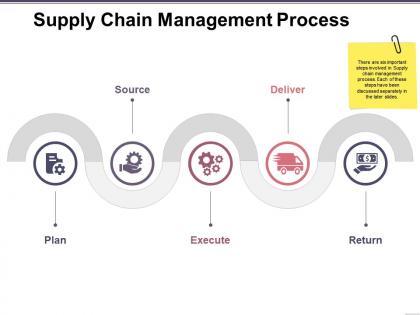
Introducing Supply Chain Management Process PPT Sample Presentations that helps you to create value for your organization and maintain the relationship with the suppliers. Plan and execute the activities of the supply chain with the help of inventory control management presentation template. Use logistics management PowerPoint graphic to concentrate on several strategy models like a balanced scorecard, strategy map, value chain analysis, SWOT analysis, gap planning, and PEST model that assess the transmission of the product. Maintain a good relationship with your vendors and distributors with the help of this global supply chain management PowerPoint layout. Take the assistance of supply chain management PPT visual to outline the different goals such as to attain efficient fulfillment of demand, drive customer value, enhance organizational resources, improve financial success, and build network resiliency. There are various high-quality icons present in the slide which makes your presentation easy and attractive. Hence, achieve high-levels of customer service in targeted markets by downloading our ready-to-use supply chain optimization PowerPoint theme.
People who downloaded this PowerPoint presentation also viewed the following :
Supply chain management process ppt sample presentations with all 5 slides:
Our Supply Chain Management Process Ppt Sample Presentations ensure you land with your feet on the ground. They enable you to dive headlong into the fray.




FAQs for Supply chain management process
Key components of an effective supply chain management strategy include demand forecasting, supplier relationship management, inventory optimization, logistics coordination, and performance analytics. These elements work together by streamlining operations, reducing costs, and enhancing visibility across the entire network, with many organizations finding that strategic integration ultimately delivers faster response times, improved customer satisfaction, and significant competitive advantage.
AI and IoT enhance supply chain efficiency by enabling real-time inventory tracking, predictive maintenance, and automated demand forecasting. Through smart sensors and machine learning algorithms, companies streamline warehouse operations, minimize transportation costs, and reduce stockouts, with manufacturers and retailers finding that these technologies ultimately deliver faster fulfillment and improved customer satisfaction.
Common supply chain challenges include demand forecasting inaccuracies, supplier reliability issues, inventory optimization difficulties, transportation cost volatility, and limited visibility across networks. These disruptions significantly impact operational efficiency, with many organizations finding that inadequate technology integration, regulatory compliance complexities, and sustainability pressures ultimately create cascading effects that compromise customer satisfaction and competitive advantage.
Supplier relationship management significantly enhances supply chain performance by improving communication, fostering collaboration, and ensuring quality consistency across the network. Strong partnerships enable organizations to reduce costs, minimize disruptions, and accelerate innovation, with many manufacturing and retail companies finding that strategic supplier relationships deliver greater operational efficiency and competitive advantage.
Data analytics plays a crucial role in supply chain optimization by enabling demand forecasting, inventory management, route optimization, supplier performance tracking, and risk assessment. Through predictive analytics and real-time monitoring, companies streamline operations, reduce costs, and enhance customer satisfaction, with manufacturing and retail organizations finding that data-driven insights deliver significant competitive advantages and operational efficiency.
Best practices for inventory management include demand forecasting, ABC analysis, just-in-time ordering, safety stock optimization, and automated replenishment systems. These approaches streamline operations by reducing carrying costs, minimizing stockouts, and enhancing cash flow, with many retail and manufacturing organizations finding that strategic inventory control ultimately delivers improved customer satisfaction and competitive advantage.
Sustainability can be integrated into supply chain management through renewable energy adoption, ethical sourcing practices, waste reduction programs, carbon footprint monitoring, and circular economy principles. These approaches enable organizations to streamline operations while reducing environmental impact, with many manufacturing and retail companies finding that sustainable practices ultimately deliver cost savings, enhanced brand reputation, and competitive advantage in increasingly conscious markets.
Key supply chain performance metrics include inventory turnover, order fulfillment accuracy, delivery performance, cost per shipment, and cash-to-cash cycle time. These metrics enable organizations to streamline operations, enhance customer satisfaction, and optimize resource allocation, with manufacturing and retail companies finding that comprehensive measurement ultimately delivers competitive advantage and operational efficiency.
Organizations mitigate supply chain risks through diversification strategies, real-time monitoring systems, robust supplier vetting, contingency planning, and strategic inventory management. These approaches enable companies to identify vulnerabilities early, maintain operational continuity during disruptions, and build resilient networks, with many manufacturers and retailers finding that proactive risk management ultimately delivers competitive advantage and enhanced customer satisfaction.
Outsourcing supply chain functions delivers cost reduction, access to specialized expertise, enhanced scalability, improved focus on core competencies, and operational flexibility. While this approach enables companies to leverage advanced technologies and global networks, it also presents challenges including reduced control, potential quality issues, and dependency risks, with many organizations finding that strategic vendor partnerships help balance these considerations.
Globalization affects supply chain management strategies by creating opportunities for cost reduction, market expansion, and resource diversification, while introducing complexities around logistics coordination, regulatory compliance, and risk management. Companies increasingly adopt multi-sourcing approaches, regional distribution hubs, and advanced technology platforms to navigate cross-border operations, ultimately delivering competitive advantages through optimized global networks and enhanced market responsiveness.
Lean principles enhance supply chain operations by eliminating waste, reducing inventory costs, streamlining processes, and improving demand forecasting accuracy. These methodologies enable organizations to minimize overproduction, optimize warehouse space, and accelerate order fulfillment, with manufacturing and retail companies finding that lean approaches ultimately deliver faster response times and enhanced customer satisfaction.
Supply chain disruption strategies include diversifying suppliers, implementing real-time monitoring systems, maintaining strategic inventory buffers, developing flexible logistics networks, and creating contingency response protocols. These approaches enable organizations to quickly adapt when disruptions occur, with many manufacturing and retail companies finding that combining predictive analytics with supplier relationship management ultimately delivers greater resilience and competitive advantage.
Consumer trends are fundamentally reshaping supply chain management through demands for faster delivery, sustainability, personalization, and transparency. Companies are implementing omnichannel logistics, circular supply chains, and real-time tracking systems to meet these expectations, with retailers like Amazon and Walmart investing heavily in automated fulfillment centers and sustainable sourcing, ultimately delivering enhanced customer experiences and competitive differentiation.
Blockchain technology enables unprecedented supply chain transparency by creating immutable transaction records, real-time tracking capabilities, automated compliance verification, and decentralized data sharing across all stakeholders. This strategic combination streamlines audit processes, reduces fraud risks, and enhances consumer trust, with many retail and pharmaceutical companies finding that blockchain delivers faster dispute resolution and stronger regulatory compliance, ultimately providing significant competitive advantage in increasingly transparency-focused markets.
-
Perfect template with attractive color combination.
-
Nice and innovative design.