

Supply Chain Network Optimization Process




Try Before you Buy Download Free Sample Product
 Impress Your
Audience
 100%
Editable
 Save Hours
of Time


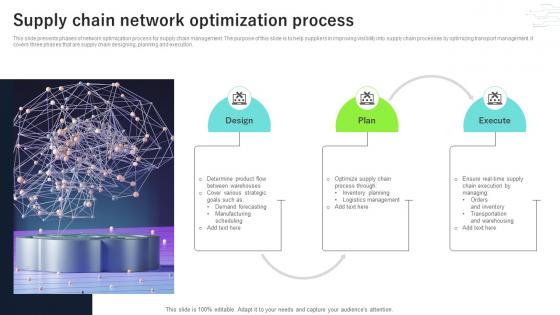
This slide presents phases of network optimization process for supply chain management. The purpose of this slide is to help suppliers in improving visibility into supply chain processes by optimizing transport management. It covers three phases that are supply chain designing, planning and execution.
People who downloaded this PowerPoint presentation also viewed the following :
Supply Chain Network Optimization Process with all 9 slides:
Use our Supply Chain Network Optimization Process to effectively help you save your valuable time. They are readymade to fit into any presentation structure.









FAQs for Supply Chain
Key supply chain performance metrics include inventory turnover, order fulfillment rates, cost per shipment, supplier performance scores, and demand forecast accuracy. These metrics enable organizations to streamline operations, reduce costs, and enhance customer satisfaction, with many manufacturing and retail companies finding that tracking these indicators delivers improved operational efficiency and competitive advantage.
AI and machine learning enhance supply chain optimization by automating demand forecasting, optimizing inventory levels, and streamlining logistics operations through predictive analytics. These technologies enable manufacturers and retailers to reduce costs, minimize waste, and improve delivery times, with many organizations finding that automated systems deliver significantly faster response times and better customer experiences.
Inventory management serves as the backbone of supply chain efficiency by balancing stock levels, minimizing carrying costs, preventing stockouts, and optimizing cash flow. Through advanced forecasting and automated replenishment systems, organizations across retail, manufacturing, and healthcare streamline operations, reduce waste, and enhance customer satisfaction, ultimately delivering faster fulfillment and competitive advantage.
Businesses balance cost reduction with service level improvements through strategic automation, demand forecasting analytics, supplier relationship optimization, and inventory management systems. These approaches streamline operations by reducing waste, improving delivery accuracy, and enhancing visibility across supply networks, with many organizations finding that integrated technology platforms ultimately deliver both lower operational costs and superior customer experiences.
Recent supply chain disruptions reveal critical lessons including diversifying supplier networks, building redundancy into operations, investing in digital visibility tools, strengthening regional partnerships, and maintaining strategic inventory buffers. These challenges have taught organizations that over-optimization for cost alone creates vulnerability, with many companies now finding that balanced approaches emphasizing resilience alongside efficiency ultimately deliver competitive advantage and sustainable operations.
Environmental sustainability initiatives significantly enhance supply chain optimization by driving efficiency improvements, cost reductions, and regulatory compliance through renewable energy adoption, waste minimization, and circular economy practices. Companies in manufacturing, retail, and logistics increasingly find that sustainable approaches streamline operations, reduce resource consumption, and strengthen brand reputation, ultimately delivering competitive advantages while meeting stakeholder expectations in an environmentally conscious marketplace.
Best practices for selecting and managing global suppliers include conducting comprehensive due diligence, establishing clear performance metrics, diversifying supplier bases across regions, implementing robust communication systems, and maintaining regular relationship reviews. These strategies enable organizations to minimize risks, ensure quality consistency, and build resilient partnerships, with many multinational companies finding that strategic supplier collaboration ultimately delivers enhanced operational efficiency and competitive advantage.
Demand forecasting methods improve inventory turnover rates by enabling accurate stock predictions, reducing overstock situations, and aligning purchase timing with actual market demand. Through advanced analytics and historical data analysis, retailers and manufacturers minimize holding costs, prevent stockouts, and optimize warehouse space, ultimately delivering faster inventory cycles and improved cash flow in increasingly competitive markets.
Just-in-time supply chain implementation faces challenges including supplier reliability risks, demand forecasting complexities, limited inventory buffers, transportation disruptions, and coordination difficulties across multiple vendors. While these obstacles require careful planning, many manufacturers find that strategic supplier partnerships, advanced analytics, and flexible logistics networks enable successful JIT adoption, ultimately delivering reduced carrying costs and enhanced operational efficiency.
Data analytics transforms supply chain decision-making by enabling predictive forecasting, real-time visibility, and automated optimization across procurement, inventory, and logistics operations. Through advanced algorithms and machine learning, organizations streamline demand planning, minimize stockouts, and reduce operational costs, with manufacturers and retailers finding that data-driven insights deliver faster response times and enhanced competitive advantage.
Geopolitical factors significantly influence supply chain optimization through trade policies, tariffs, sanctions, and regional stability concerns that affect sourcing decisions and logistics routes. These challenges drive organizations to diversify suppliers across multiple countries, develop contingency plans, and invest in supply chain visibility technologies, ultimately enabling greater resilience and competitive advantage in increasingly volatile global markets.
SMEs can leverage supply chain optimization through strategic automation, data analytics partnerships, collaborative supplier relationships, and technology adoption to level the playing field with larger competitors. While larger firms have resource advantages, smaller businesses often achieve greater agility, faster decision-making, and stronger supplier partnerships, with many finding that focused optimization in key areas delivers cost reductions and customer responsiveness that creates sustainable competitive advantage.
Supply chain visibility enables proactive risk management by providing real-time tracking, early warning systems, supplier performance monitoring, and disruption alerts across all network tiers. Through advanced analytics and IoT sensors, organizations can identify potential bottlenecks, assess supplier vulnerabilities, and implement contingency plans rapidly, ultimately reducing operational risks while maintaining service continuity.
**INPUT**: How can collaboration between departments improve overall supply chain performance? **OUTPUT**: Collaboration between departments enhances supply chain performance by breaking down silos, enabling real-time information sharing, coordinating demand planning, and aligning procurement with production schedules. When procurement, manufacturing, logistics, and sales teams work together, organizations achieve faster response times, reduced inventory costs, and improved customer satisfaction, with many companies finding that integrated collaboration ultimately delivers significant competitive advantage. [Word count: 60 words]
Future supply chain trends include AI-powered demand forecasting, autonomous logistics, blockchain transparency, sustainable sourcing practices, and resilient multi-sourcing strategies. These technologies enhance operational efficiency by reducing waste, improving delivery times, and minimizing disruptions, with many manufacturers and retailers finding that early adoption delivers significant competitive advantages in increasingly complex markets.
-
The content is very helpful from business point of view.
-
Good research work and creative work done on every template.