

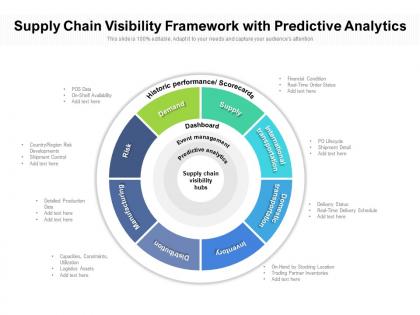
Supply chain visibility framework with predictive analytics




Try Before you Buy Download Free Sample Product
 Impress Your
 Audience
 100%
100% Editable
 Save Hours
 of Time


Our Supply Chain Visibility Framework With Predictive Analytics are topically designed to provide an attractive backdrop to any subject. Use them to look like a presentation pro.
People who downloaded this PowerPoint presentation also viewed the following :
Supply chain visibility framework with predictive analytics with all 2 slides:
Use our Supply Chain Visibility Framework With Predictive Analytics to effectively help you save your valuable time. They are readymade to fit into any presentation structure.

FAQs for Supply chain visibility framework
Honestly, it boils down to three things: real-time tracking, systems that actually work together, and suppliers who don't hide stuff from you. Get sensors, RFID, GPS - whatever keeps you updated on where everything is. Your tech needs to talk to each other (crazy how companies spend millions then can't get basic integration right). Most important though? Your suppliers have to be willing to share their data. Good luck getting anywhere without that transparency. I'd start by figuring out where you're most blind right now and fix those spots first.
So basically you get this live feed of everything happening in your supply chain instead of staring at last week's reports. Track shipments, inventory, supplier stuff - all as it's actually going down. Catches problems before they blow up into major headaches. Honestly feels like having GPS but for your whole operation (and trust me, once you have it you'll wonder how anyone functioned before). The trick is connecting data from everywhere so you're not stuck with these random information bubbles. I'd say pick your worst blind spots first and start there.
Look, tech really is everything for supply chain visibility these days. IoT sensors give you real-time tracking, AI spots problems before they blow up, and platforms automatically grab data from all your suppliers and warehouses. Cloud dashboards keep everyone aligned - way better than the old Excel nightmare we used to deal with. Honestly, those days of constant phone calls and spreadsheet chaos are pretty much over. I'd start by connecting your current systems first, then add the fancy analytics later. You'll spot issues you never even knew existed. Trust me on this one.
Focus on delivery performance first - are shipments actually arriving on time? Then check inventory turns and forecast accuracy. Here's what most people miss: measure how fast you catch supply chain problems. That's huge. Also track whether your team's still making endless calls just to get basic supplier updates (if so, your tools suck). Compare manual work vs. actual analysis time. Honestly, if people are playing phone tag for data, you're not there yet. Set quarterly benchmarks and do solid before/after comparisons to show ROI. Response time during disruptions is another good one to watch.
Ugh, data silos are gonna be your worst nightmare. Everyone's using different tracking systems that don't communicate - it's honestly ridiculous how fragmented everything gets. Your suppliers will have one system, you'll have another, and good luck getting a clear picture of where anything actually is. Real-time info sharing? Forget about it when half the processes are still manual. Getting people to agree on standard reporting is... well, imagine trying to coordinate a group text with 20 people. My advice? Don't try fixing everything at once. Pick your biggest pain points first and focus on connecting those systems. Way less overwhelming that way.
Honestly, when customers can see exactly where their order is, they're way happier. Real-time tracking means they're not constantly wondering "did my package get lost?" You can send them updates when stuff ships or if there's gonna be a delay. People hate being kept in the dark - I know I do! The transparency thing really works because even if something goes wrong, at least they know what's happening. Trust builds from there. Oh, and automated notifications save you from answering a million "where's my order" emails. Start with basic order tracking - you'll see the difference pretty quick.
So right now you've got IoT sensors tracking everything - temperature, location, the works. Real-time data is pretty sweet. Blockchain's supposed to give you that tamper-proof record thing, but honestly adoption's still crawling along. AI and machine learning though? That's where it gets interesting. They'll spot disruptions before they wreck your day and catch patterns you'd totally miss. Oracle and SAP have cloud platforms for this stuff, plus some newer companies making it way more accessible. Oh, and definitely figure out your biggest visibility gaps first - that's like step zero.
Start with blockchain tracking - it's basically tamper-proof. Zero-trust access is huge too. Encrypt data everywhere, obviously. API gateways are clutch because partners get what they need without seeing your whole setup. Most companies mess up by oversharing when selective transparency actually works way better. Role-based permissions are your friend here - vendors only see their piece. Oh, and definitely pilot one program first to test your security before going company-wide. I've seen too many rollouts crash because they skipped that step.
Honestly, real-time supply chain visibility is a game changer for catching issues early. You'll spot delays, quality problems, or sketchy suppliers way before they blow up your whole operation. Think of it like having early warning systems - you can actually react instead of just panicking later. Switch to backup suppliers, reroute stuff, tweak production schedules. Whatever needs fixing. The trick is setting up good dashboards that alert you to the important stuff without overwhelming you with every tiny detail (learned that one the hard way). Makes such a difference when you're not constantly firefighting.
Honestly, working closely with suppliers changes everything. They'll actually share real data instead of leaving you guessing - inventory numbers, production timelines, shipping info flowing straight to you. It's like finally getting read receipts instead of wondering if your messages went through lol. Joint planning meetings help too, plus shared dashboards keep everyone on the same page. I'd start small though - pick your top 3 suppliers and just ask what they can share electronically. You'd be shocked how open most of them are once you actually ask.
Look, most companies go crazy tracking every little thing and totally miss what actually matters. Start with the basics - can you instantly find any order at any moment? That's your foundation right there. Then add supplier delivery rates, how fast your inventory's moving, and response time when stuff goes wrong. Honestly, I'd rather have 3-4 solid metrics I actually use than drowning in reports nobody reads. Focus on what connects to your real business goals. Order visibility is huge though - can't stress that enough.
Honestly, supply chain visibility is a game changer for compliance stuff. You get real-time tracking of everything - products, materials, processes. When auditors show up (and they always do at the worst times), you can instantly pull documentation and trace where everything came from. No more digging through random files or praying your suppliers actually kept records. The best part? You'll catch compliance problems before they turn into actual violations. I'd definitely set up automated alerts for the important checkpoints so nothing sneaks up on you. Makes proving you're following safety standards so much less stressful.
Honestly, AI and machine learning are crushing it right now - they can actually predict when stuff's gonna break before it happens. Real-time tracking isn't even special anymore, customers just expect it. Blockchain's getting pretty solid for tracing products, especially if you're dealing with food or drugs. IoT sensors used to cost a fortune but they're way more affordable now, so you can track temps, locations, whatever. My advice? Don't go crazy trying to do everything. Pick maybe 2-3 things that'll actually fix your worst headaches first.
Honestly, I'd just start by figuring out which suppliers you really need to keep tabs on - like the ones where you're always wondering "where's my order?" Map out those relationships first. Cloud platforms are actually pretty cheap these days, which is nice. Don't go crazy trying to digitize everything at once though. Pick your top 3-5 suppliers and focus there. Even something basic like shared dashboards or automatic email updates makes a massive difference. You'll be surprised how much clearer everything becomes once you can actually see what's happening with inventory and deliveries.
Honestly, cloud tech is probably your best bet here. You get real-time data sharing across everything - no more waiting around for updates or dealing with info stuck in different systems. Track shipments, inventory, supplier stuff, all in one place everyone can see from wherever. Way better than those nightmare email chains and random spreadsheets we used to deal with (ugh). The cool part is it connects with IoT sensors and tracking devices, so updates happen automatically instead of someone manually entering data. I'd start by figuring out where your biggest blind spots are, then find cloud solutions that can actually connect those points.
-
Out of the box and creative design.