

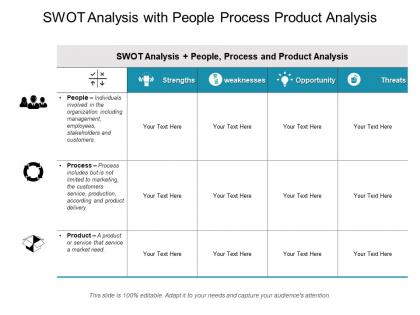
Swot analysis with people process product analysis




Try Before you Buy Download Free Sample Product
 Impress Your
 Audience
 100%
100% Editable
 Save Hours
 of Time


Gain their endorsement with our Swot Analysis With People Process Product Analysis. They will be eager to accredit you.
People who downloaded this PowerPoint presentation also viewed the following :
Swot analysis with people process product analysis with all 5 slides:
Control the board with our Swot Analysis With People Process Product Analysis. They ensure an excellent opening gambit.


FAQs for Swot analysis with people
SWOT analysis comprises four key components: Strengths (internal advantages), Weaknesses (internal limitations), Opportunities (external favorable conditions), and Threats (external challenges). These elements interact strategically, with organizations leveraging strengths to capitalize on opportunities, addressing weaknesses to minimize vulnerability to threats, and using this comprehensive assessment to develop competitive strategies that maximize internal capabilities while navigating external market dynamics.
SWOT analysis enhances strategic planning by systematically evaluating internal strengths and weaknesses alongside external opportunities and threats, enabling data-driven decision making. This framework streamlines resource allocation, identifies competitive advantages, and reveals potential risks across industries, with many organizations finding that regular SWOT assessments ultimately deliver clearer strategic direction and improved market positioning.
Companies can incorporate stakeholder feedback through surveys, interviews, focus groups, advisory panels, and digital feedback platforms to gather diverse perspectives on strengths, weaknesses, opportunities, and threats. This strategic approach enables organizations to identify blind spots, validate internal assessments, and uncover market insights they might otherwise miss, ultimately delivering more comprehensive analyses and stronger competitive positioning in increasingly dynamic business environments.
Organizations can leverage identified strengths by strategically aligning their core competencies, resources, and competitive advantages with emerging market opportunities through targeted expansion, product development, and strategic partnerships. Through this alignment, companies streamline market entry processes, enhance operational efficiency, and accelerate growth initiatives, with many finding that strength-opportunity combinations deliver sustainable competitive advantage and improved market positioning.
Businesses can identify weaknesses through internal audits, employee feedback surveys, performance benchmarking against competitors, customer complaint analysis, and financial ratio assessments. These methods enable organizations to uncover operational inefficiencies, skill gaps, and resource limitations across departments, with many companies finding that systematic weakness identification ultimately delivers improved strategic planning and competitive positioning.
SWOT analysis for startups focuses heavily on potential and market opportunity assessment, while established companies emphasize competitive positioning, market share analysis, and resource optimization. Startups typically identify threats like funding gaps and regulatory hurdles, whereas established companies analyze market disruption and operational inefficiencies, with many finding that strategic focus differs significantly between growth-stage versus stability-focused organizations.
Yes, SWOT analysis significantly aids risk management by systematically identifying internal weaknesses and external threats that could impact business operations, market position, and strategic objectives. Through this structured assessment, organizations can develop targeted mitigation strategies, allocate resources more effectively, and create contingency plans, while leveraging strengths to offset potential vulnerabilities, ultimately delivering proactive risk oversight and enhanced business resilience.
Common mistakes include being too vague with assessments, focusing only on internal factors while neglecting external market conditions, allowing personal biases to cloud objective evaluation, and failing to prioritize findings by strategic importance. Many organizations find that rushing the analysis process, not involving diverse stakeholders, and creating overly lengthy lists without actionable insights ultimately diminishes the framework's strategic value for decision-making.
Businesses should perform a SWOT analysis annually as a baseline, with quarterly reviews during periods of significant change, market shifts, or strategic planning cycles. Many organizations in dynamic sectors like technology, retail, and financial services conduct abbreviated SWOT assessments more frequently, enabling them to adapt strategies quickly, anticipate competitive threats, and capitalize on emerging opportunities in increasingly volatile markets.
Market research enhances SWOT analysis accuracy by providing data-driven insights into competitive positioning, customer preferences, industry trends, and emerging threats rather than relying on internal assumptions. Through comprehensive market research, organizations can identify genuine opportunities in underserved segments, validate perceived strengths against competitor benchmarks, and uncover blind spots, ultimately delivering more strategic decision-making and competitive advantage.
Digital tools enhance SWOT analysis effectiveness by automating data collection, enabling real-time collaboration, and providing advanced analytics for deeper insights. Through cloud-based platforms and AI-powered analysis, organizations streamline stakeholder input gathering, visualize complex data patterns, and generate actionable strategic recommendations, ultimately delivering faster decision-making and more comprehensive competitive assessments.
SWOT analysis helps non-profit organizations identify internal strengths like volunteer networks and donor relationships, weaknesses such as funding limitations, external opportunities including grants and partnerships, and threats like regulatory changes or competing causes. Through strategic assessment, non-profits can optimize resource allocation, enhance program effectiveness, and strengthen community impact, with many organizations finding that regular SWOT evaluations improve sustainability and mission alignment.
Visual presentation templates enhance SWOT analysis communication by organizing complex strategic information into clear, digestible formats that stakeholders can quickly comprehend and act upon. These templates enable leadership teams to present strengths, weaknesses, opportunities, and threats through structured layouts, color coding, and visual hierarchies, ultimately delivering faster decision-making and stronger stakeholder alignment across organizations.
Industry-specific considerations for SWOT analysis include regulatory environments, competitive landscapes, technological requirements, customer expectations, and supply chain dynamics unique to each sector. These factors significantly impact strategic planning, with healthcare organizations focusing on compliance and patient outcomes, financial institutions emphasizing risk management and digital transformation, and retail companies prioritizing customer experience and inventory optimization, ultimately delivering more targeted and actionable strategic insights.
Companies can measure SWOT-derived strategy outcomes through key performance indicators, financial metrics, market share analysis, customer satisfaction scores, and operational efficiency benchmarks. Through regular quarterly assessments, organizations track revenue growth, cost reduction, and competitive positioning improvements, with many finding that balanced scorecards effectively integrate SWOT insights into measurable business results and strategic advantage.
-
Great designs, Easily Editable.
-
Use of icon with content is very relateable, informative and appealing.