

Symmetrical Multiprocessor SMP Architecture Parallel Processor System And Computing Types




Try Before you Buy Download Free Sample Product
 Impress Your
Audience
 100%
Editable
 Save Hours
of Time


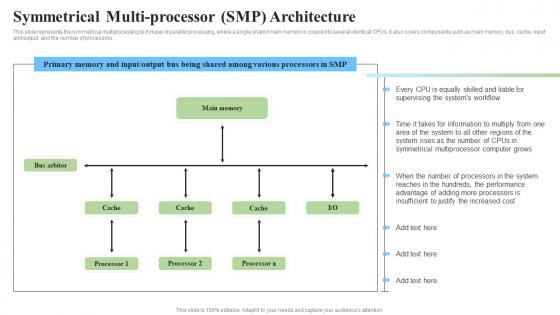
This slide represents the symmetrical multiprocessing technique of parallel processing, where a single shared main memory is coupled to several identical CPUs. It also covers components such as main memory, bus, cache, input and output, and the number of processors.
People who downloaded this PowerPoint presentation also viewed the following :
Symmetrical Multiprocessor SMP Architecture Parallel Processor System And Computing Types with all 6 slides:
Use our Symmetrical Multiprocessor SMP Architecture Parallel Processor System And Computing Types to effectively help you save your valuable time. They are readymade to fit into any presentation structure.






FAQs for Symmetrical Multiprocessor SMP Architecture Parallel Processor System
**INPUT**: What are the key characteristics that define Symmetrical Multiprocessor (SMP) architecture? **OUTPUT**: SMP architecture features multiple identical processors sharing unified memory, equal system resource access, and symmetric processing capabilities across all CPUs. This design enables organizations to streamline computational workloads by distributing tasks evenly, enhancing system reliability, and delivering scalable performance, with many financial institutions and data centers finding significant processing efficiency gains. **Word count: 54 words**
SMP architecture improves system performance by enabling parallel processing across multiple CPUs, distributing computational workloads efficiently, and allowing simultaneous execution of multiple threads or processes. Through shared memory access and coordinated processing power, organizations in data-intensive sectors like financial services, scientific computing, and enterprise applications achieve significantly faster processing speeds, reduced bottlenecks, and enhanced multitasking capabilities, ultimately delivering superior throughput and responsiveness.
Shared memory in SMP architecture serves as a centralized communication hub where all processors access the same physical memory space, enabling seamless data sharing, task coordination, and real-time collaboration between processing units. This architecture streamlines inter-processor communication by eliminating complex message-passing protocols, ultimately delivering faster computational performance and enhanced system scalability, with many enterprises finding significant efficiency gains in data-intensive applications.
SMP systems handle process scheduling through a shared operating system that maintains a common ready queue, distributing processes across available processors using load balancing algorithms, priority-based scheduling, and dynamic processor affinity management. This centralized approach enables efficient resource allocation by allowing all processors to access shared memory, I/O devices, and system resources simultaneously, ultimately delivering improved throughput and system responsiveness for enterprise applications.
SMP architecture offers enhanced performance through parallel processing, improved scalability for demanding applications, better resource utilization, and increased system reliability through redundancy. While implementation complexity and potential bottlenecks present challenges, many organizations find that SMP systems deliver significantly faster computational speeds and seamless multitasking capabilities, ultimately providing competitive advantages in data-intensive environments.
SMP architecture addresses concurrency and synchronization through shared memory spaces, hardware-based locking mechanisms, and atomic operations that coordinate multiple processors accessing common resources simultaneously. These systems enable organizations to streamline parallel processing while maintaining data integrity, with many financial institutions and manufacturing companies finding that proper synchronization delivers enhanced computational performance and operational efficiency.
SMP architecture proves preferable when applications require dynamic load balancing, uniform resource access, and simplified programming models, particularly in enterprise servers, database systems, and high-performance computing environments. Organizations handling unpredictable workloads, complex multithreading applications, and scalable business operations find SMP delivers superior flexibility, enhanced system utilization, and streamlined development processes compared to AMP's rigid processor specialization.
Common real-world applications benefiting from SMP architecture include database management systems, web servers, scientific computing, enterprise resource planning, and virtualization platforms. These systems leverage multiple processors by distributing computational workloads, handling concurrent user requests, and processing large datasets simultaneously, with many financial institutions, healthcare organizations, and e-commerce platforms finding enhanced performance and operational efficiency.
Cache coherence in SMP systems maintains data consistency across multiple processor caches through protocols like MESI and directory-based schemes, ensuring all processors see the same memory values. This synchronization prevents data corruption and race conditions, enabling reliable parallel processing in enterprise servers, database systems, and high-performance computing environments, ultimately delivering consistent application performance and system stability.
SMP architecture faces significant scaling limitations including memory bandwidth bottlenecks, cache coherence overhead, bus contention, synchronization complexities, and diminishing performance returns beyond 8-16 processors. These challenges increasingly impact system efficiency in data centers and high-performance computing environments, with many organizations finding that distributed architectures or NUMA designs deliver better scalability and resource utilization for large-scale operations.
Operating systems optimize SMP performance through intelligent process scheduling, load balancing across multiple CPUs, and efficient memory management with cache coherency protocols. These optimizations enable seamless task distribution, minimize processor idle time, and enhance system throughput, with many enterprise environments finding that proper SMP configuration delivers significantly improved application responsiveness and overall computational efficiency.
Key technological advancements driving SMP evolution include cache coherence protocols, high-speed interconnects, multi-core processors, advanced memory hierarchies, and sophisticated scheduling algorithms. These innovations enable organizations to achieve significantly enhanced parallel processing capabilities, improved system scalability, and reduced computational bottlenecks, with many enterprises finding that modern SMP systems deliver superior performance for data-intensive applications.
SMP architecture uses multiple discrete processors sharing memory and resources, while multi-core integrates multiple processing units on single chips, and many-core designs pack hundreds of specialized cores together. Multi-core delivers better power efficiency and communication speeds for general computing, while many-core excels in parallel workloads, with SMP offering superior scalability for enterprise applications requiring extensive computational resources.
Developers face challenges including race conditions, deadlock prevention, load balancing across processors, memory consistency issues, and synchronization overhead when programming for SMP systems. These complexities require careful thread management and locking strategies, with many software teams finding that proper parallel programming frameworks and debugging tools ultimately streamline development while delivering enhanced application performance.
SMP architecture performance is evaluated using throughput metrics, latency measurements, scalability benchmarks, cache coherency overhead analysis, and load balancing efficiency tests. These assessments help organizations in financial services, scientific computing, and enterprise applications determine processing capabilities, memory bandwidth utilization, and multi-core coordination effectiveness, ultimately delivering optimized resource allocation and enhanced computational performance.
-
Thank you for offering such fantastic custom design services. The team is really helpful and innovative. In a very short time, I received my personalized template.
-
I want to express my gratitude to SlideTeam’s presentation design services team for helping me create the best presentation of my life!