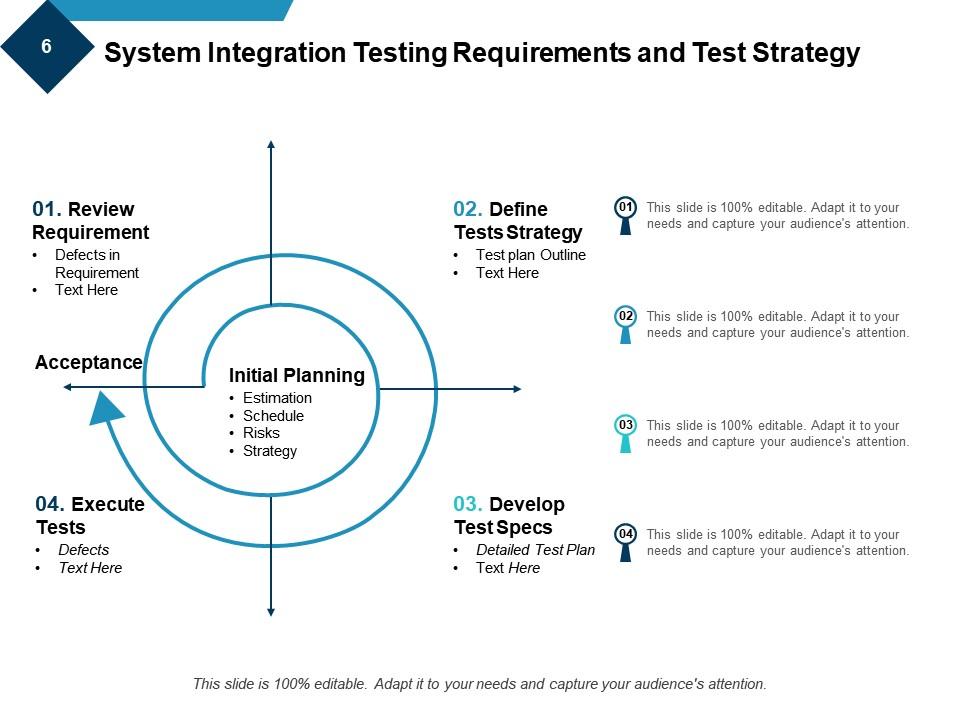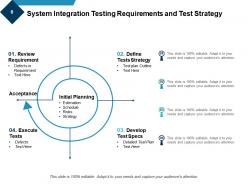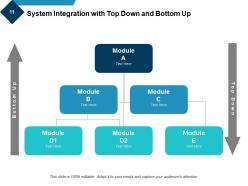
System Integration Test Review Requirement Initial Planning Define Tests Strategy

Rating:
90%
System Integration Test Review Requirement Initial Planning Define Tests Strategy
Slide 1 of 12
Favourites Favourites

Try Before you Buy Download Free Sample Product

Audience Impress Your
Audience
Editable 100%
Editable
Time Save Hours
of Time
The Biggest Sale is ending soon in
0
0
:
0
0
:
0
0
AI-Ready
Upload this template to AI and ask it to make any changes to content or color
100% editable Powerpoint Template for AI-assisted presentations. Finish your work in less time. Download Prompt Kit ​
Works with
Microsoft PowerPoint
Microsoft 365
Claude for PowerPoint
ChatGPT
Google Slides
Microsoft Copilot
Rating:
90%
Enhance your audiences knowledge with this well researched complete deck. Showcase all the important features of the deck with perfect visuals. This deck comprises of total of twelve slides with each slide explained in detail. Each template comprises of professional diagrams and layouts. Our professional PowerPoint experts have also included icons, graphs and charts for your convenience. All you have to do is DOWNLOAD the deck. Make changes as per the requirement. Yes, these PPT slides are completely customizable. Edit the colour, text and font size. Add or delete the content from the slide. And leave your audience awestruck with the professionally designed System Integration Test Review Requirement Initial Planning Define Tests Strategy complete deck.

People who downloaded this PowerPoint presentation also viewed the following :

FAQs for System Integration Test Review Requirement Initial Planning

The primary purpose of System Integration Test (SIT) is to verify that different software modules, components, and external systems work together seamlessly as a unified whole, identifying interface defects and data flow issues between integrated parts. Through comprehensive testing scenarios, organizations ensure system reliability, minimize post-deployment failures, and deliver robust applications that meet business requirements while reducing costly fixes later.

SIT differs from unit testing and user acceptance testing by focusing on interface validation between integrated modules, while unit testing examines individual components in isolation and UAT verifies business requirements from end-user perspectives. This middle-layer approach enables organizations to identify integration conflicts, data flow issues, and communication breakdowns between systems before user validation, ultimately streamlining deployment processes.

Key components of successful SIT include test environment setup, data management, interface validation, end-to-end scenario testing, and defect tracking systems. These components work together by ensuring realistic test conditions, validating data flow between modules, and identifying integration failures early, with many organizations finding that comprehensive SIT significantly reduces post-deployment issues and accelerates delivery timelines.

Organizations can effectively plan for SIT phases by establishing clear test objectives, defining comprehensive integration scenarios, allocating sufficient resources, and creating detailed test schedules with realistic timelines. Through systematic coordination between development teams, rigorous environment preparation, and proactive risk management strategies, companies streamline their integration processes, minimize costly delays, and ultimately deliver more reliable software solutions.

Common SIT challenges include interface mismatches, data inconsistency, timing issues, environment configuration problems, and integration point failures. These obstacles can be mitigated through comprehensive interface documentation, standardized data formats, automated testing frameworks, and phased integration approaches, with many organizations finding that early stakeholder collaboration and robust test environment management ultimately streamline system integration and reduce deployment risks.

Determining SIT scope involves analyzing system architecture, identifying critical integration points, assessing data flow between modules, and evaluating external system dependencies. Organizations typically prioritize high-risk interfaces, customer-facing functionality, and core business processes, with many finding that focusing on end-to-end scenarios delivers comprehensive coverage while optimizing testing resources.

Automation tools enhance SIT efficiency by accelerating test execution, reducing manual effort, and enabling comprehensive regression testing across integrated systems. These tools streamline data validation, interface testing, and end-to-end workflow verification, with many organizations finding that automated SIT delivers faster release cycles, improved test coverage, and significantly lower operational costs.

System Integration Testing success metrics include defect detection rate, test coverage percentage, interface fault identification, data flow accuracy, and end-to-end transaction completion rates. These measurements enable organizations to assess integration quality, minimize post-deployment issues, and ensure seamless system interoperability, with many enterprises finding that comprehensive metric tracking ultimately delivers faster releases and enhanced operational reliability.

Data integrity and security during SIT are ensured through encrypted test environments, anonymized or synthetic datasets, role-based access controls, and comprehensive audit trails. These measures enable thorough testing while protecting sensitive information, with many organizations finding that implementing data masking techniques, secure API connections, and validation checkpoints ultimately delivers both compliance confidence and operational security without compromising testing effectiveness.

Test cases serve as the foundation of SIT by defining specific scenarios that validate data flow, interface functionality, error handling, and end-to-end business processes across integrated systems. These should be designed to mirror real-world workflows from sectors like banking transactions or healthcare records management, with many organizations finding that comprehensive test cases covering both positive and negative scenarios ultimately deliver faster deployment timelines and reduced post-integration defects.

Effective cross-functional team involvement in SIT requires establishing clear communication protocols, defining specific role responsibilities, and implementing collaborative testing frameworks that enable seamless coordination between development, QA, and operations teams. Through regular sprint reviews and integrated testing environments, organizations streamline validation processes, minimize deployment risks, and accelerate delivery timelines, with many enterprises finding that structured cross-team collaboration ultimately delivers enhanced system reliability and operational efficiency.

Environment setup in System Integration Testing is crucial because it ensures realistic testing conditions that mirror production systems, enabling accurate identification of integration issues, performance bottlenecks, and compatibility problems. A well-configured test environment streamlines validation processes, reduces deployment risks, and accelerates delivery timelines, with many organizations finding that proper environment management ultimately delivers higher software quality and significantly lower post-production defect rates.

**INPUT**: What techniques can be implemented to handle dependencies between integrated systems? **OUTPUT**: Dependency management techniques include service virtualization, contract testing, mock services, staged rollouts, and circuit breaker patterns. These approaches streamline integration by isolating system interactions, enabling parallel development, and maintaining operational continuity, with many organizations finding that strategic dependency mapping ultimately delivers faster deployment cycles and enhanced system reliability.

Continuous integration practices streamline the SIT lifecycle by automating test execution, enabling faster feedback loops, and reducing integration conflicts through frequent code merges. This approach allows development teams to detect issues earlier, minimize manual testing overhead, and accelerate deployment cycles, with many organizations finding that automated SIT processes ultimately deliver improved software quality and faster time-to-market.

Documenting SIT results and lessons learned ensures comprehensive knowledge transfer, enables future project optimization, and creates institutional memory for troubleshooting recurring issues. This systematic approach streamlines subsequent integration efforts by providing teams with proven solutions, common pitfall identification, and best practice frameworks, ultimately reducing project timelines and enhancing overall system reliability across organizational initiatives.

Ratings and Reviews

90% of 100
Review Form
Write a review
Most Relevant Reviews
  1. 100%

    by Chet Cox

    Commendable slides with attractive designs. Extremely pleased with the fact that they are easy to modify. Great work!
  2. 80%

    by Dong Santos

    Qualitative and comprehensive slides.

2 Item(s)

per page: