

T Shirt Printing Business SWOT Analysis To Evaluate Custom Apparel Printing Business Plan BP SS





Try Before you Buy Download Free Sample Product
 Impress Your
Audience
 100%
Editable
 Save Hours
of Time


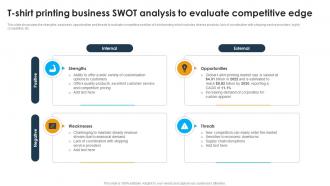
This slide showcases the strengths, weakness, opportunities and threats to evaluate competitive position of t-shirt printing which includes diverse products, lack of coordination with shipping service providers, highly competitive, etc.
People who downloaded this PowerPoint presentation also viewed the following :
T Shirt Printing Business SWOT Analysis To Evaluate Custom Apparel Printing Business Plan BP SS with all 9 slides:
Use our T Shirt Printing Business SWOT Analysis To Evaluate Custom Apparel Printing Business Plan BP SS to effectively help you save your valuable time. They are readymade to fit into any presentation structure.








FAQs for T Shirt Printing Business SWOT Analysis To Evaluate Custom Apparel Printing Business
Key strengths include advanced printing technology, custom design capabilities, rapid turnaround times, diverse product offerings, and strong supplier relationships. These advantages enable businesses to deliver personalized solutions, minimize production costs, and enhance customer satisfaction, with many printing companies finding that strategic combinations of digital and screen printing ultimately streamline operations while maintaining competitive pricing in an increasingly demanding marketplace.
High-quality materials significantly enhance customer satisfaction through improved durability, comfort, and print longevity, while poor materials lead to shrinkage, fading, and negative reviews that damage brand reputation. Companies using premium cotton blends and eco-friendly inks build stronger customer loyalty and command higher prices, ultimately delivering competitive advantage in an increasingly quality-conscious market.
New T-shirt printing businesses face potential weaknesses including high initial equipment costs, intense market competition, seasonal demand fluctuations, quality control challenges, and limited brand recognition. These vulnerabilities can impact cash flow and market penetration, with many startups finding that strategic planning, diversified product offerings, and strong supplier relationships help mitigate risks while building sustainable competitive advantage.
T-shirt printing businesses can leverage USPs like custom design capabilities, quick turnaround times, premium materials, competitive pricing, and personalized customer service to build loyalty. By consistently delivering on these differentiators, companies attract repeat customers through quality craftsmanship and reliability, while targeted marketing of unique offerings helps establish strong brand recognition and customer retention in an increasingly competitive apparel market.
Market saturation significantly limits growth potential by intensifying competition, reducing profit margins, and making customer acquisition more expensive and challenging. However, businesses can navigate saturated markets by specializing in niche segments like eco-friendly materials or corporate branding, leveraging innovative printing technologies, and focusing on superior customer service, with many successful companies finding that differentiation and operational efficiency ultimately deliver sustainable competitive advantages.
External threats to T-shirt printing businesses include economic downturns reducing discretional spending, fast fashion competition, supply chain disruptions affecting materials, and shifting consumer preferences toward sustainable alternatives. These challenges, while significant, present strategic opportunities for businesses to diversify offerings, enhance digital marketing capabilities, and develop eco-friendly printing solutions, ultimately delivering competitive differentiation in an increasingly crowded marketplace.
Direct-to-garment printing creates opportunities through faster production cycles, enhanced customization capabilities, reduced minimum order quantities, and improved color accuracy for complex designs. This technology enables T-shirt businesses to offer on-demand printing services, personalized merchandise for events and corporations, and rapid prototyping capabilities, ultimately delivering competitive advantages in an increasingly personalized retail landscape.
Social media serves as the primary marketing channel for T-shirt printing businesses, enabling direct customer engagement, showcasing design portfolios, and building brand communities through platforms like Instagram, Facebook, and TikTok. These platforms streamline customer acquisition by facilitating viral marketing campaigns, influencer partnerships, and user-generated content, with many printing businesses finding that social engagement translates directly into sales conversions and repeat customers.
Collaborations with local artists or influencers enhance T-shirt printing brand visibility by expanding audience reach, creating authentic content, and leveraging established follower bases for organic marketing. These strategic partnerships enable brands to access new customer segments, generate buzz through limited-edition designs, and build community credibility, ultimately delivering increased brand awareness and sales growth.
Effective inventory management strategies include demand forecasting through sales analytics, just-in-time ordering for blank apparel, maintaining optimal stock levels of popular sizes and colors, implementing inventory tracking systems, and establishing supplier relationships for quick restocking. These approaches streamline operations by reducing carrying costs, minimizing overstock waste, and ensuring product availability, with many printing businesses finding that strategic inventory planning ultimately delivers improved cash flow and higher profit margins.
Customer feedback reveals operational strengths like design quality, delivery speed, and service excellence, while exposing weaknesses in print durability, sizing accuracy, or communication gaps. Through systematic review analysis and satisfaction surveys, T-shirt printing businesses can enhance production processes, streamline customer interactions, and refine product offerings, ultimately delivering improved quality and competitive advantage in an increasingly personalized apparel market.
T-shirt printing businesses must navigate copyright infringement, trademark violations, licensing requirements, fair use limitations, and intellectual property clearances before reproducing any designs or logos. These legal considerations significantly impact operations across retail, custom printing, and e-commerce sectors, with many businesses finding that proactive legal compliance ultimately delivers reduced liability risks, enhanced customer trust, and sustainable competitive advantage in an increasingly regulated marketplace.
Sustainability has become increasingly critical in T-shirt printing, with consumers prioritizing eco-friendly brands and driving demand for environmentally responsible practices. Businesses can adopt water-based inks, organic cotton sourcing, energy-efficient printing technologies, and waste reduction programs, with many companies finding that sustainable practices enhance brand reputation, reduce operational costs, and deliver competitive advantage in an increasingly environmentally conscious marketplace.
Demographic trends influencing the T-shirt printing market include Gen Z's preference for personalized apparel, millennials driving custom corporate merchandise demand, aging baby boomers seeking nostalgic designs, and diverse cultural communities wanting culturally-specific graphics. Businesses should adapt by offering eco-friendly printing options, developing mobile-first design platforms, expanding size ranges, and creating targeted marketing campaigns, ultimately delivering personalized experiences while capturing broader market segments.
Seasonal trends and events can be harnessed through strategic calendar planning, creating themed designs for holidays, sports seasons, graduations, and local festivals, while leveraging social media campaigns and pre-order strategies. Many t-shirt printing businesses find success by partnering with schools for homecoming events, developing summer vacation collections, and capitalizing on back-to-school periods, ultimately delivering increased revenue streams and enhanced customer engagement throughout the year.
-
Excellent products for quick understanding.
-
The best collection of PPT templates!! Totally worth the money.