


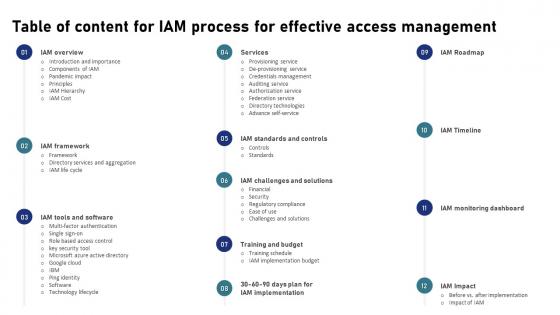
Table Of Content For IAM Process For Effective Access Management




Try Before you Buy Download Free Sample Product
 Impress Your
Audience
 100%
Editable
 Save Hours
of Time


Our Table Of Content For IAM Process For Effective Access Management are topically designed to provide an attractive backdrop to any subject. Use them to look like a presentation pro.
People who downloaded this PowerPoint presentation also viewed the following :
Table Of Content For IAM Process For Effective Access Management with all 9 slides:
Use our Table Of Content For IAM Process For Effective Access Management to effectively help you save your valuable time. They are readymade to fit into any presentation structure.









FAQs for Table Of Content For IAM Process For
Essential IAM process components include user provisioning and deprovisioning, role-based access controls, multi-factor authentication, regular access reviews, and automated compliance monitoring. These technologies streamline security operations by centralizing identity management, reducing unauthorized access risks, and ensuring regulatory compliance, with many organizations finding that strategic IAM implementation ultimately delivers enhanced operational efficiency and significantly improved security posture.
IAM processes enhance organizational security and compliance by centralizing access controls, enforcing role-based permissions, maintaining detailed audit trails, and automating user provisioning and deprovisioning across systems. These streamlined frameworks enable organizations to meet regulatory requirements like SOX and GDPR while reducing security risks, with many financial services and healthcare institutions finding that comprehensive IAM delivers both operational efficiency and regulatory peace of mind.
Multi-factor authentication serves as a critical security layer within IAM frameworks, requiring users to verify identity through multiple credentials like passwords, biometrics, mobile tokens, and smart cards. This approach significantly reduces unauthorized access risks while enabling organizations in banking, healthcare, and corporate environments to meet compliance requirements, ultimately delivering enhanced security posture and user confidence across increasingly complex digital infrastructures.
Organizations can assess their IAM maturity by evaluating access governance frameworks, authentication mechanisms, provisioning processes, compliance reporting capabilities, and risk management integration across their infrastructure. Through comprehensive audits and maturity assessment tools, companies systematically identify gaps in user lifecycle management, privilege escalation controls, and automated workflows, ultimately establishing baseline measurements that guide strategic IAM modernization initiatives and enhance security posture.
Common IAM implementation challenges include integration complexity with legacy systems, user resistance to new authentication processes, inadequate role definition and access governance, budget constraints, and compliance alignment across multiple regulations. Organizations often struggle with balancing security requirements and user experience, while ensuring seamless migration from existing systems, ultimately requiring strategic planning and phased deployment approaches for successful adoption.
IAM significantly enhances user experience and productivity by enabling single sign-on capabilities, automated user provisioning, and streamlined access requests across organizational systems. Through centralized identity management, employees access necessary applications seamlessly without multiple authentication steps, while IT teams reduce manual provisioning tasks, ultimately delivering faster onboarding and improved operational efficiency.
Cloud identity management best practices include implementing zero-trust architecture, enforcing multi-factor authentication, utilizing single sign-on solutions, establishing role-based access controls, and conducting regular access reviews. These approaches enhance security by minimizing credential vulnerabilities, streamlining user experiences, and ensuring compliance, with many financial services and healthcare organizations finding that automated provisioning ultimately delivers operational efficiency and reduced administrative overhead.
Automation streamlines IAM workflows by automatically provisioning user accounts, managing access requests, and enforcing compliance policies, significantly reducing manual administrative tasks. Through automated systems, organizations can accelerate employee onboarding, minimize security risks from delayed access updates, and ensure consistent policy enforcement, with many enterprises finding that automation delivers faster service delivery and enhanced operational efficiency.
Organizations should track metrics including user provisioning time, access request fulfillment speed, password reset frequency, compliance audit results, and security incident response times. Through these measurements, financial services firms and healthcare institutions enhance operational efficiency, reduce administrative overhead, and strengthen security postures, while ultimately delivering faster user experiences and maintaining regulatory compliance in increasingly complex digital environments.
RBAC streamlines identity management by assigning permissions through predefined roles rather than individual user accounts, reducing administrative overhead and enhancing security consistency. This approach enables organizations like hospitals and financial institutions to efficiently manage thousands of users while maintaining compliance, ultimately delivering faster user provisioning, reduced access errors, and stronger audit capabilities.
IAM processes adapt to emerging technologies by integrating intelligent automation, behavioral analytics, and dynamic risk assessment capabilities that enhance traditional access controls. Through AI-powered authentication, machine learning-based anomaly detection, and predictive access management, organizations streamline security operations, reduce manual oversight, and proactively identify threats, ultimately delivering faster incident response and more sophisticated protection.
Organizations must navigate data privacy regulations like GDPR and CCPA, industry-specific compliance requirements such as HIPAA and SOX, and cross-border data transfer laws when implementing IAM systems. These regulatory frameworks require robust audit trails, data encryption, and user consent mechanisms, with many financial services and healthcare institutions finding that proactive compliance strategies ultimately deliver competitive advantage and reduced regulatory risk.
Organizations integrate IAM with existing security frameworks through API-based connections, single sign-on protocols, centralized policy management, and automated provisioning workflows. This strategic combination enables seamless authentication across multiple systems, enhances compliance monitoring, and streamlines access controls, with many enterprises finding that integrated IAM delivers improved security posture while reducing operational complexity.
Critical IAM training programs include role-based access principles, password management best practices, multi-factor authentication procedures, incident reporting protocols, and compliance requirements awareness. These educational initiatives enhance security posture by reducing human error, improving threat detection capabilities, and ensuring consistent policy adherence, with many organizations finding that comprehensive user education significantly minimizes security breaches while streamlining access management processes.
IAM processes align with business objectives by integrating security requirements with operational goals, automating compliance workflows, and enabling scalable access governance frameworks. Through strategic identity management, organizations streamline user provisioning, reduce administrative overhead, and enhance regulatory compliance, while delivering faster employee onboarding and improved customer experiences, ultimately creating competitive advantage in increasingly regulated business environments.
-
Very well designed and informative templates.
-
Wow! The design and quality of templates on SlideTeam are simply the best.