

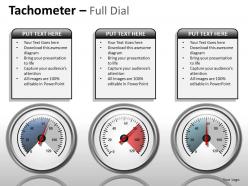
Tachometer full dial ppt 7





Try Before you Buy Download Free Sample Product
 Impress Your
Audience
 100%
Editable
 Save Hours
of Time


Our Tachometer Full Dial ppt 7 provide the links in your chain of thought. Once intertwined they enhance the strength of your words.
People who downloaded this PowerPoint presentation also viewed the following :
Tachometer full dial ppt 7 with all 5 slides:
Our Tachometer Full Dial ppt 7 are a handy tool. Drill your thoughts in to the heads of your team.


FAQs for Tachometer full
Tachometers primarily measure engine RPM, monitor engine performance, prevent over-revving damage, optimize fuel efficiency, and assist in proper gear shifting timing. These instruments enhance vehicle operation by enabling drivers to maintain optimal engine speeds, reduce mechanical stress, and improve overall performance, with automotive enthusiasts and commercial fleet operators finding them essential for maximizing engine longevity and operational efficiency.
Digital tachometers offer superior readability through clear numerical displays and enhanced precision with exact RPM measurements, while analog tachometers provide quick visual reference through needle positioning but with less precise readings. Many automotive and industrial applications increasingly favor digital versions for their accuracy in engine diagnostics and machinery monitoring, ultimately delivering better maintenance scheduling and operational efficiency.
Common automotive tachometers include analog dial gauges, digital display units, contact-type mechanical sensors, non-contact optical sensors, and integrated dashboard systems. These instruments enhance engine performance monitoring by providing real-time RPM feedback, enabling precise shift timing, and preventing over-revving damage, with many automotive manufacturers finding that accurate tachometer integration ultimately delivers improved fuel efficiency and extended engine life.
Tachometers contribute to engine performance by enabling precise RPM monitoring, optimal shift timing, and early detection of mechanical issues. Through real-time feedback, operators in automotive, marine, and industrial applications can maintain engines within peak efficiency ranges, prevent over-revving damage, and reduce fuel consumption, ultimately delivering enhanced performance and extended equipment lifespan.
Tachometers typically use RPM (revolutions per minute), RPS (revolutions per second), Hz (hertz), and angular velocity measurements like radians per second, with specialized applications requiring surface speed measurements in feet or meters per minute. These varied units enable precise monitoring across diverse sectors, with automotive industries relying on RPM for engine optimization, manufacturing facilities using Hz for equipment synchronization, and laboratories leveraging RPS for centrifuge operations, ultimately delivering enhanced operational control and performance optimization.
Tachometers aid engine diagnosis by revealing irregular RPM patterns, inconsistent idle speeds, and unexpected fluctuations that indicate potential issues like ignition problems, fuel delivery malfunctions, or mechanical wear. Through real-time RPM monitoring, automotive technicians and fleet managers can identify performance anomalies early, prevent costly breakdowns, and optimize maintenance schedules, ultimately delivering improved vehicle reliability and reduced operational costs.
A tachometer enables drivers and tuners to monitor engine RPM for optimal performance, preventing over-revving, and identifying ideal shift points during races. In motorsports applications, teams use tachometer data to calibrate engine timing, analyze performance patterns, and maximize power delivery across different racing conditions, ultimately delivering competitive advantages and protecting valuable engine components.
Vehicle design variations significantly impact tachometer placement through dashboard layouts, instrument cluster configurations, and ergonomic considerations for driver visibility and accessibility. Different engine types, transmission systems, and RPM ranges require specific calibration adjustments, with automotive manufacturers finding that strategic tachometer positioning enhances driver experience while ensuring accurate performance monitoring across diverse vehicle platforms.
Smartphone applications replicate traditional tachometer functions through built-in accelerometers, gyroscopes, camera-based RPM detection, audio frequency analysis, and Bluetooth connectivity to vehicle systems. These technologies streamline engine monitoring by providing real-time data visualization, diagnostic alerts, and performance tracking, with automotive technicians and racing enthusiasts finding that mobile solutions deliver enhanced accessibility and cost-effective maintenance capabilities.
Driving without a functioning tachometer can lead to engine over-revving, potential transmission damage, reduced fuel efficiency, and difficulty detecting engine problems early. While experienced drivers may rely on sound and feel, this presents challenges during highway merging, steep climbs, and performance driving, with many mechanics finding that early engine stress detection prevents costly repairs and maintains vehicle longevity.
Tachometers integrate with vehicle instrumentation through the engine control unit (ECU), which coordinates data sharing between speedometers, fuel gauges, temperature sensors, and diagnostic systems via CAN bus networks. This strategic combination enables comprehensive engine monitoring, streamlined maintenance scheduling, and enhanced driver awareness, with modern automotive manufacturers finding that integrated dashboard systems ultimately deliver improved vehicle performance and reduced operational costs.
Digital displays, wireless connectivity, GPS integration, smartphone compatibility, and advanced sensor technology have revolutionized modern tachometer design and functionality. These advancements enable real-time data transmission, cloud-based analytics, and seamless integration with fleet management systems, with automotive and industrial sectors finding enhanced operational efficiency and predictive maintenance capabilities.
Tachometer accuracy and reliability are governed by ISO 3046 for engine testing, ASTM standards for automotive applications, IEC 61010 for electrical safety, and SAE specifications for performance metrics. These standards ensure consistent calibration protocols, measurement tolerances, and operational safety across industries like automotive manufacturing, aerospace testing, and marine applications, ultimately delivering reliable performance data and regulatory compliance for critical speed-monitoring systems.
Tachometers convert rotational speed into electrical signals through magnetic induction, optical sensing, Hall effect sensors, or pulse generation mechanisms that produce voltage proportional to RPM. These systems utilize rotating magnets, light interruption patterns, or magnetic field changes to generate measurable electrical outputs, enabling precise speed monitoring in automotive, industrial, and aerospace applications for optimal performance control.
Creative tachometer data visualization includes gauge charts, speedometer displays, color-coded heat maps, comparative dashboards, and animated trend lines. These presentation formats enhance audience understanding by transforming complex RPM measurements into intuitive visual stories, with many automotive, manufacturing, and aerospace organizations finding that interactive dashboards and real-time gauge displays significantly improve stakeholder engagement and operational decision-making processes.
-
Commendable slides with attractive designs. Extremely pleased with the fact that they are easy to modify. Great work!
-
Excellent Designs.