Talent Assessment Dashboard With Turnover Rate
Try Before you Buy Download Free Sample Product
Audience
Editable
of Time
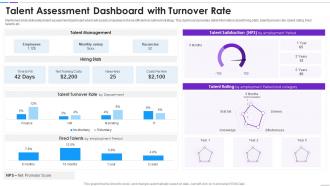
Mentioned slide delineates talent assessment dashboard which will assist companies to frame efficient recruitment strategy. This dashboard provides detail information about hiring stats, talent turnover rate, talent rating, fired talents etc.
People who downloaded this PowerPoint presentation also viewed the following :
Talent Assessment Dashboard With Turnover Rate with all 7 slides:
Use our Talent Assessment Dashboard With Turnover Rate to effectively help you save your valuable time. They are readymade to fit into any presentation structure.
FAQs for Talent Assessment Dashboard
Effective talent assessment dashboards include performance metrics visualization, skill gap analysis tools, competency mapping frameworks, succession planning indicators, and real-time feedback integration. These components streamline HR decision-making by centralizing candidate evaluations, tracking employee development progress, and identifying high-potential talent, with many organizations finding that comprehensive dashboards ultimately enhance recruitment efficiency and strategic workforce planning.
Organizations ensure validity and reliability through rigorous data collection protocols, regular calibration of assessment tools, and implementing multiple validation checkpoints across the evaluation process. These measures include standardizing assessment criteria, conducting inter-rater reliability testing, and integrating feedback loops, with many companies finding that combining automated analytics with human oversight ultimately delivers more accurate talent insights and strategic hiring decisions.
Key metrics for talent assessment dashboards include goal achievement rates, skill development progress, 360-degree feedback scores, productivity indicators, and engagement levels. These comprehensive measurements enable organizations to track performance holistically across departments like sales, operations, and customer service, while identifying high performers and development opportunities, ultimately delivering improved retention rates and strategic workforce planning capabilities.
Data visualization enhances talent assessment dashboards by transforming complex performance metrics, skill gaps, competency ratings, and career progression data into intuitive charts, heat maps, and interactive displays. These visual elements enable HR leaders and managers to quickly identify top performers, spot talent trends across departments, and make strategic workforce decisions, ultimately streamlining recruitment processes and enhancing employee development initiatives.
A talent assessment dashboard supports diversity and inclusion initiatives by providing data-driven insights into hiring patterns, identifying unconscious bias in recruitment processes, and tracking representation metrics across departments, roles, and leadership levels. Through standardized assessment criteria and demographic analytics, organizations can ensure equitable evaluation practices, monitor progress toward diversity goals, and make strategic adjustments to talent acquisition strategies, ultimately creating more inclusive workplaces while enhancing organizational performance and innovation.
Real-time data enhances talent assessment dashboards by providing immediate insights into candidate performance, enabling faster decision-making, and ensuring assessments reflect current capabilities rather than outdated information. This immediacy allows HR teams to streamline recruitment processes, reduce time-to-hire, and make more informed talent decisions, with many organizations finding that real-time analytics significantly improves their competitive advantage in securing top talent.
Talent assessment dashboards can be tailored by customizing metrics, visualizations, and data granularity to match each organizational level's decision-making needs and strategic focus areas. Executive dashboards emphasize high-level talent pipeline health, succession planning, and workforce analytics, while operational dashboards focus on individual performance metrics, skill gap identification, and team-specific development tracking, ultimately enabling targeted talent strategies across all organizational tiers.
Effective talent assessment dashboards should feature intuitive navigation, customizable views, real-time data visualization, mobile responsiveness, and role-based access controls. These design elements streamline HR workflows by enabling quick candidate comparisons, automated scoring displays, and collaborative evaluation features, with many organizations finding that well-designed interfaces reduce assessment time significantly while improving hiring decision accuracy.
Talent assessment dashboards should be updated continuously for real-time metrics like performance scores and quarterly for comprehensive evaluations, with annual updates for strategic planning cycles. This balanced approach ensures managers access current insights for daily decisions while maintaining data integrity, with many organizations finding that monthly refreshes for key talent indicators deliver optimal visibility without overwhelming HR teams with constant updates.
**INPUT**: What technological tools and platforms are best suited for creating an interactive talent assessment dashboard? **OUTPUT**: Leading platforms for interactive talent assessment dashboards include Tableau, Power BI, Qlik Sense, D3.js, and specialized HR analytics tools like Workday Analytics. These technologies streamline talent evaluation by enabling real-time data visualization, predictive analytics capabilities, and seamless integration with existing HRIS systems, with many organizations finding that interactive dashboards significantly enhance recruitment efficiency and strategic workforce planning decisions.
Talent assessment dashboards influence employee development by identifying skill gaps, tracking performance metrics, and personalizing learning pathways through comprehensive data analytics and visualization tools. These platforms enable HR teams and managers to design targeted training programs, allocate resources more strategically, and measure development ROI, ultimately delivering faster skill acquisition and enhanced career progression across organizations.
Organizations typically face challenges including data integration complexities, employee resistance to assessment processes, ensuring measurement accuracy, managing privacy concerns, and achieving stakeholder buy-in across departments. While these implementation hurdles require careful planning, many companies find that addressing data quality and change management upfront ultimately delivers enhanced hiring decisions and streamlined talent evaluation processes.
Feedback loops integrate into talent assessment dashboards through automated performance tracking, continuous competency evaluations, and real-time goal alignment monitoring, creating dynamic measurement systems that capture evolving skills and capabilities. These mechanisms enable organizations to track development trajectories, identify improvement patterns, and adjust training investments strategically, with many companies finding that integrated feedback loops deliver enhanced employee engagement and more accurate talent pipeline forecasting.
**INPUT**: What ethical considerations should be taken into account when developing talent assessment metrics? **OUTPUT**: Ethical talent assessment considerations include bias elimination, data privacy protection, transparency in evaluation criteria, fairness across diverse demographics, and consent for information collection. These principles enable organizations to build trust while delivering accurate evaluations, with many companies finding that ethical frameworks ultimately enhance employee engagement, reduce legal risks, and create more inclusive workplace cultures that attract top talent. [Word count: 60 words]
A talent assessment dashboard facilitates better recruitment strategies by centralizing candidate data, automating screening processes, providing real-time analytics, and enabling collaborative hiring decisions across teams. Through integrated assessments and predictive analytics, organizations streamline their talent acquisition workflows, reduce time-to-hire significantly, and improve candidate quality matching, ultimately delivering more strategic hiring outcomes and competitive talent advantage.
-
“Immediate response, professional support, and effective solutions that were customized and immediately provided. Well done- Thank you!”
-
Excellent template with unique design.