

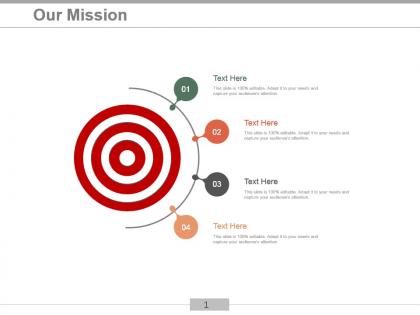
Target surrounded by 4 points showing our mission ppt slides




Try Before you Buy Download Free Sample Product
 Impress Your
 Audience
 100%
100% Editable
 Save Hours
 of Time


Convince folks of your intentions to always deliver with our Target Surrounded By 4 Points Showing Our Mission Ppt Slides. Be able to continue on the job.
People who downloaded this PowerPoint presentation also viewed the following :
Target surrounded by 4 points showing our mission ppt slides with all 5 slides:
Establish a firm grip on the growth of inflation with our Target Surrounded By 4 Points Showing Our Mission Ppt Slides. Curb any adverse influences.
FAQs for Target surrounded by 4 points showing our
Your mission statement is basically your company's "why" - what you exist for beyond just making profit. When tough decisions come up (and trust me, they will), it keeps everyone rowing in the same direction. Customers and employees both want to know what you stand for. The good ones are specific enough to actually mean something but won't box you in as you grow. Honestly, if yours sounds like generic business-speak that any company could slap on their website, scrap it and start over.
Your mission statement is like your company's GPS - everyone knows which direction they're heading. It helps people make the right calls even when you're not there breathing down their necks. Plus you'll attract employees who actually give a damn about the work, which honestly changes everything. I've seen too many companies with boring, generic mission statements that nobody remembers. Don't do that. Make yours something people can actually relate to and quote without rolling their eyes. It should guide your hiring, priorities, all that stuff.
So you need three things in your mission statement: what you do, who you're helping, and why anyone should care. Most companies totally bomb this - they either sound like they swallowed a business textbook or they're so vague you can't tell if they sell donuts or run a hospital. Just be specific about your actual work and who benefits from it. I'd test it on someone who doesn't know your company at all. If they get confused after reading it once, you've probably made it too complicated or fancy.
Look, most companies write their mission once and never touch it again - huge mistake. You'll want to revisit yours every 3-5 years, or when big shifts happen. Like pivoting your business model, jumping into new markets, that kind of thing. Don't go crazy though and change it every few months just because you added some new feature or whatever. The real test? Ask if your current statement actually captures what you do and why you exist. If your team reads it and goes "meh" or it feels totally outdated, time for a refresh.
Honestly, skip the generic fluff like "providing excellent service" - that tells people absolutely nothing. You want something specific to what you actually do, not some corporate word salad that could describe any company. Keep it short too. If your team can't remember it, it's useless. I'd test it with a few people first - sometimes what sounds great in your head makes zero sense to everyone else. The goal is authentic, not impressive. Don't write something that sounds nothing like how your organization actually operates day-to-day. That disconnect is so obvious and kinda cringey.
Okay so mission is what you're doing *right now* - like your current purpose and daily "why." Vision? That's where you want to end up someday. Mission statements are way more concrete and actionable (honestly they're just more useful for actual decisions). Your vision statement is the inspirational, future-focused stuff. When you're writing them, ask "what do we do today?" for mission and "what do we dream of becoming?" for vision. Oh and start with mission first - it's so much easier to figure out than the whole visionary thing.
Oh totally! When customers actually vibe with your company's values, they'll stick with you instead of jumping to competitors. It's wild how that connection works - like you're on the same team or something. Mission statements become this differentiator that goes way beyond just price or features. But here's the thing - you absolutely have to walk the walk. Can't just slap some inspiring words on your website and call it a day. Customers aren't stupid. They'll spot fake authenticity from a mile away and it'll totally blow up in your face.
Put that mission statement everywhere - offices, onboarding packets, team meetings. Don't just slap it on a wall and call it done (honestly, that's where most companies mess up). Your managers should be connecting daily tasks back to the mission during reviews and check-ins. Leadership has to actually live it though - employees smell BS from a mile away. If execs aren't walking the walk, nobody else will either. I'd start by looking at where it shows up now and figure out what's missing. Make it part of how decisions get made, not just wall decoration.
Definitely get your employees involved - biggest mistake companies make is writing mission statements in some boardroom bubble. Your team actually lives this stuff every day, so they know what's real vs what's just nice-sounding fluff. I'd start with surveys or maybe some workshops asking what they think drives the company right now. You'll get way better buy-in when people help create it instead of just having something handed down to them. Plus honestly? They probably have insights leadership completely missed. The whole thing feels more authentic when it comes from the people doing the actual work.
Honestly, visuals make such a huge difference for mission statements. Like, instead of boring text blocks, try adding some branded colors or simple icons that show your values. I've noticed companies with visual mission statements actually grab attention - who knew? You can play with typography to highlight important words, or add images that hit people emotionally. Short sentences work. Longer ones can guide readers through your whole message with better flow. The trick is making it memorable, you know? Design a one-page visual version of what you've got now. I bet it'll be way more engaging than whatever text-heavy thing you're working with.
Look at Google's "organize the world's information and make it universally accessible" or Tesla wanting to "accelerate the world's transition to sustainable energy." Nike keeps it simple: "bring inspiration and innovation to every athlete in the world." Disney goes emotional with entertaining and inspiring people globally. The shorter ones are way easier to remember, honestly. These work because they're specific enough to actually guide decisions but flexible for growth. When you're writing yours, make it something your team can repeat without googling it first. Nobody wants to stumble through some corporate word salad during meetings.
Your mission statement? It's basically your north star when making strategy calls. I always tell people to ask "does this actually support what we're trying to do?" before jumping into new initiatives or setting goals. Honestly, I've watched way too many companies get distracted by random opportunities that sound cool but have zero connection to their actual purpose. Your mission should guide where you spend money, what priorities you set, and - this is huge - what you turn down. If your strategy doesn't connect back to your mission somehow, you're probably heading in the wrong direction.
Honestly, just ask your employees if they can actually recite your mission statement - super awkward but you'll learn a lot. Send out quick surveys asking if people understand it and whether it connects with what they do daily. Check if your hiring managers bring it up during interviews (most don't, which is telling). Customer feedback helps too since they'll tell you if your mission actually matches their experience. The real test? See if leadership references it when making big decisions or if it just sits on the website gathering dust. Track retention and engagement over time - that stuff correlates more than you'd think. Start simple though, maybe just pulse your team about whether the mission reflects reality.
Honestly, just talk to your actual customers first. Like, real conversations - surveys, calls, whatever gets them talking. Figure out what's actually bugging them, not what you think sounds impressive. I swear half these startups write the most generic "we're revolutionizing everything" garbage that nobody cares about. Your mission needs to hit on something specific that makes them go "yes, exactly!" Test a few different versions with real people. See which one makes them lean in. The good ones feel like you crawled inside their head and put their frustration into words.
Yeah, your mission statement's gonna change as you grow - that's totally normal. When you're small, you might zero in on one specific problem. But once you scale up? You'll probably want to capture the bigger picture of what you're actually doing. I've seen companies tweak theirs when they launch new products, expand to different areas, or hit major shifts in their market. Sometimes the core idea stays put but the wording gets cleaner (or way less corporate-speak, thank god). Check yours once a year and see if it still matches where you're going, not just where you started.
-
Out of the box and creative design.
-
I discovered this website through a google search, the services matched my needs perfectly and the pricing was very reasonable. I was thrilled with the product and the customer service. I will definitely use their slides again for my presentations and recommend them to other colleagues.