

Teaching Phenomenology Pedagogical Strategies Ppt Example ST AI SS





Try Before you Buy Download Free Sample Product
 Impress Your
Audience
 100%
Editable
 Save Hours
of Time


Unlock the essence of phenomenology in education with our professional PowerPoint presentation deck. This comprehensive resource offers innovative pedagogical strategies, practical examples, and insightful frameworks to enhance teaching effectiveness. Perfect for educators seeking to deepen their understanding and application of phenomenological approaches in the classroom.
People who downloaded this PowerPoint presentation also viewed the following :
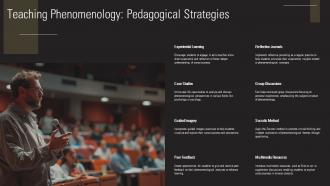
Teaching Phenomenology Pedagogical Strategies Ppt Example ST AI SS with all 9 slides:
Use our Teaching Phenomenology Pedagogical Strategies Ppt Example ST AI SS to effectively help you save your valuable time. They are readymade to fit into any presentation structure.








FAQs for Teaching Phenomenology Pedagogical Strategies Ppt Example
So basically, you study consciousness exactly as it shows up to you - no assumptions about what's "really" out there. Husserl was like "forget all the metaphysical debates for now." Just focus on how things appear in your direct experience. Your consciousness always points toward something (that's intentionality), and there are structures that make experience meaningful. The big technique is phenomenological reduction - you strip away theoretical stuff to get at pure experience. Honestly, try noticing how you actually experience time or even just looking at your coffee cup. It's way weirder than you'd expect.
So normally you just assume stuff exists "out there" and trust what you see, right? That's the natural attitude. Phenomenology completely flips that. Instead of worrying about whether things actually exist, you "bracket" those assumptions (Husserl's fancy term is "epoché") and just focus on how things show up in your experience. Like instead of "this tree exists" you'd think "how does this tree-thing appear to me right now?" It's weirdly hard to do at first. Try picking any random object and describing only how it appears, not what it "really" is.
So with phenomenology, you're basically trying to get inside people's heads and understand their actual lived experiences. Pick something specific - like what it feels like to be a new mom or deal with chronic illness. Then do deep interviews asking "what" and "how" questions about that experience. The tricky part? You gotta set aside your own assumptions first (way harder than it sounds, trust me). Look for common themes across different people's stories. Honestly, it's pretty fascinating once you get into it - you end up seeing things you never would've thought of.
Basically phenomenology says your consciousness is always *about* something - like your thoughts and perceptions are constantly pointing at stuff, real or imagined. Husserl figured consciousness can't just float around empty; it's always consciousness OF something. Each mental state gets its meaning from this directedness. Notice how remembering targets past events? Or hoping reaches toward future stuff? Pretty trippy concept honestly. Next time you're just sitting there, pay attention to your thoughts for a minute. You'll see how every single one is aimed at something specific. That's the intentional structure Husserl was obsessed with.
Yeah, so embodiment is huge for phenomenology - it's basically saying your consciousness isn't just floating brain thoughts, but tied to your actual physical body. Like when you walk, you're not just thinking "walking" - you feel the weight shift, the muscle tension, all that. Your body literally shapes how things appear to you and structures your whole experience of the world. I think people miss this a lot, honestly. When you're analyzing phenomena, pay attention to the bodily stuff too, not just mental content. Start by noticing how physical sensations inform your understanding of whatever you're examining.
So phenomenology is about noticing the *how* of stuff, not just what happens. Like with your morning coffee - instead of just drinking it, you'd actually feel the warmth in your hands, that little moment of anticipation before the first sip. We usually miss all that. It catches those weird subtle feelings that actually shape how you experience things moment to moment. Honestly, it makes boring daily stuff way more interesting once you start paying attention to what it's like to be conscious. Next time you're walking somewhere, just notice what it actually feels like to be you right then - it's pretty wild.
So Husserl invented this thing called "phenomenological reduction" - you basically ignore whether stuff actually exists and just focus on how it appears in your mind. Pretty wild idea back then. He was big on intentionality too (consciousness always points toward something). The whole point was describing experience without all the theoretical BS getting in the way. His "lifeworld" concept ended up influencing tons of later philosophers. Honestly, his *Ideas* book is dense but if you can push through it, you'll get why everyone references him constantly.
So Husserl's transcendental phenomenology basically tries to "bracket" everything - suspend all your assumptions about reality to get at pure consciousness. Existential phenomenology (Heidegger, Merleau-Ponty) thinks that's totally missing the point. You can't separate consciousness from being thrown into the world with your messy body and feelings. For research, transcendental folks describe pure phenomena. Existential ones examine how meaning emerges through your actual lived experience - honestly more interesting imo. The whole "bracketing" thing sounds neat in theory but we're always already embedded in our social contexts and relationships. Short version: one strips away the world, the other embraces it.
You see phenomenology all over therapy these days. Gestalt work uses it heavily, plus existential counseling and ACT. Instead of asking "why did this happen?" therapists focus on "what's this like for you right now?" Really changes the whole dynamic. Mindfulness stuff too - bracketing your assumptions and just listening to how clients actually experience their world. Oh, and somatic therapies are huge on this. I think it's way more effective than jumping straight to interpretations, honestly. The whole lived experience angle just hits different when you're trying to help someone.
Honestly, phenomenology is great for this stuff. It's all about how people actually experience their world instead of what we think they experience. You bracket your assumptions and just listen to how marginalized communities describe their reality - like the emotions, daily textures, all that. Quantitative research misses so much of the microaggressions and resilience strategies. Super humbling when you actually do it right. Practice epoché first (that whole suspension of judgment thing) and let participants tell their stories without forcing your own framework on them. Oh, and don't underestimate how hard the listening part is.
So bracketing is when you try to set aside your own assumptions during phenomenological research. Picture putting your preconceptions in mental parentheses. You want fresh eyes when approaching participants' experiences - don't let your beliefs mess with what you're actually hearing. Way harder than it sounds though! The whole point is letting the phenomenon show itself naturally through people's descriptions. You can't get rid of bias completely (nobody can), but being deliberate about spotting and suspending your assumptions keeps you closer to the real lived experience you're studying.
So bracketing your assumptions upfront is huge - basically admitting your biases before you start. Member checking works well too, where participants actually validate what you interpreted from their data. I always keep crazy detailed audit trails of my analysis process. Triangulation through multiple sources or having colleagues review your coding is solid. Honestly though? The bracketing thing is way trickier than people make it sound - we've all got blind spots we don't see. Lincoln and Guba's trustworthiness criteria are a good starting point. Document everything so others can follow your thinking. Transparency about your methodology decisions makes all the difference.
Yeah so phenomenology connects to existentialism and hermeneutics in cool ways. Both phenomenology and existentialism dig into lived experience - like how Sartre and Merleau-Ponty explore freedom and what it feels like to be in a body. Hermeneutics fits because it's all about interpretation through engagement rather than just standing back and analyzing. They're all pretty anti-objective when it comes to human experience, which makes sense. Heidegger's your best bet if you want someone who bridges all three - though honestly the guy can be a tough read. The boundaries get blurry but that's what makes it interesting.
You know how Virginia Woolf writes that stream-of-consciousness stuff? That's phenomenology in action - it's all about capturing how we actually *experience* things rather than analyzing them to death. Like when you look at a painting and get hit with this immediate feeling before your brain kicks in with interpretation. Art does this thing where it prioritizes the raw sensation - how anxiety literally weighs on you, or the weird way time crawls when you're waiting for something. Honestly, it's way more about the texture of being human than explaining what everything "means." Try noticing your gut reaction to art before you start picking it apart.
Honestly, the subjectivity is brutal - you're dealing with people's messy lived experiences that don't fit neat categories. Sample sizes will be tiny since you need those deep, time-intensive interviews instead of quick surveys. Oh, and good luck bracketing your own biases (we're all walking around with baggage, let's be real). The analysis part? Prepare to feel overwhelmed because you're hunting for meaning and essence, not just surface patterns. My take: start small, own your biases upfront, and seriously don't rush the analysis. It takes however long it takes.
-
I have been using SlideTeam for the past six months. Very happy and satisfied!
-
Awesomely designed templates, Easy to understand.