

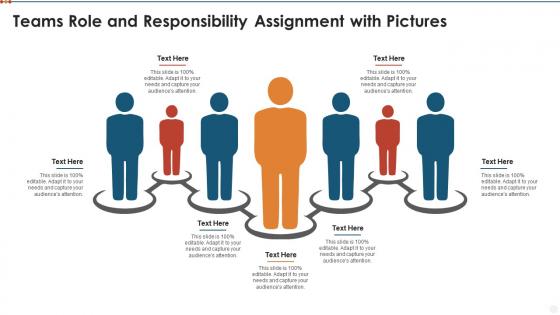
Teams role and responsibility assignment with pictures infographic template




Try Before you Buy Download Free Sample Product
 Impress Your
Audience
 100%
Editable
 Save Hours
of Time


Professionals belonging to any sector can use this set titled Teams Role And Responsibility Assignment With Pictures Infographic Template. From managers, executives to lower level employees, every individual can use this tool to present insightful details and implications in a well structured format. Various charts and graphs are added to this infographic design that makes it a resourceful set. Not only will this add to the informative qualities of this template, but it also makes it an instant attention grabber. Apart from this, it offers at a glance view of the topics, thus simplifying complex concepts. This helps in retaining the information presented for a long time. The biggest quality of this template is its visual elements, all added to elevate the aesthetic appeal of the presentation. Therefore download this template and present a customized version of it without any trouble.
People who downloaded this PowerPoint presentation also viewed the following :
Teams role and responsibility assignment with pictures infographic template with all 9 slides:
Use our Teams Role And Responsibility Assignment With Pictures Infographic Template to effectively help you save your valuable time. They are readymade to fit into any presentation structure.









FAQs for Teams role and responsibility assignment with
So you need a leader who actually makes decisions (not just talks about them), plus people who really know their stuff in key areas. Don't sleep on having someone who's good at communication - seriously, half the drama I've seen could've been avoided with better updates. You'll want your detail person tracking everything and someone creative for when you hit roadblocks. Oh, and definitely someone who's connected across other teams. Honestly though? The best part is when people can jump into different roles depending on what's needed. Just look at who does what naturally first, then figure out what's missing.
You should totally play to people's strengths when dividing up work. Like, if someone's amazing at digging into data, give them the research stuff. Got someone who's super social? They're perfect for client calls. Honestly, it just makes everything smoother when people actually enjoy what they're doing instead of dreading it. I'd start by just asking your team what skills they love using most - maybe their top 2 or 3 things. Then have real conversations about what gets them excited versus what makes them want to hide under their desk. It's basically common sense but so many teams skip this step.
Okay so first thing - sit down with each person individually and figure out what they're actually doing day-to-day versus what you think they should be doing. There's always weird overlap nobody talks about. After those conversations, make some kind of simple chart showing who owns what (doesn't have to be fancy). Most of this confusion happens because we just assume people know their lanes, but honestly? They usually don't. Get everyone in a room to go over it together so nobody feels blindsided. Oh and definitely revisit this stuff every few months since roles shift around as projects change.
Ugh, role ambiguity is the worst. Everyone ends up doing the same task while other stuff gets completely ignored. People freeze up waiting for someone to tell them what to do, or they step all over each other trying to help. Your team probably thinks certain people are slacking, but honestly they just don't know what their job actually is. Super frustrating for everyone. Try making a simple chart of who does what - even something basic works. I swear it'll save you so many headaches down the road.
Honestly, cross-functional teams are pretty great. People attack problems from totally different angles, which usually leads to better solutions. Communication gets way smoother too - team members actually learn to speak each other's "language" instead of just staying in their silos. Everyone picks up new skills, which keeps things from getting boring (and makes people way more engaged). Projects move faster since you're not constantly waiting around for someone else's department to finish their piece. The trick is just making sure people still feel valued for what they're actually good at while they branch out into other stuff.
Document everything first - seriously, this saves so much headache later. Make a RACI chart showing who's responsible for what. Share it in your team meeting, then do individual check-ins because people zone out in groups lol. Never assume anyone "just knows" their role (learned this the hard way). Follow up in writing too - email, Slack, whatever you use. The repetition isn't overkill, it's necessary. Ask each person to confirm they get their specific deadlines and tasks. You'll thank yourself when there's zero confusion down the road.
Honestly, you can't have good team roles without solid communication - it's everything. People need to know exactly what they're doing and how it fits together. Otherwise you get that annoying thing where two people work on the same task (ugh) or something important gets missed because everyone thought someone else had it. I'd say be super clear about expectations from day one. Check in regularly too since things always change. Oh and make it easy for people to speak up when they're confused about who's supposed to do what. Better to over-explain than deal with the mess later.
Honestly, the biggest thing is having those weekly check-ins where people can actually speak up about being overwhelmed or having bandwidth to help out. Cross-training saves your ass when someone suddenly needs to jump from backend to frontend work - I've watched teams totally implode when they stick to rigid role assignments while everything's changing around them. Make sure everyone feels cool about saying "I'm drowning" or "yeah, I can grab that task." Oh, and write down any role swaps you make temporarily. Trust me, stuff gets forgotten otherwise and then you're scrambling to figure out who was supposed to handle what.
Honestly, RACI matrices are your best bet here - they break down who's Responsible, Accountable, Consulted, and Informed for each task. Org charts are fine but pretty basic. Swimlane diagrams are actually my favorite since they show workflow between people really well. Mind mapping tools like Miro work great too, or you could just grab a whiteboard and hash it out old school (sometimes the simple stuff works best, you know?). Just pick whatever your team will actually use and keep updated. Half the battle is getting people to look at it more than once.
Oh man, this stuff gets messy fast. People from formal cultures expect clear hierarchies and defined roles, while others want everything collaborative and flat. Power distance is the real kicker though - some folks automatically defer to bosses, others challenge every decision. I learned this the hard way on a project once. Best thing you can do is have that awkward conversation upfront about expectations. Don't assume your way feels normal to everyone else. Check in with people regularly too, because what seems obvious to you might be totally backwards to your teammates from different backgrounds.
Ugh, role overload is the worst - it absolutely destroys morale and gets nothing done properly. People end up stressed and overwhelmed when they're juggling way too much. Mistakes start piling up because nobody can actually focus. I've watched it completely derail projects before, and honestly? The constant task-switching just fries people's brains. Quality goes down the drain, deadlines get blown, and your team burns out super fast. You really need to keep an eye on who's carrying what load. Redistributing work before people hit their limit is clutch - trust me on this one.
Honestly, team-building stuff works because it strips away all the formal work BS. You get to see who actually steps up when there's a problem to solve. Like, Sarah might be quiet in meetings but totally takes charge during an escape room. Or Mike who seems scattered? Turns out he's amazing at spotting details everyone else misses. The cool thing is there's no real pressure - nobody's stressing about missing a deadline. So people just act naturally. Then you can actually match people with roles that fit how they think instead of whatever their job title says they should do. Next team event, just watch what happens!
So basically have everyone write down what they're actually doing first - you'll be shocked at how much overlap there is that nobody talks about. Get everyone in a room to go through it together. Then make one of those RACI charts (sounds fancy but it's just who's responsible for what). The trick is figuring out clear handoff points when people do need to work together - otherwise stuff gets done twice or not at all. Put it somewhere everyone can see it, not buried in some folder nobody checks. Oh and review it every few months because this stuff changes constantly.
Your team's feedback is seriously the best way to figure out if roles are actually working. People will straight up tell you when someone's buried under work while another person has nothing to do - or when nobody knows who's supposed to handle what. Happens way more than it should, tbh. I'd do monthly check-ins where everyone can be real about what's broken. You just gotta make sure they feel comfortable being honest. Otherwise you're flying blind while responsibilities get shuffled around randomly. Short sessions work better than long meetings too.
So basically, your org structure totally controls how much freedom you get and who's your boss. Flat companies? You'll do everything and make way more decisions. Hierarchical ones give you super specific roles with clear reporting chains. Matrix structures are honestly a mess - you might answer to like three different people (been there, not fun). The main thing is figuring out your setup early so you know who to bug when stuff goes wrong and how much you can just... do things without asking. Definitely map out who reports where first week.
-
Very well designed and informative templates.
-
Informative design.
-
Awesomely designed templates, Easy to understand.