

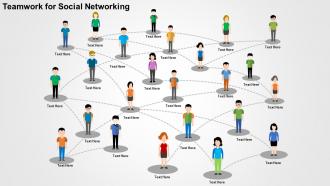
Teamwork for social networking flat powerpoint design






Try Before you Buy Download Free Sample Product
 Impress Your
Audience
 100%
Editable
 Save Hours
of Time


Download our teamwork for social networking flat PowerPoint design. This Presentation slide has been crafted by our efficient designing team. Success in the business can be achieved if you have better networking. Our PPT template highlights the concept of networking in the most perfect manner. Collaboration enables you to accomplish any goal that has been set up by the top management team. If you have professional and resourceful team members then you can increase your social network. Branding is the most vital aspect is the business as if you have good social association then it is easier for you to reach the target audience. This PowerPoint template has been designed to enable you to let your audience aware of this significant aspect that plays an important role in the business growth. You can easily demonstrate the co-operation aspect with this impressive Presentation design. We also have other PowerPoint slides available that can easily fit in your presentation. Just take a look at them and then use it as required.Fearlessly bet on our Teamwork For Social Networking Flat Powerpoint Design. Your ideas will triumph against all odds.
People who downloaded this PowerPoint presentation also viewed the following :
Teamwork for social networking flat powerpoint design with all 4 slides:
Cover distances with our Teamwork For Social Networking Flat Powerpoint Design. They wish your thoughts Godspeed.


FAQs for Teamwork for social networking
Effective teamwork in corporate environments includes clear communication channels, defined roles and responsibilities, shared goals and accountability, mutual trust and respect, and collaborative problem-solving approaches. These elements streamline project execution by reducing conflicts, accelerating decision-making, and enhancing productivity, with many organizations finding that structured teamwork frameworks ultimately deliver improved performance and competitive advantage.
Diverse teams enhance creativity and innovation by bringing varied perspectives, experiences, cultural backgrounds, problem-solving approaches, and specialized expertise to projects. This cognitive diversity enables organizations to generate more creative solutions, identify blind spots earlier, and develop products that resonate with broader markets, with many companies finding that heterogeneous teams consistently outperform homogeneous groups in innovation metrics.
Communication serves as the foundation for successful team dynamics by facilitating transparency, aligning goals, resolving conflicts, and building trust among members. Through regular updates, feedback sessions, and collaborative discussions, teams streamline decision-making processes, enhance productivity, and minimize misunderstandings, with many organizations finding that strong communication practices ultimately deliver improved project outcomes and sustained competitive advantage.
Conflict within teams can be effectively managed through open communication, active listening, establishing clear roles and expectations, focusing on shared goals, and implementing structured problem-solving processes. These approaches transform disagreements into productive discussions, with many organizations finding that well-managed conflict ultimately strengthens team dynamics, enhances creative solutions, and delivers improved collaborative outcomes.
Best practices for setting clear goals and roles include defining specific, measurable objectives, establishing individual responsibilities, creating accountability frameworks, documenting expectations clearly, and implementing regular check-in processes. These approaches streamline collaboration by eliminating confusion, reducing task overlap, and enhancing productivity, with many organizations finding that structured role clarity ultimately delivers faster project completion and improved team performance.
Remote work can weaken team cohesion through reduced spontaneous interactions, communication gaps, and diminished personal connections, while also offering flexibility that many teams find enhances work-life balance. Organizations increasingly leverage regular video check-ins, virtual team-building activities, collaborative project management tools, and structured communication protocols to maintain strong relationships, ultimately delivering improved engagement and productivity across distributed teams.
Team-building activities strengthen interpersonal relationships by fostering trust, improving communication, encouraging collaboration, and creating shared experiences among colleagues. These strategic exercises enable teams to break down silos, develop mutual understanding, and build emotional connections, with many organizations finding that regular team-building initiatives ultimately enhance workplace cohesion and operational efficiency.
**INPUT**: What tools and technologies can facilitate better collaboration among team members? **OUTPUT**: Collaboration tools include project management platforms, video conferencing software, shared document systems, instant messaging applications, and cloud-based file storage solutions. These technologies streamline communication by enabling real-time updates, centralized information access, and seamless remote coordination, with many organizations finding that integrated collaboration suites ultimately enhance productivity and reduce project timelines significantly.
Project-based teams typically experience intense collaboration phases with defined deadlines, rapid relationship formation, and goal-focused dynamics that dissolve upon completion. Ongoing workgroups develop deeper interpersonal relationships, established communication patterns, and sustained accountability structures, with many organizations finding that permanent teams deliver greater innovation and knowledge retention over time.
High-performing teams demonstrate clear communication, shared accountability, complementary skills, trust among members, and consistent goal achievement. These characteristics can be cultivated through regular team-building exercises, establishing transparent communication channels, and creating structured feedback systems, with many organizations finding that investing in collaborative tools and leadership development ultimately delivers improved productivity and stronger employee engagement.
Emotional intelligence proves crucial for effective team interactions by enhancing communication, building trust, reducing conflicts, and improving collaborative decision-making processes. Teams with emotionally intelligent members navigate workplace challenges more effectively, make more balanced decisions considering diverse perspectives, and ultimately deliver stronger performance outcomes, with many organizations finding that emotional intelligence training significantly improves team productivity and workplace satisfaction.
Leadership plays a crucial role in guiding teams by setting clear vision, establishing strategic priorities, facilitating communication, and providing resources for success. Effective leaders enable team alignment through consistent direction and support, while fostering collaboration and accountability, with many organizations finding that strong leadership significantly enhances team performance and goal achievement.
Feedback mechanisms enhance team performance by establishing clear communication channels, creating accountability structures, and enabling continuous improvement through regular check-ins and peer reviews. These systems streamline collaboration while building trust, with many organizations finding that structured feedback processes reduce project timelines, increase employee engagement, and ultimately deliver higher-quality outcomes and stronger team cohesion.
Strategies include establishing clear diversity goals, implementing bias-free recruitment processes, creating psychological safety environments, providing unconscious bias training, and ensuring equitable participation opportunities. These approaches enhance team performance by leveraging diverse perspectives, fostering innovation through varied experiences, and building stronger collaboration, with many organizations finding that inclusive teams deliver significantly better business outcomes and competitive advantage.
Cultural differences influence teamwork by creating varied communication styles, decision-making approaches, conflict resolution methods, and work pace preferences, which can lead to misunderstandings and reduced collaboration effectiveness. Organizations bridge these gaps through cultural awareness training, establishing clear communication protocols, and creating inclusive team structures, with many multinational companies finding that diverse teams ultimately deliver enhanced creativity and stronger problem-solving capabilities.
-
Great designs, Easily Editable.
-
Qualitative and comprehensive slides.