

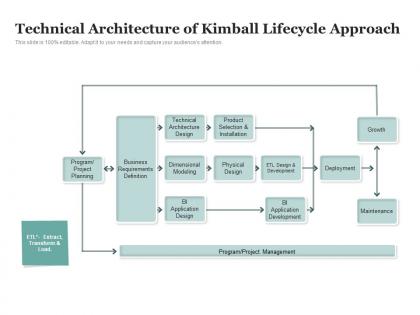
Technical architecture of kimball lifecycle approach




Try Before you Buy Download Free Sample Product
 Impress Your
Audience
 100%
Editable
 Save Hours
of Time


Our Technical Architecture Of Kimball Lifecycle Approach will never let you get desperate. They will do your bidding well in time.
People who downloaded this PowerPoint presentation also viewed the following :
Technical architecture of kimball lifecycle approach with all 5 slides:
Fulfill your destiny with our Technical Architecture Of Kimball Lifecycle Approach. They will make your dreams come true.


FAQs for Technical architecture of
The Kimball Lifecycle Approach includes project planning, business requirements definition, dimensional modeling, physical design, ETL design and development, and deployment phases. These phases work collaboratively by establishing clear business objectives, creating scalable data models, and implementing robust extraction processes, with many organizations finding that this structured methodology delivers faster implementation timelines and more user-friendly analytical capabilities.
The Kimball Lifecycle Approach emphasizes dimensional modeling with bottom-up development, rapid prototyping, and business-driven design, while Inmon's methodology focuses on top-down enterprise data warehouses with normalized structures and comprehensive data integration. These approaches deliver different outcomes, with Kimball enabling faster implementation and quicker business value through iterative development, while Inmon provides enterprise-wide consistency and long-term scalability for complex organizational requirements.
Dimensional modeling in the Kimball Lifecycle structures data into fact tables containing measurable events and dimension tables providing descriptive context, enabling intuitive business analysis through star schemas. This approach streamlines data warehouse design by organizing information how business users naturally think, with retail companies finding that sales facts connected to product, time, and customer dimensions deliver faster query performance and enhanced analytical capabilities.
Key deliverables include project planning documents and business requirements definition, dimensional models and ETL specifications during design phases, tested data warehouse components and user training materials during implementation, and ongoing performance reports with maintenance documentation during deployment. These structured deliverables streamline data warehouse development by ensuring stakeholder alignment, technical accuracy, and operational sustainability, with many organizations finding that this phased approach significantly reduces project risks while accelerating time-to-value.
The Kimball Lifecycle facilitates iterative development through phased delivery cycles, continuous stakeholder feedback integration, and incremental dimensional model refinement, allowing teams to build and deploy data marts progressively rather than attempting massive single releases. This approach enables organizations to deliver immediate business value while refining requirements, with many enterprises finding that iterative cycles reduce project risk, accelerate time-to-insight, and ensure alignment with evolving business needs.
Business requirements serve as the foundational blueprint in the Kimball Lifecycle, driving dimensional modeling decisions, defining key performance indicators, and establishing data granularity levels needed for effective analysis. These requirements guide technical architecture choices, influence ETL design patterns, and ensure the data warehouse delivers actionable insights, with many organizations finding that thorough upfront requirements gathering significantly reduces development cycles and enhances user adoption.
The Kimball Lifecycle addresses data quality through comprehensive profiling, cleansing rules, and governance frameworks integrated throughout each phase, from business requirements through deployment. Through systematic data validation, quality scorecards, and stewardship protocols, organizations streamline governance processes, enhance data reliability, and establish sustainable practices, with many enterprises finding that this structured approach ultimately delivers improved decision-making and regulatory compliance.
Best practices include creating atomic-level fact tables, designing conformed dimensions for consistency across business processes, implementing slowly changing dimension strategies, using surrogate keys, and establishing grain declaration for each fact table. These methodologies streamline data warehouse development by ensuring dimensional consistency, enabling cross-functional reporting, and maintaining data integrity, with many organizations finding that proper grain definition and conformed dimensions ultimately deliver scalable analytics architectures and improved business intelligence capabilities.
Organizations ensure stakeholder alignment throughout the Kimball Lifecycle by establishing regular communication checkpoints, creating cross-functional project teams, and maintaining shared documentation of business requirements and technical specifications. Through structured review sessions and iterative feedback loops, teams can address concerns early, validate deliverables against business needs, and ensure data warehouse solutions ultimately deliver measurable value and strategic competitive advantage.
Common tools within the Kimball Lifecycle framework include ETL platforms like Informatica and Talend, data modeling tools such as ERwin and PowerDesigner, database systems like SQL Server and Oracle, and BI platforms including Tableau and Power BI. These technologies streamline dimensional modeling, automate data integration processes, and enhance reporting capabilities, with many organizations finding that this strategic combination delivers faster implementation timelines and more scalable analytics solutions.
The Kimball Lifecycle supports new data source integration through its iterative design methodology, dimensional modeling framework, and phased implementation approach that accommodates evolving business requirements. Organizations can seamlessly add data sources by leveraging existing dimensional structures, extending fact and dimension tables, and maintaining consistent ETL processes, with many enterprises finding that this flexibility enables rapid scalability while preserving data integrity.
Common challenges include data quality issues, stakeholder alignment difficulties, technical complexity management, resource allocation constraints, and timeline pressures during iterative development cycles. These obstacles can be mitigated through comprehensive data profiling, early stakeholder engagement workshops, phased implementation strategies, and dedicated cross-functional teams, with many organizations finding that proactive communication and realistic milestone setting ultimately deliver more successful data warehouse deployments.
The Kimball approach manages historical data through slowly changing dimensions (SCDs), utilizing Type 1, Type 2, and Type 3 methodologies to track changes over time. Type 2 dimensions create new records for changes, preserving complete historical context, while Type 1 overwrites data and Type 3 maintains limited history, enabling organizations to analyze trends and maintain data integrity across evolving business requirements.
Organizations should track data warehouse usage rates, query response times, user adoption metrics, data quality scores, and business intelligence report accuracy throughout their Kimball Lifecycle implementation. These metrics enable teams to measure operational efficiency, user satisfaction, and system performance, with many enterprises finding that monitoring dimensional model effectiveness and ETL process reliability ultimately delivers improved decision-making capabilities and competitive advantage.
Agile methodologies can be incorporated into the Kimball Lifecycle by implementing iterative development cycles, regular stakeholder feedback loops, and incremental delivery of dimensional models. This hybrid approach enables data warehouse teams to deliver business value faster through shorter sprints, while maintaining Kimball's rigorous dimensional modeling standards, ultimately enhancing project flexibility and stakeholder engagement.
No Reviews