

Technology differentiators





Try Before you Buy Download Free Sample Product
 Impress Your
Audience
 100%
Editable
 Save Hours
of Time


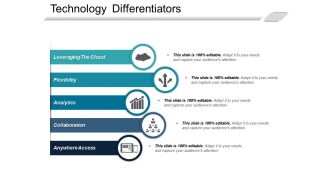
Reach the pinnacle of growth in terms of technical expertise with this Technology Differentiators PowerPoint presentation. This technology framework PPT consists of cloud computing, flexibility, analytics, collaboration and anywhere access. Take advantage of this business attribute layout to reveal five key differentiators such as target audience, informative content, expertise searching, etc. Take the assistance of this emerging trends slideshow to showcase the role of information technology in driving growth of the business. Further, you can depict the latest trends such as cybersecurity, artificial intelligence, etc. with this technology diagram. Implement an MIS(Management Information System) for the collection, storage, analysis and management of data. As this slide is 100% adaptable, you are free to add or replace information according to your needs or desire. Disrupt the market through consistent innovation with this template and increase the market value of your organization. Download this predesigned technology advancement infographic to implement the latest technology and get the first mover advantage over your rivals.
People who downloaded this PowerPoint presentation also viewed the following :
Technology differentiators with all 5 slides:
Insist on catering for any emergencies with our Technology Differentiators. It will ensure a happy journey.


FAQs for Technology differentiators
Innovation drives business growth by enabling companies to develop new products, streamline operations, enter emerging markets, and differentiate from competitors through unique value propositions. Organizations leveraging strategic innovation, particularly in technology and customer experience design, achieve significant competitive advantages, with many finding that consistent innovation cycles ultimately deliver sustained revenue growth and market leadership positioning.
Organizations foster innovation culture through diverse teams, psychological safety for risk-taking, dedicated innovation time, cross-departmental collaboration, and leadership modeling creative behaviors. These approaches streamline idea generation by encouraging experimentation, removing hierarchical barriers, and rewarding creative problem-solving, with many companies finding that empowered employees ultimately deliver breakthrough solutions and sustained competitive advantage.
Effective strategies for measuring innovation success include revenue from new products, time-to-market metrics, customer adoption rates, patent applications, and employee engagement in innovation programs. These measurement approaches enable organizations to track both financial outcomes and innovation pipeline health, with many companies finding that balanced scorecards combining quantitative ROI data with qualitative innovation culture assessments deliver the most comprehensive insights.
Emerging technologies revolutionize innovation by accelerating product development, enabling data-driven decision making, and creating entirely new business models across sectors. Through AI, IoT, and automation, industries like healthcare streamline drug discovery, manufacturing optimizes supply chains, and financial services deliver personalized experiences, ultimately enhancing competitive advantage and operational efficiency.
Companies face implementation challenges including resource constraints, organizational resistance to change, regulatory compliance issues, talent shortages, and integration complexities with existing systems. While these obstacles can slow innovation adoption, organizations in sectors like healthcare, financial services, and manufacturing increasingly find that strategic planning, phased rollouts, and cross-functional collaboration enable successful implementation, ultimately delivering competitive advantage and operational efficiency.
Innovation can be effectively integrated through cross-functional teams, dedicated innovation labs, flexible reporting structures, collaborative workspaces, and innovation-focused performance metrics. These approaches streamline idea generation by breaking down silos, encouraging experimentation, and aligning resources with creative initiatives, with many organizations finding that structured innovation processes ultimately deliver faster product development and sustained competitive advantage.
Customer feedback significantly shapes innovation by identifying unmet needs, validating concepts, prioritizing development resources, and reducing market risks through real-world insights. Organizations across sectors like healthcare, retail, and financial services increasingly integrate customer input throughout development cycles, ultimately delivering more targeted solutions, faster market adoption, and stronger competitive positioning.
Cross-sector collaboration enhances innovation by combining diverse expertise, sharing complementary resources, accelerating development timelines, and reducing individual risk exposure. Through strategic partnerships, organizations leverage varied perspectives and capabilities, with healthcare-tech alliances, finance-retail integrations, and public-private partnerships ultimately delivering breakthrough solutions, faster market entry, and sustained competitive advantage across industries.
Product innovation focuses on tangible improvements like new features, materials, design enhancements, and manufacturing processes that deliver better functionality and user experiences. Service innovation emphasizes process improvements, customer journey optimization, digital integration, and delivery methods, with sectors like banking, healthcare, and retail finding that streamlined service experiences often drive greater customer loyalty and competitive advantage than product features alone.
Design thinking significantly enhances innovation by emphasizing user-centered problem solving, iterative prototyping, and cross-functional collaboration to uncover breakthrough solutions. This human-focused methodology enables organizations across sectors like healthcare, financial services, and retail to reduce development costs, accelerate time-to-market, and create products that genuinely resonate with customers, ultimately delivering sustainable competitive advantage.
Small businesses can leverage innovation to compete with larger corporations by embracing agile decision-making, adopting cost-effective digital technologies, focusing on niche market specialization, and building direct customer relationships. These strategic approaches enable smaller organizations to respond faster to market changes, deliver personalized experiences, and streamline operations, ultimately creating competitive advantages that larger, less flexible corporations struggle to match.
Ethical considerations in technological innovation include data privacy, algorithmic bias, job displacement, environmental impact, and equitable access to emerging technologies. These challenges present both risks and opportunities for organizations, with many companies finding that proactive ethical frameworks enhance consumer trust, ensure regulatory compliance, and ultimately deliver sustainable competitive advantage in an increasingly conscious marketplace.
Innovation can be sustained through establishing dedicated innovation labs, implementing continuous learning programs, fostering cross-functional collaboration, maintaining robust feedback loops, and allocating consistent R&D budgets. Organizations increasingly find that embedding innovation into their core processes, rather than treating it as a separate initiative, delivers sustained competitive advantage while enabling teams to adapt quickly to market changes and emerging opportunities.
Leadership drives innovative thinking by establishing psychological safety, allocating resources for experimentation, modeling creative problem-solving, and rewarding calculated risk-taking rather than punishing failures. Through strategic vision-setting and cross-functional collaboration, leaders create environments where teams challenge conventional approaches, explore emerging technologies, and develop breakthrough solutions, with many organizations finding that innovation-focused leadership directly correlates with competitive advantage and market differentiation.
Innovation partnerships between startups and established companies create strategic value through resource sharing, market access, and accelerated development cycles. Startups gain funding, infrastructure, and distribution networks from corporations, while established companies access cutting-edge technologies, agile methodologies, and fresh market perspectives, ultimately delivering faster innovation cycles and competitive advantages for both entities.
-
Good job!!!
-
Attractive design and informative presentation.
-
Informative design.