


Technology Roadmap Sample Ppt Powerpoint Presentation Slides




Try Before you Buy Download Free Sample Product
 Impress Your
 Audience
 100%
100% Editable
 Save Hours
 of Time


Create a cult with our Technology Roadmap Sample Ppt Powerpoint Presentation Slides. Your ideas will become a craze.
People who downloaded this PowerPoint presentation also viewed the following :
Content of this Powerpoint Presentation
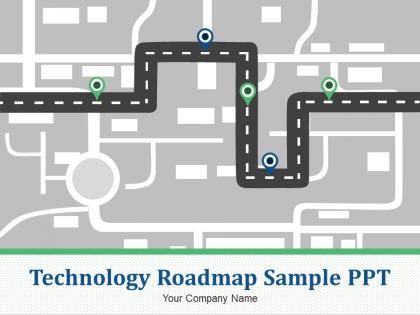
Slide 1: This slide introduces Technology Roadmap Sample PPT. State your company name and begin.
Slide 2: This is the first slide showing Roadmap (Layout-1) with five steps which you can add as per your requirement.
Slide 3: This is the second slide showing Roadmap (Layout-2) with text boxes to add your milestones, growth etc.
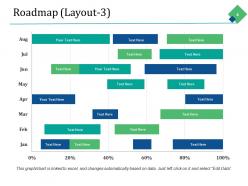
Slide 4: This is the third slide showing Roadmap (Layout-3) with text boxes to add your text.
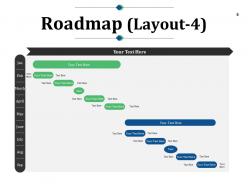
Slide 5: This is fourth slide showing Roadmap (Layout-4) in terms of years. Add your milestones, growth, evolution etc.
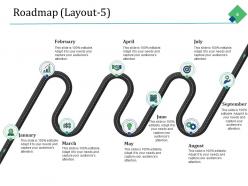
Slide 6: This is the fifth slide showing another variation of Roadmap (Layout-5).
Slide 7: This is a Coffee Break slide to halt. Alter as per your need.
Slide 8: This is sixth slide showing Roadmap (Layout-6). Add in the steps.
Slide 9: This is seventh slide showing Roadmap (Layout-7). State your milestones, growth, evolution etc. here.
Slide 10: This is eighth slide showing Roadmap (Layout-8).
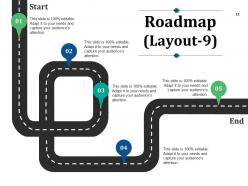
Slide 11: This is ninth slide showing Roadmap (Layout-9) with starting and end points.
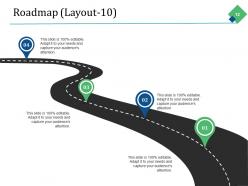
Slide 12: This is the tenth slide showing Roadmap (Layout-10). Use it according to your business requirement.
Slide 13: This is a Thank You slide with Address# street number, city, state, Contact Numbers, Email Address.
Technology Roadmap Sample Ppt Powerpoint Presentation Slides with all 13 slides:
Acquire a firm grip on the course of events with our Technology Roadmap Sample Ppt Powerpoint Presentation Slides. It helps indulge in damage control.





FAQs for Technology Roadmap Sample Ppt
Key components include strategic objectives, current technology inventory, gap analysis, timeline milestones, resource requirements, and risk assessments. These elements work together by aligning IT investments with business goals, identifying upgrade priorities, and establishing clear implementation phases, with many organizations finding that comprehensive roadmaps streamline decision-making and deliver measurable competitive advantages.
Organizations align their technology roadmap with business objectives by establishing clear strategic priorities, conducting regular stakeholder consultations, and implementing phased deployment schedules that support revenue goals. Through cross-functional collaboration between IT and business teams, companies in sectors like retail and healthcare streamline operations, enhance customer experiences, and accelerate digital transformation, ultimately delivering measurable ROI and sustainable competitive advantage.
Stakeholder engagement ensures technology roadmaps align with diverse business needs, user requirements, technical constraints, and strategic priorities through collaborative input and feedback. With executives, IT teams, end-users, and department heads contributing insights, organizations develop more comprehensive roadmaps that address real-world challenges, reduce implementation resistance, and ultimately deliver greater adoption success and strategic value.
Technology roadmaps should be updated quarterly for tactical adjustments and annually for comprehensive strategic reviews, with major updates triggered by significant market shifts, budget cycles, or competitive changes. This balanced approach enables organizations to maintain strategic direction while adapting to emerging technologies, with many enterprises finding that regular updates deliver better resource allocation and faster responses to market opportunities.
Common pitfalls include lack of stakeholder alignment, unrealistic timelines, insufficient budget planning, poor integration with business strategy, and inadequate change management. These challenges often arise when organizations rush the planning process or fail to consider interdependencies, with many companies finding that involving cross-functional teams early prevents costly revisions and ensures smoother implementation.
Emerging technologies can be effectively integrated through phased implementation, pilot programs, stakeholder alignment, risk assessment, and strategic timing considerations. Organizations successfully integrate these technologies by conducting proof-of-concept trials, establishing clear success metrics, and ensuring compatibility with existing infrastructure, ultimately delivering enhanced operational efficiency and competitive advantage while minimizing disruption.
Technology roadmap success metrics include alignment with business objectives, milestone achievement rates, ROI on technology investments, time-to-market improvements, and stakeholder satisfaction scores. These measurements enable organizations to track strategic progress, resource allocation effectiveness, and competitive positioning, with many companies finding that balanced scorecards combining financial, operational, and innovation metrics ultimately deliver comprehensive visibility into their technology transformation outcomes.
Regional and industry-specific trends significantly shape technology roadmaps by dictating compliance requirements, market demands, and competitive pressures that organizations must address. These trends influence investment priorities, implementation timelines, and strategic focus areas, with financial services emphasizing regulatory technology while manufacturing prioritizes automation, ultimately ensuring roadmaps remain relevant and competitive within specific market contexts.
Technology roadmap tools include Aha!, ProductPlan, Roadmunk, Microsoft Visio, and Lucidchart, each offering strategic planning capabilities, timeline visualization, and stakeholder collaboration features. These platforms streamline roadmap development by enabling cross-functional alignment, real-time updates, and integration with project management systems, with many organizations finding that dedicated roadmap software significantly enhances strategic communication and accelerates technology implementation timelines.
A technology roadmap supports innovation by aligning emerging technologies with strategic goals, identifying capability gaps, and creating structured pathways for technological advancement. Through systematic planning and resource allocation, organizations streamline R&D investments, accelerate product development cycles, and anticipate market opportunities, with many companies finding that roadmaps enhance cross-functional collaboration and ultimately deliver sustained competitive advantage.
Effective strategies include visual storytelling through infographics and dashboards, translating technical concepts into business outcomes, conducting regular milestone reviews, and creating executive summaries with clear timelines. These approaches streamline complex information by emphasizing cost savings, competitive advantages, and operational efficiency, with many organizations finding that interactive presentations and progress tracking ultimately enhance stakeholder buy-in and strategic alignment.
Organizations balance short-term needs with long-term technology goals by implementing phased approaches, prioritizing scalable solutions, and establishing flexible frameworks that accommodate immediate operational requirements while advancing strategic objectives. Through iterative planning cycles, companies in manufacturing, healthcare, and financial services streamline current processes while building foundations for future innovation, ultimately delivering operational efficiency and sustainable competitive advantage.
Competitive analysis informs technology roadmap decisions by identifying market gaps, emerging trends, industry benchmarks, and differentiation opportunities that guide strategic investments. Through systematic competitor assessment, organizations can prioritize technologies that deliver competitive advantages, avoid redundant developments, and accelerate time-to-market, ultimately enabling more strategic resource allocation and market positioning.
Organizations ensure adaptable technology roadmaps by implementing modular architectures, establishing regular review cycles, maintaining flexible budgeting approaches, and creating cross-functional governance structures. Through agile planning methodologies and scenario-based forecasting, companies like financial services firms and manufacturing organizations can pivot quickly when market conditions shift, ultimately delivering sustained competitive advantage while minimizing disruption costs.
Prioritizing initiatives within a technology roadmap ensures optimal resource allocation, aligns projects with strategic business objectives, and maximizes return on investment across development cycles. This approach enables organizations to tackle high-impact projects first, manage dependencies effectively, and deliver measurable value progressively, with many companies finding that structured prioritization accelerates innovation while minimizing costly delays.
-
Good research work and creative work done on every template.
-
It saves your time and decrease your efforts in half.