

Telephone Handling Tips For Front Office Executives Training Ppt




Try Before you Buy Download Free Sample Product
 Impress Your
 Audience
 100%
100% Editable
 Save Hours
 of Time


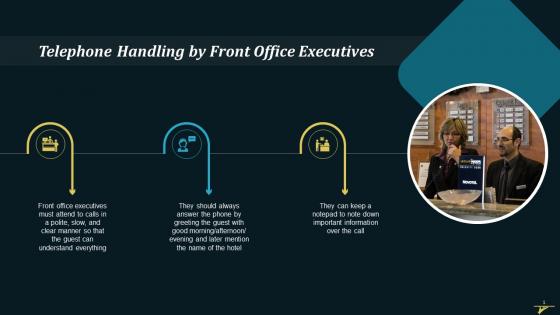
This slide showcases how telephone handling has to be done in the hotel. It has to be done in a polite, slow, and clear manner so that the guest can understand everything properly and a notepad could be kept to note down important information.
People who downloaded this PowerPoint presentation also viewed the following :
Telephone Handling Tips For Front Office Executives Training Ppt with all 19 slides:
Use our Telephone Handling Tips For Front Office Executives Training Ppt to effectively help you save your valuable time. They are readymade to fit into any presentation structure.
















FAQs for Telephone Handling Tips For Front Office
Key elements of effective phone communication include clear articulation, active listening, professional greeting protocols, concise messaging, and prompt follow-up procedures. These communication strategies enhance customer experiences by reducing misunderstandings, building trust, and streamlining business interactions, with many organizations finding that proper phone etiquette ultimately delivers improved client retention and operational efficiency.
Tone of voice significantly impacts phone message reception by conveying emotions, establishing rapport, and influencing customer perceptions of professionalism and credibility. A warm, confident tone enhances trust and comprehension, while monotone or rushed delivery can create confusion or negative impressions, with many customer service organizations finding that proper vocal techniques improve satisfaction rates and business outcomes.
Strategies for difficult callers include active listening, remaining calm, empathizing with their concerns, offering specific solutions, and setting clear boundaries when necessary. These approaches enable customer service teams to de-escalate tensions, transform negative experiences into positive outcomes, and maintain professional relationships, with many organizations finding that trained representatives can convert frustrated callers into loyal customers while reducing call resolution times.
Active listening techniques enhance telephone interactions by demonstrating genuine engagement, building rapport through verbal acknowledgments, and ensuring accurate understanding of customer needs and concerns. These approaches include paraphrasing key points, asking clarifying questions, and providing thoughtful responses, with many customer service teams finding that active listening significantly reduces call resolution times while improving satisfaction scores and fostering stronger client relationships.
Body language significantly impacts phone communication through vocal tone, energy, and confidence, even when visual cues are absent. Smiling while speaking creates warmth in your voice, sitting up straight projects authority and clarity, and gesturing naturally enhances vocal expressiveness, with many customer service professionals finding that maintaining positive physical posture ultimately delivers more engaging conversations and stronger client relationships.
To ensure clarity when discussing complex information over the phone, speak slowly, use simple language, break information into digestible segments, confirm understanding regularly, and summarize key points. Many customer service teams in banking and insurance find that pausing for confirmation, repeating critical details, and asking specific questions enhances client comprehension, ultimately delivering better service outcomes and stronger professional relationships.
Effective phone call note-taking practices include preparing templates beforehand, using shorthand or abbreviations, focusing on key decisions and action items, timestamping important points, and confirming details before ending calls. These techniques enhance accuracy and follow-up efficiency, with many customer service teams and sales professionals finding that structured note-taking systems streamline client communications, reduce miscommunication risks, and ultimately deliver improved relationship management and accountability.
Managing call time effectively involves setting clear expectations upfront, using structured conversation frameworks, and summarizing key points throughout the discussion to maintain focus. Professional call handlers streamline interactions by preparing relevant information beforehand, asking targeted questions, and politely guiding conversations toward resolution, ultimately delivering efficient service while ensuring customers feel heard and valued.
Techniques for maintaining positivity include taking deep breaths between responses, using positive language patterns, focusing on problem-solving rather than dwelling on frustrations, and keeping water nearby to stay refreshed. These approaches help customer service representatives and sales professionals manage energy levels, deliver consistent service quality, and build stronger relationships with callers, ultimately reducing burnout while enhancing customer satisfaction and retention rates.
Effective phone call preparation involves reviewing client history, setting clear objectives, preparing relevant documents, testing technology, and outlining key discussion points. This strategic approach enables smoother conversations, faster decision-making, and stronger stakeholder relationships, with many organizations finding that structured preparation ultimately delivers more productive outcomes and enhanced client satisfaction.
Common pitfalls include interrupting customers, lacking empathy, providing inconsistent information, failing to actively listen, and rushing through calls without resolution. These mistakes significantly damage customer relationships and brand reputation, with many service organizations finding that comprehensive agent training, clear communication protocols, and empathy-focused approaches ultimately deliver improved customer satisfaction and increased loyalty.
Effective follow-up techniques include sending written summaries within 24 hours, scheduling next steps with specific timeframes, and confirming action items with all relevant stakeholders. These approaches enhance communication clarity by documenting key decisions, establishing accountability, and maintaining momentum, with many businesses finding that systematic follow-up protocols ultimately deliver stronger client relationships and improved project outcomes.
Cultural sensitivity significantly enhances phone communication by improving customer rapport, reducing misunderstandings, and building trust across diverse markets. Organizations that train staff in cultural awareness, language preferences, and communication styles find they deliver more personalized service, increase customer satisfaction, and ultimately gain competitive advantage in increasingly global business environments.
Effectively transitioning calls requires clear communication with both the caller and receiving department, including summarizing the issue, confirming the appropriate transfer destination, and providing relevant account details. Professional transitions involve staying on the line to introduce the caller, ensuring the new representative understands the context, and confirming the transfer is successful before disconnecting, ultimately delivering seamless customer experiences.
Establishing personal connections during phone conversations enhances customer satisfaction, builds trust, reduces conflict resolution time, and increases conversion rates. Through active listening, empathetic responses, and personalized communication, businesses in sectors like financial services, healthcare, and retail find that meaningful phone interactions ultimately deliver stronger customer loyalty, repeat business, and competitive advantage in an increasingly digital landscape.
-
I had them make a presentation for an office retirement party. They were very helpful in understanding what we wanted and delivered the perfect presentation. Highly recommended!
-
Use of different colors is good. It's simple and attractive.