


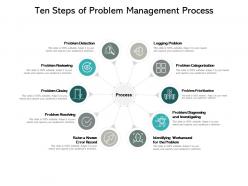
Ten steps of problem management process





Try Before you Buy Download Free Sample Product
 Impress Your
Audience
 100%
Editable
 Save Hours
of Time


Display great composure with our Ten Steps Of Problem Management Process. Your thoughts will be extremely balanced.
People who downloaded this PowerPoint presentation also viewed the following :
Ten steps of problem management process with all 5 slides:
Our Ten Steps Of Problem Management Process ensure thoughts appear extremely balanced. You will display great composure.


FAQs for Ten steps of
The key stages in the Problem Management Process include problem identification, problem logging, problem categorization, problem investigation and diagnosis, workaround implementation, and problem resolution. These stages streamline IT operations by systematically addressing root causes, preventing recurring incidents, and minimizing service disruptions, with many organizations finding that structured problem management ultimately delivers improved system reliability and enhanced customer satisfaction.
Problem Management focuses on identifying and eliminating root causes of recurring issues, while Incident Management prioritizes rapid service restoration when disruptions occur. Through comprehensive analysis and preventive measures, Problem Management enables organizations to reduce future incidents, minimize operational costs, and enhance system reliability, whereas Incident Management delivers immediate fixes, ultimately creating a strategic combination that improves overall service quality.
Root cause analysis serves as the cornerstone of effective problem management by systematically identifying underlying issues rather than addressing surface-level symptoms, enabling organizations to implement permanent solutions through data analysis, process mapping, and stakeholder interviews. This methodical approach helps IT teams, healthcare systems, and manufacturing operations eliminate recurring incidents while reducing operational costs, ultimately delivering sustained system stability and enhanced service reliability across the enterprise.
Organizations effectively prioritize problems by assessing business impact, urgency levels, resource requirements, affected user populations, and potential cascading effects on critical systems. Through structured priority matrices and cross-functional collaboration, companies streamline resolution workflows, minimize operational disruptions, and allocate technical resources strategically, with many finding that systematic prioritization ultimately delivers faster incident response and enhanced service reliability.
**INPUT**: What tools and techniques are commonly used in the Problem Management Process? **OUTPUT**: Problem Management processes utilize root cause analysis, trend analysis, error control databases, knowledge management systems, and automated monitoring tools. These techniques streamline problem identification by tracking recurring incidents, analyzing patterns, and maintaining comprehensive solution repositories, with many organizations finding that strategic combination of these approaches significantly reduces repeat issues while enhancing operational efficiency. **Word count**: 54 words
Problem Management success is measured through key metrics including problem resolution time, root cause identification rates, recurring incident reduction, mean time to resolution, and prevention effectiveness scores. Organizations typically track these indicators alongside cost savings from prevented outages, improved service availability percentages, and stakeholder satisfaction scores, with many finding that comprehensive measurement frameworks ultimately deliver enhanced operational efficiency and stronger competitive positioning.
A Problem Management database centralizes critical incident data, root cause analyses, known solutions, and resolution patterns, enabling faster problem identification and prevention. This knowledge repository streamlines troubleshooting processes, reduces recurring incidents, and enhances team collaboration across IT departments, with many organizations finding that comprehensive databases significantly minimize downtime and accelerate service restoration.
Communication between teams enhances Problem Management by facilitating faster root cause identification, coordinating cross-functional expertise, and ensuring comprehensive solution implementation across all affected systems. Through integrated communication channels, IT operations, development, and business teams can share critical insights, minimize resolution timeframes, and prevent problem recurrence, ultimately delivering improved service reliability and reduced operational costs.
Common barriers to effective Problem Management include insufficient data quality, inadequate root cause analysis capabilities, poor cross-team collaboration, limited resource allocation, and lack of executive support. These challenges often result in organizations experiencing recurring incidents, longer resolution times, and higher operational costs, with many IT departments finding that investing in proper Problem Management tools and training ultimately delivers significant competitive advantage and service reliability.
Continuous improvement drives Problem Management Process effectiveness by analyzing recurring issues, identifying root causes, and implementing preventive measures to reduce future incidents. Organizations leverage trend analysis, stakeholder feedback, and performance metrics to enhance their problem-solving capabilities, ultimately delivering faster resolution times, improved system reliability, and greater operational efficiency across IT services.
Problem documentation best practices include creating detailed problem records with clear symptoms, root cause analysis, step-by-step resolution procedures, timeline tracking, and stakeholder communications. These comprehensive documentation standards streamline future incident responses by enabling faster diagnosis, reducing resolution times, and building institutional knowledge, with many IT organizations finding that systematic documentation ultimately delivers improved service reliability and enhanced team efficiency across complex technical environments.
Organizations leverage data analytics to improve Problem Management by identifying recurring incident patterns, predicting potential system failures, and optimizing resource allocation through predictive modeling and trend analysis. Through advanced analytics platforms, IT teams can reduce problem resolution times, minimize service disruptions, and enhance overall system reliability, with many enterprises finding that data-driven insights ultimately deliver proactive problem prevention and significant operational cost savings.
Problem Management Process integrates with ITIL frameworks by aligning with incident management, change management, and knowledge management processes through standardized workflows, shared databases, and escalation procedures. This integration streamlines root cause analysis, minimizes service disruptions, and enhances organizational learning, with many IT departments finding that coordinated frameworks deliver faster resolutions and improved service quality.
Problem Managers coordinate problem identification, analysis, and resolution across IT infrastructure while serving as liaisons between technical teams and business stakeholders. They oversee root cause investigations, maintain problem databases, prioritize critical incidents, and develop preventive measures, with many organizations finding that dedicated Problem Managers reduce recurring issues by up to 40% while enhancing operational reliability.
Proactive Problem Management reduces incident frequency by identifying root causes through trend analysis, pattern recognition, and preventive measures before issues escalate into service disruptions. Through systematic monitoring and continuous improvement initiatives, organizations can eliminate recurring incidents, minimize system vulnerabilities, and enhance operational stability, ultimately delivering more reliable services and improved customer experiences.
No Reviews