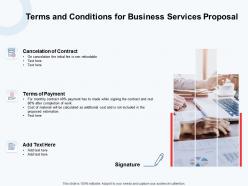
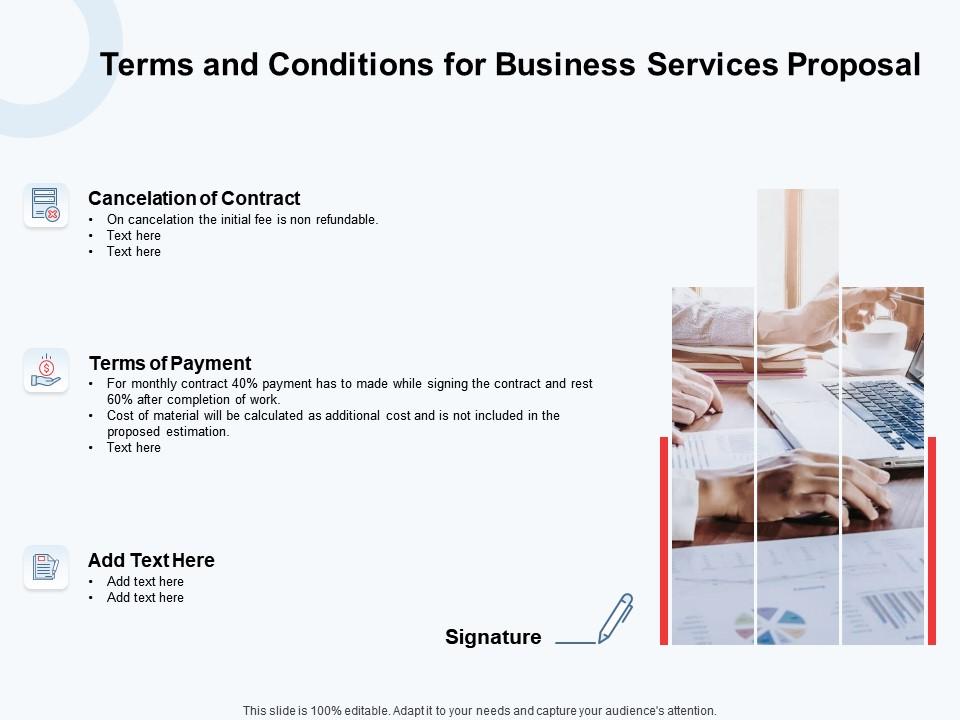
Terms and conditions for business services proposal ppt powerpoint template
Try Before you Buy Download Free Sample Product
Audience
Editable
of Time
Our Terms And Conditions For Business Services Proposal Ppt Powerpoint Template are topically designed to provide an attractive backdrop to any subject. Use them to look like a presentation pro.
People who downloaded this PowerPoint presentation also viewed the following :
Terms and conditions for business services proposal ppt powerpoint template with all 2 slides:
Use our Terms And Conditions For Business Services Proposal Ppt Powerpoint Template to effectively help you save your valuable time. They are readymade to fit into any presentation structure.
FAQs for Terms and conditions for business services proposal
Key elements include intellectual property rights, usage restrictions, licensing terms, liability limitations, and payment policies. These components work together to protect both providers and users by establishing clear boundaries for commercial use, redistribution rights, and modification permissions, with many template platforms finding that comprehensive terms ultimately enhance user confidence while minimizing legal disputes.
Licensing agreements in Terms and Conditions protect creators by defining usage rights, preventing unauthorized distribution, and maintaining copyright ownership, while protecting users by clearly outlining permitted uses, modification rights, and liability limitations. These agreements enable template creators to monetize their work while providing users with legal certainty for business presentations, ultimately delivering transparent expectations and reducing disputes for both parties.
Without well-defined Terms and Conditions, businesses face significant legal vulnerabilities including unlimited liability exposure, inability to enforce user restrictions, jurisdictional disputes, and weakened intellectual property protection. These gaps can result in costly litigation, regulatory penalties, and compromised dispute resolution capabilities, with many digital companies finding that comprehensive terms ultimately deliver stronger legal positioning and reduced operational risk.
Customization options should specify permitted modifications, usage rights for altered templates, intellectual property ownership of custom elements, and restrictions on redistributing modified content. These terms enable organizations to adapt presentations while protecting original design copyrights, with many businesses finding that clear customization guidelines streamline creative processes and ensure compliance across teams.
Templates are provided "as-is" without warranties, require user customization for specific needs, may not suit all business contexts, and cannot guarantee particular outcomes or results. Organizations should clarify that templates serve as starting points rather than final solutions, with users responsible for compliance, accuracy, and professional review before implementation.
Refund policies for digital downloads are typically embedded within Terms and Conditions, outlining specific timeframes, eligibility criteria, and processing procedures for template returns. These policies balance customer satisfaction with business protection by addressing issues like compatibility problems, quality concerns, and accidental purchases, while establishing clear boundaries around usage rights, ultimately delivering transparency and trust that enhances customer confidence in digital marketplace transactions.
Users bear responsibility for ensuring downloaded templates align with their intended use, comply with applicable laws and regulations, and maintain data security standards during customization. When utilizing SlideTeam templates, organizations must respect licensing terms, avoid redistribution beyond permitted scope, and verify content accuracy for their specific business context, ultimately ensuring professional compliance while maximizing template value.
Intellectual property clauses should clearly distinguish between platform-owned template copyrights, user licensing rights, derivative work permissions, and content ownership transfers upon purchase or subscription. These provisions must balance creator protections with user flexibility, especially for commercial applications like presentations to clients, while establishing clear boundaries for redistribution, modification rights, and attribution requirements, ultimately delivering legal clarity that enables confident business use.
Terms and Conditions help mitigate disputes by establishing clear usage guidelines, defining liability limitations, outlining dispute resolution procedures, and setting expectations for both parties upfront. These legal frameworks enable businesses to streamline conflict resolution through predefined processes, reduce litigation costs, and enhance customer relationships, with many organizations finding that transparent terms ultimately deliver stronger user trust and operational efficiency.
Updates to Terms and Conditions typically apply to existing users through grandfathering clauses or transition periods, ensuring purchased templates remain accessible under original terms while new provisions govern future interactions. Most reputable platforms implement these changes transparently, with clear communication timelines and user notifications, ultimately protecting existing investments while enabling service improvements and enhanced user experiences across their growing customer base.
User agreements establish clear expectations, usage rights, licensing terms, intellectual property boundaries, and liability protections when downloading presentation templates. While comprehensive legal frameworks can initially seem complex, they ultimately enhance customer confidence by providing transparency around permitted uses, redistribution policies, and commercial applications, with many organizations finding that clear terms reduce confusion and enable strategic template utilization across teams.
Clear language in Terms and Conditions involves using plain English instead of legal jargon, shorter sentences with active voice, and consistent terminology throughout the document. Organizations can enhance user comprehension by defining technical terms immediately, using bullet points for complex clauses, and providing examples of key policies, ultimately reducing disputes while improving user trust and compliance across diverse audiences.
Resale restrictions should prohibit unauthorized commercial redistribution, require original licensing verification, limit bulk transfers without consent, and mandate attribution preservation. These controls protect intellectual property while enabling legitimate business use, with many template providers finding that clear redistribution guidelines, exclusive licensing tiers, and usage monitoring systems ultimately deliver brand protection and sustainable revenue models.
Terms and Conditions should be reviewed quarterly and updated whenever significant business changes, new regulations, or technology implementations occur. With digital platforms constantly evolving through feature updates, data handling changes, and regulatory shifts like GDPR or CCPA, companies find that regular reviews ensure legal compliance, protect user relationships, and maintain competitive positioning in an increasingly regulated marketplace.
**INPUT**: What strategies can be implemented to ensure users agree to the Terms and Conditions before downloading templates? **OUTPUT**: Effective strategies include mandatory checkboxes, multi-step confirmation processes, clickwrap agreements, popup notifications, and progressive disclosure methods. These approaches streamline compliance by requiring explicit consent, displaying key terms prominently, and creating audit trails, with many organizations finding that clear, accessible agreements ultimately enhance user trust while protecting intellectual property rights. *[Word count: 55]*
No Reviews