

Terrorist Financing Concept In AML Training Ppt




Try Before you Buy Download Free Sample Product
 Impress Your
 Audience
 100%
100% Editable
 Save Hours
 of Time


This set of slides provides information about terrorist financing. It also includes details of the terrorist financing process stages, i.e., collecting, storing, moving, and using.
People who downloaded this PowerPoint presentation also viewed the following :
Content of this Powerpoint Presentation
Slide 1
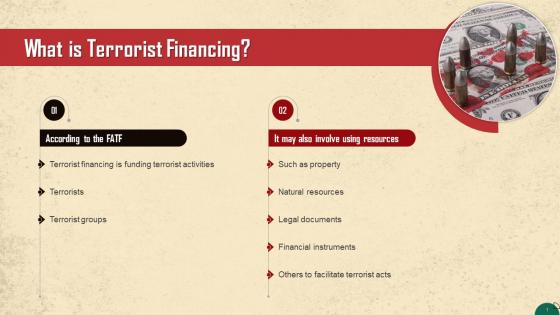
This slide gives the definition of terrorist financing. According to the FATF, terrorist financing is funding terrorist activities, terrorists, and terrorist groups.
Slide 2
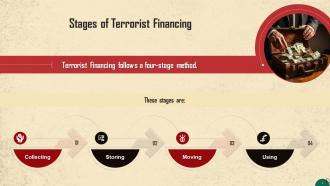
This slide showcases stages of terrorist financing. These are Collecting, Storing, Moving, and Using.
Instructor’s Notes:
- Collecting: In the first stage, funds are generated from sources intended for a terrorist or terror organization
- Storing: Funds can be stored through means such as bank and other accounts, pre-paid cards, and high-value commodities such as oil, art, agricultural products, precious metals, cryptocurrencies.
- Moving: When the terrorist organization has enough money and needs it, they relocate the money from the store to another location. The common mechanisms for moving funds include the traditional banking and financial sector, the Hawala financial system
- Using: The final stage is using the funds. There are many examples of how terrorists may spend their funds. These include using this money to pay for weapons, materials, equipment, media and training
Slide 3
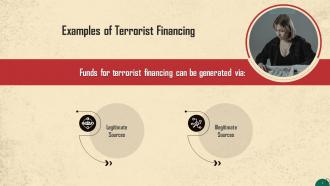
This slide discusses sources of terrorist financing. Funds for terrorist financing can be generated via legitimate as well as illegitimate sources.
Instructor’s Notes:
- Legitimate Sources: Many terrorist organizations run legitimate businesses. Some of the most prominent terrorist organizations ran fields where peanuts were grown and honey was produced. Some even ran trading businesses, tanneries
- Illegitimate Sources: Most terrorist organizations also rely on transnational crime, valued between USD 1.6 trillion and USD 2.2 trillion annually. Additionally, terrorist organizations also smuggle goods
Slide 4
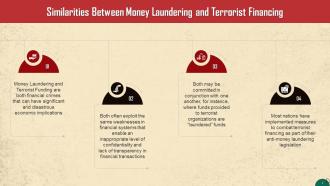
This slide highlights the similarities between money laundering and terrorist financing. Money laundering and terrorist funding are both financial crimes that can have major and disastrous economic implications.
Slide 5
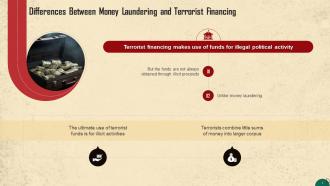
This slide lists the differences between money laundering and terrorist financing. Terrorist financing makes use of funds for illegal political activity, but the funds are not always obtained through illicit proceeds, unlike money laundering.
Terrorist Financing Concept In AML Training Ppt with all 24 slides:
Use our Terrorist Financing Concept In AML Training Ppt to effectively help you save your valuable time. They are readymade to fit into any presentation structure.














FAQs for Terrorist Financing Concept In
Terrorist organizations finance activities through hawala networks, cryptocurrency transactions, charitable front organizations, drug trafficking, kidnapping for ransom, and legitimate business infiltration. These methods enable groups to move funds across borders while avoiding traditional banking systems, with many organizations combining multiple approaches to diversify revenue streams and minimize detection risks.
The internet and cryptocurrency facilitate terrorist financing through anonymous transactions, encrypted communications, decentralized exchanges, crowdfunding platforms, and digital wallets that bypass traditional banking oversight. While these technologies present monitoring challenges for financial institutions and regulatory bodies, they also enable enhanced detection capabilities through blockchain analysis and AI-powered transaction monitoring, ultimately helping banks and security agencies identify suspicious patterns more effectively.
Non-profit organizations can unintentionally fund terrorist groups through inadequate due diligence processes, compromised intermediary partners, and insufficient oversight of fund distribution channels. While most organizations implement robust compliance frameworks, those operating in high-risk regions often find that strengthening verification protocols, enhanced monitoring systems, and strategic partnerships with financial intelligence units ultimately delivers greater transparency and operational security.
Countries combat terrorist financing through enhanced banking regulations, international intelligence sharing, suspicious transaction monitoring, asset freezing mechanisms, and cross-border collaboration frameworks. These comprehensive approaches enable financial institutions, law enforcement agencies, and regulatory bodies to detect illicit funding patterns more effectively, with many nations finding that coordinated efforts significantly disrupt terrorist networks while strengthening global financial security.
Legal frameworks to combat terrorist financing include the UN Convention for the Suppression of Terrorist Financing, national anti-terrorism financing acts, banking compliance regulations, and international sanctions regimes. These frameworks enable financial institutions and governments to detect suspicious transactions, freeze assets, and prosecute offenders, while enhancing global cooperation and ultimately delivering strengthened security and financial system integrity.
The relationship between organized crime and terrorist financing creates overlapping networks that blur jurisdictional boundaries, complicate intelligence gathering, and require coordinated responses across multiple agencies. These interconnected operations enable terrorists to exploit established criminal infrastructures for money laundering, arms trafficking, and resource acquisition, while organized crime benefits from terrorist operational expertise, ultimately forcing law enforcement to develop more sophisticated, multi-faceted counter-terrorism strategies.
International sanctions significantly disrupt terrorist financing by freezing assets, blocking financial transactions, restricting money transfers, and limiting access to legitimate banking systems. Through coordinated efforts between financial institutions and government agencies, organizations face reduced funding capabilities, operational constraints, and recruitment challenges, while sanctions ultimately force terrorist groups toward riskier, less efficient funding methods that increase their vulnerability to detection.
Financial institutions can enhance terrorist financing prevention through advanced transaction monitoring systems, real-time suspicious activity detection, enhanced customer due diligence protocols, and integrated data analytics platforms. These technologies streamline compliance by automating pattern recognition, cross-referencing global watchlists, and generating comprehensive audit trails, with many banks finding that proactive monitoring significantly reduces regulatory risks while improving operational efficiency.
Social media enables terrorist fundraising through encrypted messaging, crowdfunding campaigns, cryptocurrency solicitation, propaganda dissemination, and network coordination across platforms. While platforms increasingly implement detection algorithms and reporting mechanisms, terrorist organizations adapt by using private channels and coded language, with financial institutions finding that monitoring social media patterns helps identify suspicious transaction flows and funding networks.
Economic instability and socio-political turmoil create opportunities for terrorist organizations to exploit weakened regulatory systems, informal financial networks, and vulnerable populations for funding operations. These conditions enable groups to leverage cash-intensive economies, cross-border smuggling routes, and resource extraction in conflict zones, while governments increasingly focus on strengthening financial intelligence capabilities and regional cooperation to counter these adaptive financing strategies.
Law enforcement agencies face challenges including encrypted communications, use of informal money transfer systems, exploitation of legitimate businesses as fronts, cross-border jurisdictional complexities, and rapid adaptation of new technologies. These obstacles are compounded by limited international cooperation, resource constraints, and the time-sensitive nature of investigations, with many agencies finding that terrorists increasingly leverage cryptocurrency and hawala networks to evade traditional banking surveillance systems.
Terrorist groups adapt their financing methods by shifting to decentralized funding networks, exploiting cryptocurrency and digital payment systems, utilizing legitimate businesses as fronts, and leveraging informal value transfer systems like hawala. These evolving strategies enable groups to circumvent traditional banking monitoring, maintain operational funding across borders, and exploit regulatory gaps between jurisdictions, with many organizations finding that adaptability remains their most significant advantage in sustaining financial operations.
Technology can disrupt terrorist financing through AI-powered transaction monitoring, blockchain analysis tools, machine learning algorithms for pattern recognition, automated suspicious activity reporting, and cross-border payment tracking systems. These technologies enable financial institutions and law enforcement agencies to identify unusual fund flows, detect emerging money laundering schemes, and block illicit transactions in real-time, ultimately strengthening global security frameworks.
Anti-terrorist financing measures present both necessary security protections and civil liberty concerns, including privacy erosion, potential profiling, and restricted financial access for legitimate activities. While these measures enhance national security through monitoring suspicious transactions and freezing assets, financial institutions and governments increasingly balance surveillance capabilities with constitutional protections, ultimately delivering safer communities while preserving democratic freedoms through transparent oversight mechanisms.
Collaboration strengthens anti-terrorist financing efforts by enabling comprehensive information sharing, coordinated regulatory frameworks, and real-time threat intelligence across all sectors. Through strategic partnerships, governments enhance oversight capabilities, financial institutions streamline suspicious activity reporting, and civil society organizations provide grassroots monitoring, ultimately delivering faster threat detection and more effective resource allocation in an increasingly complex global financial landscape.
-
I was confident and well prepared for my presentation for the first time ever. With SlideTeam’s templates, I could deliver one of my best presentations. Will be coming back for more!
-
Unique and attractive product design.