

Test cases process breakdown risk mitigation reporting phase





Try Before you Buy Download Free Sample Product
 Impress Your
Audience
 100%
Editable
 Save Hours
of Time


Our Test Cases Process Breakdown Risk Mitigation Reporting Phase are topically designed to provide an attractive backdrop to any subject. Use them to look like a presentation pro.
People who downloaded this PowerPoint presentation also viewed the following :
Test cases process breakdown risk mitigation reporting phase with all 12 slides:
Use our Test Cases Process Breakdown Risk Mitigation Reporting Phase to effectively help you save your valuable time. They are readymade to fit into any presentation structure.

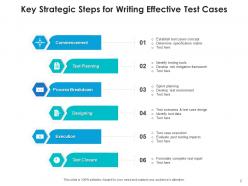
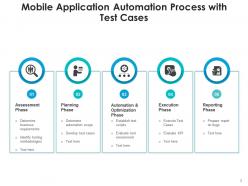

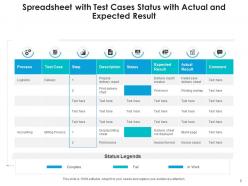
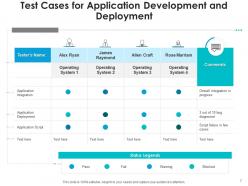



FAQs for Test cases process breakdown risk
A well-constructed test case includes clear test objectives, detailed preconditions, specific test steps, expected results, and defined acceptance criteria. These components streamline quality assurance processes by ensuring comprehensive coverage, reducing ambiguity, and enabling consistent execution across testing teams, ultimately delivering faster development cycles and more reliable software products for organizations.
Test case prioritization involves assessing business criticality, user frequency, regulatory compliance, complexity levels, and potential failure impact. Teams typically categorize functionality by revenue impact and customer experience risks, with banking systems prioritizing security tests, healthcare focusing on patient safety scenarios, and e-commerce emphasizing checkout processes, ultimately delivering optimized testing coverage within resource constraints.
Test case management in Agile methodologies streamlines sprint planning, ensures continuous integration quality, and maintains traceability across rapid development cycles. Through automated test suites and collaborative platforms, Agile teams accelerate feedback loops, reduce regression risks, and enhance product reliability, with many software organizations finding that structured test management ultimately delivers faster releases and improved customer satisfaction.
Automation enhances test case effectiveness by enabling faster execution, reducing human error, and providing consistent repeatability across multiple testing cycles. Through automated frameworks, organizations can execute thousands of test cases simultaneously, increase test coverage significantly, and deliver faster feedback to development teams, while reducing overall testing costs and accelerating time-to-market for software releases.
Common pitfalls include writing vague or ambiguous test steps, lacking clear expected results, poor test data management, insufficient coverage of edge cases, and creating overly complex scenarios. These issues streamline by establishing standardized templates, implementing peer review processes, and maintaining traceability matrices, with many development teams finding that systematic approaches ultimately deliver faster debugging, reduced defects, and enhanced software quality.
Test cases become reusable through standardized documentation, modular design, parameterization, and comprehensive metadata tagging that enables easy adaptation across projects. Many software development teams find that creating template-based test structures, maintaining centralized repositories, and designing scenario-independent validation logic ultimately delivers faster deployment cycles and significantly reduced testing costs for future initiatives.
Functional test cases verify that software features work as intended, testing specific functionalities like login processes, data validation, and user interactions against requirements. Non-functional test cases evaluate performance aspects like speed, security, usability, and scalability, with many organizations finding that combining both approaches delivers comprehensive quality assurance and enhanced user experiences.
The appropriate level of detail in test cases depends on team expertise, project complexity, regulatory requirements, and maintenance capacity. While experienced teams may require less detailed steps, complex systems and regulated industries like healthcare and finance benefit from comprehensive documentation, with many organizations finding that balancing clarity with maintainability ultimately delivers more efficient testing processes and better coverage.
**INPUT**: What techniques can be employed for effective test case design? **OUTPUT**: Effective test case design techniques include boundary value analysis, equivalence partitioning, decision table testing, state transition testing, and exploratory testing approaches. These methodologies streamline quality assurance by identifying critical failure points, reducing redundant testing efforts, and maximizing coverage across applications, with many software development teams finding that strategic combinations ultimately deliver faster release cycles and enhanced user experiences. [Word count: 60 words]
Test case alignment involves mapping requirements to specific test scenarios, tracing business objectives to validation criteria, and ensuring comprehensive coverage through requirement matrices and stakeholder reviews. Through systematic requirement analysis and user story decomposition, organizations streamline validation processes, minimize gaps, and accelerate delivery cycles, with many development teams finding that structured alignment reduces rework while ultimately delivering higher quality products and enhanced user experiences.
Test case effectiveness metrics include defect detection rate, code coverage percentage, test execution time, pass/fail ratios, and requirements traceability coverage. These measurements enable organizations to streamline their testing processes by identifying gaps, optimizing resource allocation, and enhancing software quality, with many development teams finding that comprehensive metrics ultimately deliver faster release cycles and improved customer experiences.
Test cases support regression testing by providing standardized, repeatable validation frameworks that ensure new code changes don't break existing functionality, enabling automated verification of critical system behaviors, user workflows, and integration points. Through comprehensive test suites, development teams can quickly identify defects, maintain software quality throughout iterative releases, and deliver consistent user experiences, ultimately reducing deployment risks and accelerating development cycles.
Collaboration between developers and testers improves test case design by enabling shared understanding of requirements, early identification of potential defects, comprehensive coverage of edge cases, and alignment on acceptance criteria. Through regular communication and joint planning sessions, development teams create more robust testing strategies, reduce rework cycles, and deliver higher quality software products, ultimately streamlining the development process while enhancing user experiences.
Handling test cases for complex integrated systems requires comprehensive test planning that includes unit testing, integration testing, API testing, end-to-end workflows, and data validation across all touchpoints. Through strategic test automation and environment simulation, organizations streamline quality assurance processes, minimize system failures, and ensure seamless functionality, ultimately delivering reliable user experiences and reducing costly post-deployment issues.
**INPUT**: What strategies can help in managing test case documentation efficiently? **OUTPUT**: Effective test case documentation strategies include centralized repositories, standardized templates, version control systems, automated documentation tools, and regular review cycles. These approaches streamline quality assurance by reducing redundancy, enhancing traceability, and enabling seamless collaboration across development teams, with many organizations finding that structured documentation ultimately accelerates testing processes and improves software reliability. [Word count: 54 words]
-
Helpful product design for delivering presentation.
-
Designs have enough space to add content.
-
Innovative and attractive designs.