


Testing process in agile scrum template ppt slide design




Try Before you Buy Download Free Sample Product
 Impress Your
 Audience
 100%
100% Editable
 Save Hours
 of Time


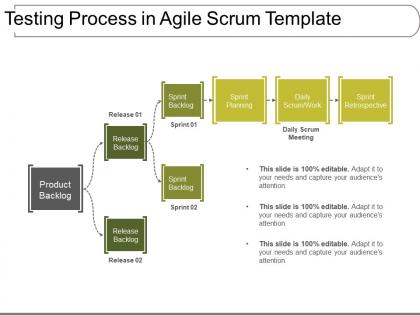
Walk in line with the changing market through our, testing process in agile scrum template PPT slide design. Rectify any flaws or if all the features are working properly or not, before your new product launch. We have shown an agile framework for managing your work. We have shown an eight-stage process here, through the help of arrow symbols we have directed the subsequent steps. Stages shown here are, product backlog, release backlog, spring backlog, sprint planning, daily scrum/work and spirit retrospective. This testing process flow PPT design covers up various aspects of strategically using the innovations of an application as an end-user. Execute steps like defect logging, test case creation, defect fix & verification and go through a complete requirement analysis to know what the destination application is going to be like. Prepare your future projects with us and enlighten folks on prejudice through our testing process in agile scrum template PPT slide design and ensure an aesthetic blend. Download to explore various features. Our Testing Process In Agile Scrum Template Ppt Slide Design help address growing demands. They build capability to cater.
People who downloaded this PowerPoint presentation also viewed the following :
Testing process in agile scrum template ppt slide design with all 5 slides:
Do away with dogma with our Testing Process In Agile Scrum Template Ppt Slide Design. They let your thoughts break free.



FAQs for Testing process in agile scrum template
Agile Scrum testing integrates continuously throughout development sprints, emphasizes collaborative cross-functional teams, prioritizes working software over documentation, and adapts quickly to changing requirements. Traditional methodologies follow sequential phases with distinct testing cycles, rely on comprehensive documentation, and implement rigid change control processes, while Scrum enables faster feedback loops, iterative quality assurance, and ultimately delivers more responsive products that better meet evolving customer needs.
Test-driven development integrates into Agile Scrum through sprint planning incorporation, daily standup coordination, and continuous integration practices that align testing cycles with development sprints. This strategic combination enables teams to deliver higher-quality code faster, reduce debugging time significantly, and maintain consistent velocity across iterations, with many software organizations finding that TDD enhances their sprint predictability and overall delivery confidence.
The Product Owner defines acceptance criteria, prioritizes testing requirements, and validates that developed features meet business expectations and user needs. Throughout the sprint, they collaborate closely with testers and developers to clarify requirements, participate in sprint reviews, and make real-time decisions on defect priorities, ultimately ensuring delivered increments align with stakeholder value and market demands.
Regression testing in Agile Scrum environments is handled through automated test suites, continuous integration pipelines, and iterative testing cycles within each sprint. Teams streamline this process by implementing test automation frameworks, maintaining comprehensive test repositories, and conducting regular regression checks, with many development teams finding that automated regression testing significantly reduces deployment risks while accelerating delivery timelines.
**INPUT**: What techniques can the Scrum Team use to ensure effective collaboration between testers and developers? **OUTPUT**: Effective collaboration techniques include pair programming, shared testing responsibilities, early test case reviews, cross-functional stand-ups, and collaborative sprint planning sessions. These approaches streamline quality assurance by breaking down silos, enabling continuous feedback, and fostering shared ownership of deliverables, with many development teams finding that integrated testing practices ultimately accelerate delivery cycles while enhancing product reliability. **Word count: 58 words**
Automated testing tools support Agile Scrum by enabling continuous integration, accelerating sprint cycles, and maintaining code quality through rapid feedback loops. These tools streamline regression testing, facilitate test-driven development, and enhance collaboration between development and QA teams, with many organizations finding that automated frameworks reduce manual testing overhead by 60-70%, ultimately delivering faster releases and improved product reliability.
Continuous testing in Agile Scrum delivers faster feedback cycles, reduced defect costs, improved code quality, enhanced team collaboration, and accelerated release timelines. This approach enables development teams to identify issues earlier in sprints, streamline debugging processes, and maintain consistent product quality, with many software organizations finding that continuous testing ultimately enhances customer satisfaction and competitive delivery speed.
Testing should be prioritized in the Sprint backlog based on business value, risk assessment, and dependencies, with high-priority user stories receiving corresponding test coverage first. Teams typically integrate testing throughout development cycles rather than treating it as a separate phase, ensuring critical functionalities like payment processing or user authentication are validated early, ultimately delivering more reliable products and faster feedback loops.
Scrum teams implementing UAT often face challenges including limited stakeholder availability, unclear acceptance criteria, compressed testing timelines, coordination between development and business teams, and managing feedback iterations within sprint constraints. These obstacles can delay releases and impact quality, but teams increasingly find that establishing clear UAT protocols early, maintaining continuous stakeholder engagement, and integrating automated testing frameworks ultimately streamlines the process and enhances delivery predictability.
Scrum teams ensure rapid testing feedback integration through continuous integration pipelines, daily standups for immediate issue discussion, and embedded testers working alongside developers throughout each sprint. This approach enables real-time defect resolution, accelerated iteration cycles, and seamless communication between testing and development, with many software organizations finding that integrated testing reduces deployment risks while delivering faster, higher-quality releases.
Testing effectiveness in Agile Scrum can be measured through defect detection rate, test coverage percentage, sprint burndown charts, cycle time, and customer satisfaction scores. These metrics enable teams to track quality improvements, identify bottlenecks, and optimize testing processes, with many organizations finding that combining quantitative and qualitative measures ultimately delivers faster releases and enhanced product reliability.
Exploratory testing complements scripted testing by uncovering unexpected issues, validating user experience scenarios, and adapting to evolving requirements that scripted tests might miss. This strategic combination enables development teams to maintain comprehensive coverage while remaining agile, with many organizations finding that exploratory testing reveals critical usability and edge-case issues, ultimately delivering more robust products.
The definition of "done" establishes comprehensive testing criteria that must be met before any user story can be considered complete, including unit tests, integration tests, code reviews, and user acceptance validation. This standardized approach streamlines quality assurance by ensuring consistent testing protocols across all sprint deliverables, ultimately delivering faster releases and enhanced product reliability for development teams.
Managing testing lifecycle events in Sprints requires continuous integration testing, sprint-based test planning, automated regression suites, cross-functional collaboration, and early defect detection strategies. These approaches streamline quality assurance by embedding testing throughout development cycles, enabling faster feedback loops, and maintaining sprint velocity, with many agile teams finding that integrated testing ultimately delivers higher software quality and reduced time-to-market.
Scrum facilitates early defect detection through short sprints with continuous testing, daily standups for immediate issue identification, and sprint reviews that gather stakeholder feedback before final delivery. This iterative approach enables development teams to address bugs within days rather than months, with many software companies finding that integrated testing throughout each sprint reduces overall project costs by 40-60% while delivering higher-quality products.
-
Good research work and creative work done on every template.
-
Wonderful templates design to use in business meetings.