

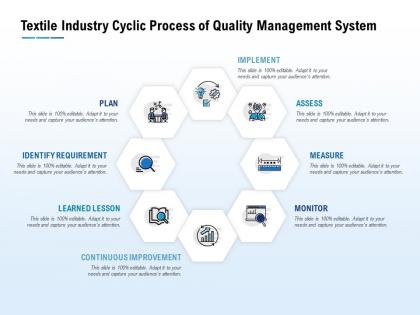
Textile industry cyclic process of quality management system




Try Before you Buy Download Free Sample Product
 Impress Your
 Audience
 100%
100% Editable
 Save Hours
 of Time


Address joint gatherings with our Textile Industry Cyclic Process Of Quality Management System. Be able to inspire every individual.
People who downloaded this PowerPoint presentation also viewed the following :
Textile industry cyclic process of quality management system with all 5 slides:
Our Textile Industry Cyclic Process Of Quality Management System enable you to inspire every individual. It becomes easy to address joint gatherings.




FAQs for Textile industry cyclic process of
The Textile Quality Management Cycle involves raw material inspection, incoming quality control, in-process monitoring, pre-production testing, and final product evaluation. These stages streamline operations by identifying defects early, ensuring consistency throughout manufacturing, and maintaining brand standards, with many textile manufacturers finding that systematic quality cycles ultimately reduce waste, enhance customer satisfaction, and deliver competitive advantage in increasingly demanding markets.
Quality management significantly enhances textile manufacturing productivity by streamlining processes, reducing defects, minimizing waste, and optimizing resource allocation throughout production cycles. Through systematic quality controls, manufacturers achieve faster production speeds, lower rework costs, and improved operational efficiency, with many textile companies finding that comprehensive quality systems ultimately deliver 15-30% productivity gains and stronger competitive positioning.
Raw material selection serves as the foundation of the Textile Quality Management Cycle, determining fiber quality, durability, performance characteristics, and final product specifications. This strategic selection process enables manufacturers to streamline production workflows, minimize defects, and enhance customer satisfaction, with many textile companies finding that investing in premium raw materials ultimately delivers competitive advantage and reduced long-term costs.
Advanced technologies like AI and IoT enhance textile quality control by enabling real-time monitoring throughout production, predictive defect detection, automated inspection systems, and comprehensive data analytics for pattern identification. Through smart sensors and machine learning algorithms, manufacturers can detect fabric irregularities, color variations, and structural defects instantly, while optimizing production parameters, reducing waste by up to 30%, and ultimately delivering consistent quality standards that strengthen brand reputation in increasingly competitive textile markets.
Common textile quality issues include fabric defects like pilling and shrinkage, color inconsistencies, dimensional instability, seam failures, and contamination during processing. These challenges can be addressed through automated inspection systems, standardized dyeing protocols, pre-shrinking treatments, and rigorous supplier auditing, with many manufacturers finding that integrated quality management systems significantly reduce defects while enhancing production efficiency and customer satisfaction.
International quality standards significantly impact the textile industry by establishing manufacturing benchmarks, ensuring product consistency, facilitating global trade compliance, and driving operational improvements across production facilities. These standards enable textile manufacturers to access international markets, reduce defect rates, and streamline supply chain processes, with many companies finding that compliance ultimately delivers enhanced brand reputation and competitive advantage in increasingly quality-conscious consumer markets.
Textile quality testing methods include fiber strength analysis, colorfastness testing, dimensional stability checks, fabric weight measurements, and seam strength evaluations. These techniques enable manufacturers to detect defects early, ensure compliance with international standards, and maintain consistent product quality, with many textile companies finding that systematic inspection processes reduce returns and enhance customer satisfaction.
Employee training and engagement enhance textile quality management by developing technical skills, promoting quality awareness, and fostering accountability across production teams. Well-trained staff identify defects earlier, implement best practices consistently, and maintain equipment properly, while engaged employees actively contribute to continuous improvement initiatives, ultimately reducing waste, minimizing rework, and delivering superior textile products that meet stringent quality standards.
Best practices for implementing a textile quality management system include establishing clear quality standards, conducting regular supplier audits, implementing real-time monitoring protocols, training staff comprehensively, and maintaining detailed documentation processes. These approaches enhance operational efficiency by minimizing defects, streamlining production workflows, and ensuring compliance standards, with many textile manufacturers finding that systematic quality management ultimately delivers reduced costs and improved customer satisfaction.
Sustainability practices integrate into the Textile Quality Management Cycle through eco-friendly material sourcing, water-efficient processing methods, waste reduction protocols, and circular design principles. These approaches enable textile manufacturers to minimize environmental impact while maintaining quality standards, with many companies finding that sustainable practices ultimately deliver cost savings, enhanced brand reputation, and competitive advantage in increasingly conscious markets.
Key textile quality metrics include defect rates per batch, customer complaint frequency, production yield percentages, fabric strength and durability measurements, and compliance scores with industry standards. These indicators enable manufacturers to streamline operations, reduce waste costs, and enhance product consistency, with many textile companies finding that systematic tracking delivers improved customer satisfaction and competitive advantage in increasingly demanding markets.
Customer feedback and market trends significantly influence textile quality standards by driving demand for enhanced durability, sustainability, comfort, and performance characteristics. Through consumer insights and industry analysis, textile manufacturers adjust production processes, material selection, and testing protocols, with fashion brands, athletic wear companies, and home textile producers finding that responsive quality adaptation delivers competitive advantage and increased customer loyalty.
Continuous improvement within the Textile Quality Management Cycle can be fostered through regular performance reviews, employee feedback systems, advanced analytics integration, cross-departmental collaboration, and systematic process audits. These approaches streamline operations by identifying bottlenecks, enhancing fabric consistency, and reducing waste, with many textile manufacturers finding that data-driven insights ultimately deliver faster production cycles and improved customer satisfaction.
Risk management integrates into textile quality assurance through hazard identification, risk assessment protocols, preventive controls, and continuous monitoring systems. These approaches streamline quality processes by establishing critical control points, implementing supplier audits, and creating corrective action procedures, with many textile manufacturers finding that proactive risk strategies ultimately deliver reduced defects and enhanced product reliability.
**INPUT**: What case studies exemplify successful textile quality management implementations? **OUTPUT**: Successful textile quality management implementations include Zara's fast-fashion quality systems, Patagonia's sustainable material standards, Nike's supply chain transparency initiatives, and H&M's supplier audit programs. These companies streamline operations through automated testing, real-time monitoring, and comprehensive supplier partnerships, ultimately delivering consistent product quality, reduced waste, and enhanced customer satisfaction while maintaining competitive advantage in increasingly demanding markets. **Word count: 60 words**
No Reviews