

The Role Of Soil Microorganisms PPT Structure ACP





Try Before you Buy Download Free Sample Product
 Impress Your
Audience
 100%
Editable
 Save Hours
of Time


Explore the intricate world of soil microorganisms with our professional PowerPoint presentation deck. This comprehensive guide delves into their essential roles in ecosystem health, nutrient cycling, and soil fertility. Perfect for educators and researchers, it features engaging visuals and structured content to enhance understanding and foster discussion.
People who downloaded this PowerPoint presentation also viewed the following :
The Role Of Soil Microorganisms PPT Structure ACP with all 9 slides:
Use our The Role Of Soil Microorganisms PPT Structure ACP to effectively help you save your valuable time. They are readymade to fit into any presentation structure.
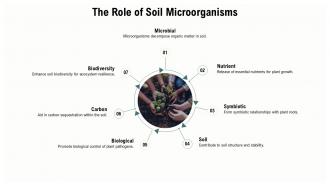








FAQs for The Role Of Soil Microorganisms
So there's basically four main types of microorganisms in soil - bacteria, fungi, protozoa, and nematodes. Bacteria are your nutrient recyclers, breaking down organic stuff and handling nitrogen cycles. Fungi create these cool web-like networks that help plants grab water and nutrients while improving soil structure. Then you've got protozoa acting like tiny cleanup crews, munching on bacteria and fungi to release more nutrients. Nematodes keep pests in check and boost nutrient cycling too. Honestly, just throw some compost or organic matter at your soil and avoid harsh chemicals - these little guys will handle the rest. They're basically doing all the work for you anyway.
So basically those tiny microbes in your soil are like nature's cleanup crew. They're constantly breaking down dead stuff - leaves, roots, whatever - and turning it into nutrients plants can actually absorb. Bacteria handle a lot of the heavy lifting with decomposition, while some even grab nitrogen straight from the air (which is wild if you think about it). Fungi are in there doing their thing too. Without them, all those nutrients would just be stuck in dead material doing nothing. If you want to check how healthy your soil is, look at microbial activity first.
Dude, soil microbes are seriously amazing for plants. They break down organic stuff into nutrients plants can actually use. Plus mycorrhizal fungi team up with roots to expand their whole network - it's wild how that works. Some bacteria literally pull nitrogen right out of the air, which honestly blows my mind. They also fight off the bad stuff that tries to attack your plants. Just throw some compost or organic matter at your soil and don't go crazy with chemicals. Trust me, you'll see way stronger, healthier plants.
So pH and moisture are basically the big players here. Bacteria love neutral to slightly alkaline soil (pH 6-8), but fungi can handle the acidic stuff (pH 4-6). Moisture's huge too - not enough and the microbes basically shut down, but too much creates those nasty anaerobic conditions. I swear, these little guys are so picky! Oh, and if you're dealing with clay soil, moisture becomes even trickier to manage. Definitely test both factors first - they'll give you a solid picture of what microbial communities you're working with.
For soil microbial diversity, DNA sequencing is definitely where you wanna start - 16S rRNA for bacteria, ITS for fungi. Way better than the old cultivation stuff that missed most microbes anyway. PLFA analysis works too if you want functional profiles, plus enzyme assays show metabolic activity. Culture methods are kinda outdated honestly since like 99% of soil microbes won't grow in labs. DNA sequencing costs more but gives you the real picture of what's down there. Oh, and if budget's tight, enzyme assays are a decent backup option.
So basically, your soil is like a crazy underground city. Bacteria and fungi are constantly fighting over food, but they also team up with plant roots - mycorrhizal partnerships, nitrogen fixation, all that good stuff. Then you've got tiny predators like protozoa that eat the bacteria, which sounds bad but actually releases nutrients back into the mix. Wild, right? Meanwhile earthworms and bugs are chomping through dead leaves, creating fresh real estate for more microbes to move in. My advice? Keep adding compost and don't go nuts with chemicals - these little guys are way more sensitive than you'd think.
Think of soil microbes as nature's janitors - they're constantly breaking down dead plants and organic stuff into nutrients that living plants can actually absorb. Bacteria and fungi team up for this whole decomposition process. Without them? You'd have piles of dead material just sitting there, which sounds gross but also explains why some soils are terrible. The cool part is it's basically a recycling loop that keeps going. If you want your soil healthy, just keep it moist and add organic matter occasionally. Those little microbes will do the rest of the work for you.
So basically you've got two options - work with the microbes already in your soil or add new ones that eat specific pollutants. Test what's there first though, you might get lucky and just need to feed them better. Pseudomonas bacteria are solid for oil spills, fungi handle organic stuff really well. pH and oxygen levels matter a ton - think of it like keeping pets happy, honestly. Oh and nutrients too, obviously. It's pretty wild that these tiny things can clean up our messes around the clock without complaining.
So basically farming practices totally wreck the little critters living in your soil - bacteria, fungi, all that stuff. Tillage and pesticides especially kill off diversity. Without those fungal networks, plants can't grab nutrients as well. Water retention goes down the drain too. Monocultures are honestly the worst for this since they don't feed different microbes. But here's the thing - cover crops and cutting back on tilling actually helps a ton. My neighbor started doing this and saw results pretty quick. Even small organic amendments make a difference in rebuilding that whole underground world.
Think of soil microbes as tiny construction workers - they're constantly building the framework that keeps soil healthy. Bacteria and fungi pump out these sticky substances that cement soil particles into clumps. Fungal threads are the real MVPs here, weaving through everything like microscopic ropes. All this activity creates those crucial air pockets for water and oxygen to flow through. Kill off your microbial community and you'll end up with concrete-hard dirt that nothing wants to grow in. My advice? Keep feeding them compost and organic scraps, and lay off the harsh chemicals. Those little guys do all the heavy lifting if you just don't mess with them too much.
So warmer temps do speed up your soil microbes initially - they get more active and break down stuff faster. But then moisture becomes a problem because heat dries everything out. Some microbes love it, others hate it, so you get this whole species shift happening. The annoying part? All that extra microbial activity can actually reduce your soil carbon since they're decomposing organic matter quicker than plants add it back. I'd definitely watch your soil moisture more if temps are climbing - that's gonna be your limiting factor.
So microbial inoculants are like adding a bunch of helpful bacteria and fungi to your soil - they team up with plant roots and make everything work better. Your plants get more nutrients, fight off diseases easier, and you'll see better yields without dumping tons of chemicals everywhere. The nitrogen-fixing ones? Total money saver on fertilizer costs. Plus they help crops handle weird weather - droughts, heat waves, whatever. Honestly, if you're trying to farm more sustainably, I'd start with legumes since they love those rhizobia inoculants. Way easier than jumping into the deep end.
Yeah, so pesticides definitely mess with soil microbes. Some get wiped out completely - especially with fungicides, which makes sense. But here's the weird part: other microbes actually do better because there's less competition. It's basically like clearing out a crowded room. The whole thing depends on what chemical you're using, how much, and how long it sticks around. Honestly, if you're worried about keeping your soil healthy, you might want to test the microbial activity before and after spraying. Or just go with more targeted stuff that won't nuke all the good bacteria too.
Compacted soil basically suffocates all the good microbes living in there. You're crushing the air pockets they need to survive, which really screws over aerobic bacteria. Plus those fungal networks get torn apart - kinda like trying to grow roots through a brick wall. Water can't move around either, so nutrients just sit there instead of cycling properly. Honestly, the damage spreads faster than you'd think. Best thing you can do is keep heavy equipment off wet ground and maybe throw down some cover crops. Organic matter helps too - gives the soil structure something to rebuild around. Those microbial communities will come back, but it takes time.
So basically you can grab beneficial bacteria from healthy soil - stuff like Rhizobium and Azotobacter that fix nitrogen. Culture them in a lab, then make your own biofertilizer to put on seeds or dirt. Pretty cool actually! These little guys team up with plant roots and do all the work of pulling nitrogen from air or freeing up nutrients plants can't normally reach. Way better than dumping synthetic fertilizer everywhere. Oh, and it keeps your soil healthier long-term too. I'd start by figuring out what good microbes you've already got in your local soil first though.
-
I was mind-blown by the services that SlideTeam provided me. Thanks a ton!
-
I was able to find the right choice of PPT template for my thesis with SlideTeam. Thank you for existing.