

Thought Leadership Strategy Framework Levels




Try Before you Buy Download Free Sample Product
 Impress Your
 Audience
 100%
100% Editable
 Save Hours
 of Time


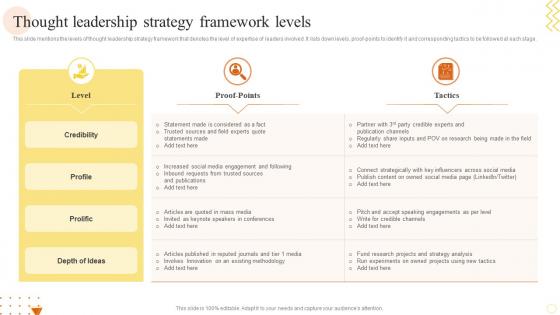
This slide mentions the levels of thought leadership strategy framework that denotes the level of expertise of leaders involved. It lists down levels, proof points to identify it and corresponding tactics to be followed at each stage.
People who downloaded this PowerPoint presentation also viewed the following :
Thought Leadership Strategy Framework Levels with all 6 slides:
Use our Thought Leadership Strategy Framework Levels to effectively help you save your valuable time. They are readymade to fit into any presentation structure.






FAQs for Thought Leadership
Thought leadership strategy frameworks encompass content creation, distribution channels, audience engagement, and measurable impact, ultimately establishing credibility. These approaches streamline brand positioning by leveraging blog posts, webinars, social media, and industry events, with many financial services and healthcare institutions finding that consistent, valuable content enhances trust and attracts qualified leads, ultimately delivering competitive advantage and increased market share.
Organizations can identify expertise through internal audits of successful projects, client feedback analysis, and competitive benchmarking, subsequently leveraging these strengths via targeted content creation. While subject matter expertise is crucial, it also requires aligning insights with industry trends, with many institutions finding that a strategic combination of data-driven analysis and compelling storytelling enhances credibility and ultimately delivers increased brand recognition and competitive advantage.
Audience segmentation is crucial for thought leadership, enabling tailored content addressing specific pain points, industry challenges, and aspirational goals. While broad reach seems appealing, it also risks diluting messaging, necessitating focused efforts on key demographics like banking executives or healthcare administrators. These technologies streamline content creation by prioritizing relevant themes, ultimately delivering enhanced engagement and establishing credible expertise within targeted niches.
Content marketing tactics integrate into a thought leadership framework by consistently delivering valuable insights, fostering industry conversations, and showcasing expertise through blogs, webinars, and whitepapers. While promotional content maintains a necessary presence, prioritizing educational resources—like those utilized by banks and hospitals—enhances credibility, ultimately driving engagement and establishing a respected voice in an increasingly competitive landscape.
Thought leadership success is measured through website traffic, social media engagement, and lead generation, alongside media mentions and analyst inquiries. These metrics enhance brand reputation by demonstrating expertise, ultimately delivering increased sales opportunities and competitive advantage, with many organizations finding that consistent content drives significant pipeline growth.
Collaboration with industry influencers enhances a thought leadership strategy by amplifying reach, building credibility, and fostering engagement. While organic content creation remains vital, influencer partnerships deliver access to established audiences across sectors like finance and healthcare, ultimately streamlining brand messaging and accelerating market penetration. With many organizations finding that co-created content generates significantly higher lead quality and establishes lasting authority, this approach delivers competitive advantage and increased brand visibility.
Thought leadership framework implementation often stumbles with inconsistent content, lack of executive buy-in, and unclear audience targeting, plus failing to measure impact or differentiate from competitors. These challenges present both opportunities and risks, with many organizations finding that a strategic combination of content diversification, robust analytics, and cross-departmental alignment ultimately delivers enhanced brand reputation and competitive advantage.
Maintaining authentic voice and credibility in thought leadership requires consistent messaging, transparent expertise, and genuine engagement with industry challenges. Businesses achieve this by showcasing unique perspectives, sharing data-driven insights, and fostering open dialogue, with many financial services and healthcare institutions finding that vulnerability builds trust. Ultimately delivering stronger brand resonance and establishing lasting authority in an increasingly competitive landscape.
Emerging trends for thought leadership include AI-powered content creation, short-form video dominance, personalized content experiences, and the rise of niche communities. These technologies streamline content delivery by enhancing reach, fostering engagement, and enabling data-driven insights, with many financial services and healthcare institutions finding that authentic, value-driven content ultimately builds trust and competitive advantage.
Thought leadership strategies drive innovation by fostering external engagement, internal knowledge sharing, and proactive trend analysis. While requiring consistent content creation and expert participation, it also enables organizations to identify emerging opportunities, benchmark against competitors, and refine offerings. With many financial services and healthcare institutions finding that consistent thought leadership enhances internal collaboration, ultimately delivering a competitive advantage and accelerated product development.
Thought leadership strategies encompass content repurposing, strategic SEO implementation, and consistent cross-platform promotion—including LinkedIn, Twitter, and industry blogs. These technologies enhance reach by tailoring messaging to each channel, fostering engagement through interactive formats, and ultimately delivering increased brand visibility and qualified lead generation, with many organizations finding that a multi-faceted approach yields the strongest results.
Thought leadership alignment requires organizations to define clear business goals, identify key audience challenges, and create content addressing those needs. These strategies streamline marketing and sales by establishing credibility, enhancing brand reputation, and generating qualified leads. With many institutions finding that consistent, value-driven content ultimately delivers increased market share and stronger customer relationships.
Thought leadership execution benefits from content management systems, social listening tools, data analytics platforms, and SEO optimization software. These technologies streamline content creation by facilitating research, distribution, and performance tracking, with many marketing institutions finding that integrated platforms enhance campaign reach. Ultimately delivering increased brand visibility and establishing credible industry expertise.
Cultural and industry differences significantly impact thought leadership frameworks by necessitating nuanced content, tailored messaging, and varied distribution channels. While universal principles like originality and value apply, effective strategies require acknowledging regional sensitivities, industry-specific jargon, and preferred communication styles—with many organizations finding that localized content resonates more deeply. These approaches enhance engagement, build trust across diverse audiences, and ultimately deliver stronger brand authority and competitive advantage in an increasingly global landscape.
Storytelling plays a crucial role in impactful thought leadership by humanizing data, fostering emotional connections, and illustrating complex ideas through relatable narratives. While data presents facts, stories deliver context, enabling audiences across sectors like healthcare and finance to grasp nuanced concepts and remember key takeaways. These narratives enhance engagement, build trust, and ultimately deliver stronger brand resonance and competitive advantage, with many institutions finding that authentic storytelling drives measurable influence.
-
Professional and unique presentations.
-
Really like the color and design of the presentation.