

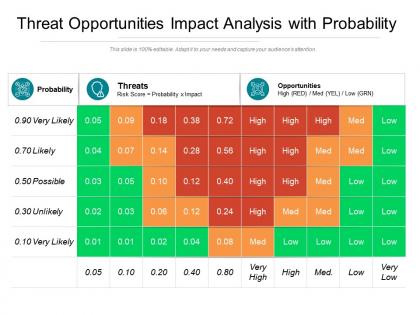
Threat opportunities impact analysis with probability




Try Before you Buy Download Free Sample Product
 Impress Your
Audience
 100%
Editable
 Save Hours
of Time


Our Threat Opportunities Impact Analysis With Probability are topically designed to provide an attractive backdrop to any subject. Use them to look like a presentation pro.
People who downloaded this PowerPoint presentation also viewed the following :
Threat opportunities impact analysis with probability with all 2 slides:
Use our Threat Opportunities Impact Analysis With Probability to effectively help you save your valuable time. They are readymade to fit into any presentation structure.


FAQs for Threat opportunities impact
A comprehensive threat opportunities impact analysis includes threat identification, vulnerability assessment, probability evaluation, impact quantification, and strategic response planning. These components work together by systematically mapping potential risks, evaluating their likelihood and consequences, and developing mitigation strategies, with many organizations finding that this structured approach enhances decision-making and competitive positioning.
Organizations can effectively identify potential threats through comprehensive risk assessments, environmental scanning, stakeholder feedback, competitive intelligence gathering, and scenario planning exercises. These methodologies enable companies to monitor regulatory changes, technological disruptions, and market shifts, with many financial institutions and healthcare organizations finding that proactive threat identification ultimately delivers enhanced preparedness and competitive resilience.
Techniques include SWOT analysis, scenario planning, market research, competitive benchmarking, and financial modeling to assess strategic alignment and potential returns. These methods enable organizations to evaluate opportunities through risk assessment, resource allocation analysis, and strategic fit evaluation, with many companies finding that systematic opportunity analysis delivers enhanced decision-making and sustainable competitive advantage.
Threat opportunities impact analysis varies significantly across industries due to different risk profiles, regulatory environments, and operational complexities. Financial services focus on cyber threats and market volatility, while healthcare emphasizes patient data security and regulatory compliance, and manufacturing prioritizes supply chain disruptions and operational continuity, ultimately enabling sector-specific strategic responses.
Data analytics plays a crucial role in threat and opportunity assessment by processing vast datasets, identifying patterns and trends, predicting potential risks, and uncovering market gaps or emerging opportunities. Through advanced algorithms and real-time monitoring, organizations across financial services, retail, and healthcare can quantify threats, prioritize responses, and capitalize on competitive advantages, ultimately delivering faster decision-making and strategic positioning.
Stakeholder input enhances threat opportunities impact analysis by providing diverse perspectives, insider knowledge of operational vulnerabilities, and real-world context that data alone cannot capture. Through cross-functional collaboration, organizations gather comprehensive insights from finance, operations, and frontline teams, ultimately delivering more accurate risk assessments and strategic responses, with many companies finding that inclusive analysis reduces blind spots significantly.
Common pitfalls include overlooking low-probability high-impact scenarios, relying on outdated data, conducting analysis in silos without cross-departmental input, and failing to quantify potential financial impacts. These oversights can lead organizations to misallocate resources and miss critical strategic opportunities, with many financial services and healthcare institutions finding that comprehensive, regularly updated assessments ultimately deliver more accurate risk mitigation and competitive positioning.
Emerging technologies influence threat landscapes by creating new attack vectors, enabling sophisticated cybercriminal techniques, and expanding organizational vulnerability surfaces through increased connectivity and data exposure. However, these same technologies also enhance security capabilities, with AI-powered threat detection, automated response systems, and advanced encryption helping organizations stay ahead of evolving risks.
Metrics include risk reduction percentages, response time improvements, cost savings from prevented incidents, stakeholder satisfaction scores, and implementation success rates of recommended actions. These indicators enable organizations to measure operational efficiency, strategic preparedness, and competitive advantage gained through proactive threat management, with many enterprises finding that comprehensive measurement frameworks ultimately deliver enhanced decision-making capabilities and organizational resilience.
Organizations can prioritize threats and opportunities by assessing potential financial impact, likelihood of occurrence, strategic alignment with business goals, and implementation timeframes. Through risk assessment matrices and stakeholder consultation, companies like financial institutions and healthcare providers systematically rank scenarios, ultimately enabling resource allocation toward high-impact initiatives while mitigating critical vulnerabilities.
Several frameworks guide threat opportunities impact analysis, including SWOT analysis, PEST analysis, scenario planning, risk matrices, and Monte Carlo simulations. These strategic tools enable organizations to systematically evaluate potential threats across financial services, healthcare, and manufacturing sectors, with many companies finding that structured frameworks enhance decision-making accuracy and competitive positioning.
Scenario planning integrates into threat opportunities impact assessments by developing multiple future scenarios, mapping potential threat pathways, and evaluating cascading effects across different operational contexts. Through strategic modeling, organizations can stress-test their resilience frameworks, identify emerging opportunities within threats, and enhance preparedness strategies, ultimately delivering more robust risk management and competitive positioning in uncertain environments.
A poorly executed threat opportunities analysis can result in inadequate risk mitigation strategies, misallocated resources, and vulnerability to unexpected disruptions that compromise operational stability. These oversights often lead to extended downtime, revenue losses, and damaged stakeholder confidence, with many organizations finding that insufficient analysis ultimately undermines their competitive positioning and long-term resilience.
Threat opportunities impact analysis should be revisited quarterly at minimum, with updates triggered by major market shifts, regulatory changes, competitive developments, or internal strategic pivots. Many organizations increasingly implement continuous monitoring systems that track key indicators in real-time, enabling proactive adjustments to risk mitigation strategies and opportunity capture mechanisms, ultimately delivering enhanced agility and competitive positioning.
Organizations can turn threats into opportunities through strategic reframing, competitive analysis, resource reallocation, innovation initiatives, and partnership development. By leveraging market disruptions as catalysts for transformation, companies in sectors like retail and financial services often discover new revenue streams, enhanced operational efficiency, and competitive advantages that ultimately strengthen their market position.
No Reviews