


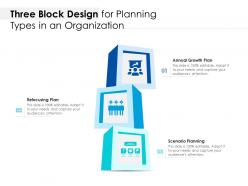
Three block design for planning types in an organization





Try Before you Buy Download Free Sample Product
 Impress Your
Audience
 100%
Editable
 Save Hours
of Time


Our Three Block Design For Planning Types In An Organization are topically designed to provide an attractive backdrop to any subject. Use them to look like a presentation pro.
People who downloaded this PowerPoint presentation also viewed the following :
Three block design for planning types in an organization with all 2 slides:
Use our Three Block Design For Planning Types In An Organization to effectively help you save your valuable time. They are readymade to fit into any presentation structure.

FAQs for Three block design for planning types
Three-block design principles include visual hierarchy, balanced content distribution, logical flow progression, clear focal points, and strategic white space utilization. This structured approach streamlines complex information by dividing content into digestible segments, enhancing audience comprehension and retention, while enabling presenters to deliver more impactful messaging that drives engagement and decision-making.
The three-block design enhances audience engagement by creating visual hierarchy, simplifying complex information, and maintaining focus through structured content organization. This approach enables presenters to guide attention systematically across key points, with many organizations finding that audiences retain information more effectively when content is divided into digestible segments, ultimately delivering clearer communication and stronger presentation outcomes.
The three-block design offers enhanced visual hierarchy, improved audience engagement, and flexible content organization compared to linear formats. This structure enables presenters to emphasize key relationships between concepts, streamline complex information delivery, and accommodate different learning styles simultaneously, with many organizations finding that audiences retain information more effectively through this strategic, modular approach.
The three-block design adapts through flexible content allocation, audience-specific messaging, visual complexity adjustments, and strategic emphasis shifts based on demographics and subject matter. Organizations across sectors, from healthcare presenting patient data to financial services explaining investment strategies, customize block proportions, terminology depth, and visual elements to match audience expertise levels, ultimately delivering more targeted communication and enhanced comprehension.
Visuals can be integrated through strategic placement of charts, graphs, infographics, icons, and images that directly support each block's core message. In the first block, compelling data visualizations establish credibility, the middle block benefits from process diagrams or comparison charts, and the final block leverages outcome-focused graphics, with many organizations finding that cohesive visual elements enhance audience engagement and message retention significantly.
Common pitfalls include overcrowding blocks with excessive text, creating unequal visual weight between sections, using inconsistent formatting across blocks, and failing to establish clear hierarchical relationships. These design missteps can confuse audiences and dilute key messages, with many presenters finding that maintaining balanced content distribution, consistent typography, and logical flow ultimately delivers clearer communication and stronger audience engagement.
The three-block design creates compelling narratives by establishing context in the first block, developing tension or conflict in the second, and delivering resolution in the third. This structure enables organizations to craft presentations, marketing campaigns, and strategic communications that guide audiences through logical progression, building engagement systematically while ensuring clear messaging and memorable conclusions.
Each block should include a clear headline, concise explanatory text, and relevant visual element like an icon or image, ensuring consistent typography and balanced white space throughout. Strategic placement of these elements enhances readability and engagement, with many organizations finding that maintaining visual hierarchy through size, color, and positioning ultimately delivers stronger audience comprehension and message retention.
The three-block design facilitates better retention by organizing information into digestible segments that align with cognitive processing patterns, reducing mental overload and creating clear progression pathways. This structured approach enables audiences to process complex concepts systematically, with many educational institutions and corporate training programs finding that participants retain 40-60% more information compared to traditional linear presentations.
Storytelling within three-block design serves as the narrative thread connecting problem identification, solution development, and outcome presentation across all blocks. This framework enables organizations, from healthcare systems to financial institutions, to craft compelling presentations by establishing context, building tension, and delivering resolution, ultimately enhancing audience engagement and decision-making processes.
Presenters can measure three-block presentation effectiveness through audience engagement metrics, comprehension assessments, feedback surveys, and behavioral outcomes following each segment. By tracking attention levels during problem identification, solution explanation, and implementation phases, organizations can optimize content flow, enhance message retention, and ultimately deliver more persuasive presentations that drive decision-making and strategic outcomes.
PowerPoint, Keynote, Canva, Prezi, and Google Slides offer robust features for three-block design implementation, with built-in templates, alignment tools, and visual hierarchy options. These platforms streamline presentation creation by enabling consistent spacing, professional layouts, and seamless content organization, with many organizations finding that template-based approaches significantly reduce design time while enhancing visual impact and audience engagement.
The three-block design adapts to virtual presentations through enhanced visual hierarchy, interactive elements like polls and breakout rooms, and streamlined content delivery across multiple screens or slides. Digital platforms enable presenters to leverage chat features, screen sharing capabilities, and virtual whiteboards, while maintaining clear sectional breaks that help remote audiences stay engaged, ultimately delivering more dynamic and participatory experiences than traditional formats.
The three-block design promotes organizational clarity by creating distinct sections for problem identification, solution development, and implementation outcomes, enabling audiences to follow logical progression through complex information. This structured approach streamlines comprehension across industries like healthcare, finance, and consulting, where professionals must present multifaceted strategies, ultimately delivering enhanced stakeholder understanding and faster decision-making processes.
Presenters can encourage audience participation through the three-block approach by incorporating interactive elements within each block, using strategic breaks for questions and discussions, and designing transition moments that invite feedback. This structure enables natural participation points between blocks, while polls, Q&A sessions, and collaborative activities keep audiences engaged, ultimately delivering higher retention rates and more meaningful presenter-audience connections.
-
Appreciate the research and its presentable format.
-
Appreciate the research and its presentable format.
-
Visually stunning presentation, love the content.
-
Very unique and reliable designs.