

Three Key HR Automation Trends





Try Before you Buy Download Free Sample Product
 Impress Your
Audience
 100%
Editable
 Save Hours
of Time


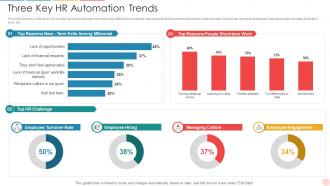
This slide focuses on the three key human resource automation trends using software for workforce management which includes reasons for employee exits, top human resource challenges, reasons people choosing short-term work, etc.
People who downloaded this PowerPoint presentation also viewed the following :
Three Key HR Automation Trends with all 7 slides:
Use our Three Key HR Automation Trends to effectively help you save your valuable time. They are readymade to fit into any presentation structure.






FAQs for Three Key
The top three HR automation tools reshaping the industry include applicant tracking systems (ATS), employee self-service portals, and AI-powered performance management platforms. These technologies streamline recruitment processes, enhance employee experiences through seamless access to benefits and payroll information, and deliver data-driven insights for talent development, ultimately enabling organizations to reduce administrative costs while improving strategic workforce planning.
AI revolutionizes recruitment processes by automating resume screening, conducting preliminary candidate assessments, and predicting job fit through behavioral analysis. Through machine learning algorithms, HR departments streamline hiring timelines, reduce unconscious bias, and enhance candidate matching accuracy, with many organizations finding that AI-driven recruitment delivers faster placements, improved quality hires, and significant cost reductions.
Data analytics enhances HR decision-making by providing predictive insights into employee performance, retention risks, recruitment effectiveness, and compensation benchmarking through automated data processing. These analytics enable HR teams to identify talent gaps, optimize hiring strategies, and improve employee engagement proactively, with many organizations finding significantly faster, more strategic workforce planning and reduced turnover costs.
Small businesses can leverage HR automation through payroll processing systems, applicant tracking software, employee onboarding platforms, performance management tools, and time tracking applications. These technologies streamline administrative tasks by reducing manual data entry, accelerating recruitment cycles, and minimizing compliance risks, ultimately enabling small business owners to focus on strategic growth while delivering faster employee services and improved operational efficiency.
Automating employee onboarding delivers faster processing times, consistent documentation, reduced administrative burden, enhanced compliance tracking, and improved new hire experiences. Through digital workflows and integrated systems, organizations streamline paperwork completion, automate background checks, and ensure regulatory compliance, while enabling HR teams to focus on strategic relationship-building rather than manual tasks, ultimately accelerating productivity and retention.
Automation improves employee engagement and retention by streamlining administrative tasks, enabling personalized career development pathways, and providing real-time feedback systems that enhance workplace satisfaction. Through automated performance tracking and predictive analytics, organizations can identify at-risk employees early, deliver targeted retention interventions, and create more meaningful work experiences, ultimately reducing turnover costs while fostering stronger employee loyalty.
Organizations face implementation challenges including employee resistance to change, integration complexities with existing systems, data security concerns, high upfront costs, and skill gaps in managing new technologies. While these hurdles initially slow adoption, companies across industries like manufacturing and healthcare find that strategic planning, comprehensive training, and phased rollouts ultimately deliver streamlined operations and enhanced employee experiences.
Future HR automation trends include AI-powered recruitment, predictive analytics for employee retention, automated onboarding workflows, intelligent performance management systems, and personalized learning platforms. These technologies will revolutionize talent acquisition, workforce planning, and employee development by reducing administrative overhead, enhancing decision-making accuracy, and delivering more strategic HR insights, with many organizations finding that automation ultimately enables HR teams to focus on strategic initiatives rather than routine tasks.
Automation facilitates diversity and inclusion efforts by removing unconscious bias from resume screening, standardizing interview processes, and analyzing hiring data for disparities. Through AI-powered tools, organizations can focus on skills-based assessments, expand candidate sourcing across diverse platforms, and track representation metrics, ultimately delivering fairer hiring practices and more inclusive workplace cultures.
HR professionals should develop data analytics skills, emotional intelligence, strategic thinking, change management expertise, and technology proficiency to navigate automation effectively. These competencies enable HR teams to interpret workforce metrics, manage human-AI collaboration, and design employee experiences that leverage automation while maintaining organizational culture, ultimately delivering enhanced productivity and competitive advantage.
Automation significantly enhances HR compliance by streamlining audit trails, ensuring consistent policy application, and maintaining accurate documentation across all employee interactions. Through automated systems, organizations minimize human error in regulatory reporting, accelerate compliance monitoring, and deliver real-time alerts for policy violations, with many companies finding that automated compliance reduces legal risks while improving operational efficiency.
Key ethical considerations include ensuring algorithmic fairness in hiring and evaluations, maintaining transparent decision-making processes, protecting employee privacy and data security, preventing discriminatory bias, and preserving human oversight in critical decisions. These safeguards enable organizations to streamline HR operations while maintaining trust, compliance, and equitable treatment, with many companies finding that ethical automation frameworks ultimately enhance both efficiency and employee satisfaction.
Organizations measure HR automation ROI by tracking cost reduction in administrative tasks, time savings in recruitment and onboarding, and improved employee satisfaction scores. Through automated payroll processing, performance management systems, and self-service portals, companies typically see 30-40% efficiency gains, reduced compliance risks, and enhanced data accuracy, ultimately delivering measurable productivity improvements across their workforce operations.
Automating performance management systems streamlines evaluation processes, reduces administrative burden, enables real-time feedback collection, and provides data-driven insights for strategic decisions. These systems enhance consistency across organizations while delivering faster review cycles, improved employee engagement, and better talent development outcomes, with many companies finding that automated approaches ultimately strengthen their competitive advantage in talent retention.
Employee feedback significantly influences HR automation effectiveness by identifying system gaps, revealing user experience issues, highlighting process bottlenecks, and uncovering integration challenges within existing workflows. Through continuous feedback loops, organizations can optimize their automation tools, enhance user adoption rates, and streamline administrative processes, with many companies finding that employee-driven insights ultimately deliver improved operational efficiency and better workplace experiences.
-
I faced no difficulty while searching for the slide I wanted. Honestly, the website’s interface is easy to use and can be navigated easily!
-
Informative design.