

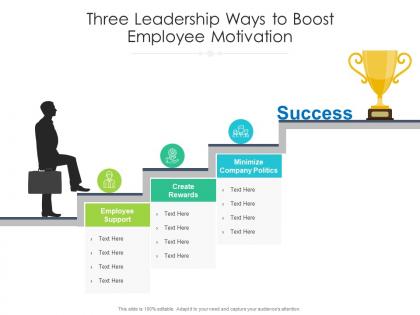
Three leadership ways to boost employee motivation




Try Before you Buy Download Free Sample Product
 Impress Your
Audience
 100%
Editable
 Save Hours
of Time


Our Three Leadership Ways To Boost Employee Motivation are topically designed to provide an attractive backdrop to any subject. Use them to look like a presentation pro.
People who downloaded this PowerPoint presentation also viewed the following :
Three leadership ways to boost employee motivation with all 2 slides:
Use our Three Leadership Ways To Boost Employee Motivation to effectively help you save your valuable time. They are readymade to fit into any presentation structure.


FAQs for Three leadership ways to
Effective leaders in today's environment demonstrate adaptability, emotional intelligence, strategic vision, clear communication skills, and decisive decision-making capabilities. These qualities enable leaders to navigate uncertainty, build resilient teams, and drive organizational transformation, with many companies finding that leaders who combine strategic thinking with authentic relationship-building deliver superior performance and sustainable competitive advantage.
Leaders foster innovation by encouraging experimentation, providing psychological safety for risk-taking, allocating dedicated time for creative projects, and celebrating both successes and intelligent failures. Through regular brainstorming sessions, cross-functional collaboration, and recognition programs, organizations streamline idea generation while enhancing team engagement, with many companies finding that empowered teams deliver breakthrough solutions and sustained competitive advantage.
Emotional intelligence enables effective leadership by enhancing self-awareness, empathy, social skills, and decision-making under pressure. Leaders with high emotional intelligence build stronger team relationships, navigate organizational conflicts more successfully, and create psychologically safe work environments, with many companies finding that emotionally intelligent executives drive higher employee engagement and organizational performance.
Leaders effectively communicate their vision through storytelling that connects organizational goals to personal values, consistent messaging across multiple channels, and regular two-way dialogue that invites feedback and collaboration. By demonstrating authenticity, celebrating progress milestones, and connecting daily tasks to larger purposes, leaders create emotional buy-in while fostering transparency, ultimately building trust and sustained engagement across their organizations.
Leaders adapt strategies to different team dynamics by assessing individual communication styles, motivation drivers, work preferences, and collaboration patterns within their teams. Through personalized approaches like adjusting feedback methods, tailoring recognition systems, and modifying delegation styles, leaders enhance team cohesion, productivity, and engagement, with many organizations finding that adaptive leadership ultimately delivers improved performance and stronger workplace relationships.
Remote leadership challenges include communication barriers, team engagement difficulties, performance monitoring complexities, cultural alignment issues, and technology dependencies. These obstacles can be overcome by establishing clear communication protocols, scheduling regular one-on-ones, implementing collaborative digital platforms, and fostering virtual team-building activities, with many organizations finding that proactive relationship management and structured feedback systems ultimately deliver stronger remote team performance and employee satisfaction.
Leaders balance authority with approachability by maintaining clear expectations while remaining accessible for dialogue, demonstrating competence through consistent decision-making, and showing genuine interest in team members' perspectives and development. This combination enables trust-building across organizations, with many finding that leaders who communicate transparently while holding firm boundaries ultimately deliver stronger team performance and employee engagement.
Leaders can develop future leaders through mentoring programs, cross-functional project assignments, leadership training workshops, succession planning initiatives, and providing stretch opportunities with increased responsibilities. These strategies work by exposing high-potential employees to diverse challenges, decision-making scenarios, and strategic thinking exercises, with many organizations finding that structured leadership development programs significantly enhance employee retention and create a robust pipeline of capable leaders ready for advancement.
Diversity and inclusion enhance leadership effectiveness by expanding perspectives, improving decision-making quality, and fostering innovative problem-solving approaches across teams. Organizations with diverse leadership consistently demonstrate stronger financial performance, better employee engagement, and enhanced market adaptability, with many companies finding that inclusive leaders drive significantly higher team productivity and organizational growth.
Ethical considerations include transparency in decision-making processes, ensuring fairness across all stakeholder groups, maintaining accountability for outcomes, protecting employee rights and well-being, and considering long-term societal impact alongside business objectives. These principles enhance organizational trust, reduce legal risks, and strengthen stakeholder relationships, with many companies finding that ethical leadership ultimately delivers sustainable competitive advantage and improved brand reputation.
Leaders can measure their effectiveness through 360-degree feedback, performance metrics analysis, employee engagement surveys, and regular self-reflection assessments. By combining quantitative data like team productivity and retention rates with qualitative insights from stakeholders, leaders can identify specific development areas while enhancing decision-making capabilities and organizational impact.
Leaders can motivate teams during challenging times through transparent communication, recognition of efforts, flexible support systems, collaborative problem-solving, and maintaining future vision. These approaches enhance morale by acknowledging difficulties while emphasizing collective strength, with many organizations finding that leaders who combine empathy with clear direction ultimately deliver stronger team resilience and sustained performance.
Feedback can be integrated through regular one-on-one meetings, structured performance reviews, real-time coaching moments, peer feedback systems, and creating psychological safety for open dialogue. Organizations implementing these practices find that teams achieve higher engagement, faster skill development, and improved collaboration, while leaders gain valuable insights for strategic decision-making and talent development initiatives.
Mentorship accelerates leadership development by providing personalized guidance, real-world insights, strategic feedback, and exposure to diverse leadership styles and decision-making approaches. Through structured mentoring relationships, emerging leaders in organizations like Fortune 500 companies and healthcare systems gain critical skills faster, build stronger networks, and develop nuanced judgment, ultimately delivering more effective leadership capabilities and improved organizational outcomes.
Leaders can maintain work-life balance by establishing clear boundaries, delegating effectively, promoting flexible work arrangements, and modeling healthy behaviors themselves. Through strategic scheduling and open communication about workload expectations, organizations in healthcare, technology, and consulting increasingly find that prioritizing balance reduces burnout, enhances productivity, and ultimately delivers better employee retention and improved team performance.
-
Content of slide is easy to understand and edit.