


Three levels city infrastructure administration org chart




Try Before you Buy Download Free Sample Product
 Impress Your
 Audience
 100%
100% Editable
 Save Hours
 of Time


Review the powers of local administration related to overall city infrastructure with our three levels city infrastructure administration org chart. This presentation slide of city administration has been designed by our team professional designers and allows you to power of local authorities delegated to them by legislation or higher level of government. This PPT of local administration organizational chart can be used to review all the actions performed by city administrative authorities, local authorities and self-governing institutions. Our small city administration chart is useful to display the information of local government, a county or the place where the central administration of a commune is located. With the help of our smart infrastructure power point slide you can review optimization of city operations such as to how it facilitates local officials to interact directly with both community and city infrastructure to monitor what is happening within the city. Download this PPT template of smart city infrastructure development & monitoring chart for establishing the overall smart city framework. Clear every bottleneck with our Three Levels City Infrastructure Administration Org Chart. Allow your thoughts to flow freely.
People who downloaded this PowerPoint presentation also viewed the following :
Content of this Powerpoint Presentation
Description:
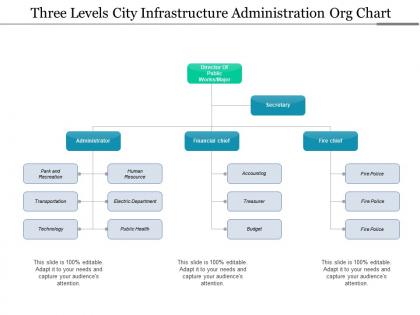
The image shows an organizational chart titled "Three Levels City Infrastructure Administration Org Chart." At the top of the hierarchy is the "Director of Public Works/Major," followed by their subordinate, the "Secretary." The chart then branches into three key columns, each representing different areas of responsibility within the city administration: an "Administrator," a "Financial Chief," and a "Fire Chief."
Underneath the Administrator, there are six departments: "Park and Recreation," "Human Resource," "Transportation," "Electric Department," "Technology," and "Public Health." The Financial Chief's column includes "Accounting," "Treasurer," and "Budget" departments. Under the Fire Chief, there are three "Fire Police" positions listed.
Use Cases:
This type of organizational chart can be used in various industries for different purposes:
1. Government:
Use: To clarify the structure of municipal departments and roles.
Presenter: City Manager or HR Director.
Audience: City Council Members or Government Employees.
2. Public Safety:
Use: To outline the hierarchical structure of emergency services.
Presenter: Police or Fire Chief.
Audience: Emergency Services Personnel.
3. Education:
Use: As a template for school district administrative organization.
Presenter: Superintendent or School Board Official.
Audience: School Administrators and Teachers.
4. Healthcare:
Use: To present the administrative structure of a hospital or healthcare system.
Presenter: Hospital Administrator or CEO.
Audience: Hospital Staff or Stakeholders.
5. Urban Planning:
Use: For delineating the responsibilities within a city's urban planning department.
Presenter: Chief Urban Planner.
Audience: Urban Planning Staff or City Officials.
6. Environmental Services:
Use: To demonstrate the organization of departments tasked with environmental management and city sanitation.
Presenter: Environmental Services Director.
Audience: Environmental Department Employees.
7. Public Utilities:
Use: To illustrate the management of public utility services like water, gas, and electricity.
Presenter: Utilities Director.
Audience: Utility Company Staff or Oversight Committees.
Three levels city infrastructure administration org chart with all 5 slides:
Our Three Levels City Infrastructure Administration Org Chart foster growth of global harmony. It is an instrument of communication.




FAQs for Three levels city infrastructure
Effective city infrastructure management includes asset inventory systems, predictive maintenance protocols, integrated monitoring networks, resource allocation frameworks, and citizen engagement platforms. These components work together by optimizing maintenance schedules, reducing operational costs, and enhancing service delivery, with many municipalities finding that strategic integration ultimately delivers improved urban efficiency and better resident experiences.
Data analytics enhances urban infrastructure decision-making by analyzing traffic patterns, utility usage, demographic trends, and maintenance schedules to optimize resource allocation and project prioritization. Through predictive modeling and real-time monitoring, city planners streamline budget planning, reduce project delays, and improve service delivery, with many municipalities finding that data-driven approaches deliver cost savings and enhanced citizen experiences.
Citizen engagement plays a crucial role in identifying infrastructure priorities, gathering local insights, ensuring community needs alignment, and building public support for projects. Through digital platforms, public consultations, and feedback systems, cities can streamline planning processes, reduce project delays, and enhance resource allocation, ultimately delivering more responsive infrastructure that serves residents effectively.
Cities ensure sustainable and resilient infrastructure through smart technology integration, green building standards, climate-adaptive design, renewable energy systems, and predictive maintenance programs. These strategic approaches enable municipalities to reduce environmental impact, minimize operational costs, and enhance disaster preparedness, with many urban centers finding that comprehensive infrastructure planning ultimately delivers improved citizen services while building long-term competitive advantages.
Best practices for maintaining aging infrastructure include proactive asset management systems, predictive maintenance technologies, strategic resource allocation, phased replacement programs, and integrated digital monitoring platforms. These approaches streamline operations by identifying issues before failures occur, optimizing repair schedules, and extending asset lifecycles, with many cities finding that data-driven maintenance strategies reduce costs while enhancing service reliability.
Public-private partnerships enhance infrastructure development by combining public oversight with private sector efficiency, innovation, and capital investment. These collaborations streamline project delivery, reduce government financial burden, and accelerate construction timelines, with many cities finding that partnerships in transportation, utilities, and smart city initiatives ultimately deliver improved services, cost-effective maintenance, and enhanced citizen experiences.
Smart sensors, IoT networks, AI-powered analytics, digital twin platforms, and automated maintenance systems are revolutionizing urban infrastructure management. These technologies streamline operations by enabling predictive maintenance, optimizing resource allocation, and enhancing service delivery, with many cities finding that integrated smart systems ultimately deliver significant cost reductions and improved citizen experiences.
Cities can prioritize infrastructure investments through community surveys, public forums, data analytics on usage patterns, needs assessments, and stakeholder consultations to identify critical areas. These strategic approaches enable municipalities to allocate resources toward high-impact projects like transportation networks, utilities, and public facilities, ultimately delivering improved services and enhanced quality of life for residents.
Integrating smart technologies into existing infrastructure presents challenges including compatibility issues with legacy systems, high implementation costs, cybersecurity vulnerabilities, workforce training requirements, and regulatory compliance complexities. However, cities like Barcelona and Singapore demonstrate that strategic phased approaches enable successful integration, ultimately delivering improved traffic management, energy efficiency, and citizen services while building competitive advantage in an increasingly connected urban landscape.
Climate change significantly impacts urban infrastructure planning through increased flooding risks, extreme temperature variations, sea-level rise, and more frequent severe weather events requiring enhanced resilience measures. Cities are increasingly adopting adaptive strategies like green infrastructure, flood management systems, and heat-resistant materials, with many municipalities finding that proactive climate-responsive planning ultimately delivers cost savings and improved community resilience.
Cities should evaluate infrastructure performance using utilization rates, maintenance costs, service reliability, citizen satisfaction scores, and environmental impact measurements. These metrics enable municipal governments to optimize resource allocation, identify improvement opportunities, and enhance service delivery across transportation, utilities, and public facilities, with many cities finding that data-driven approaches significantly improve operational efficiency and resident experiences.
Transportation infrastructure can be optimized through smart traffic management systems, dedicated public transit lanes, integrated multimodal hubs, real-time data analytics, and strategic route planning. These technologies streamline urban flow by reducing congestion, enhancing connectivity, and improving commuter experiences, with cities like Singapore and Barcelona finding that such comprehensive approaches ultimately deliver faster transit times and significantly lower operational costs.
Funding and budget allocation serve as the foundation for effective infrastructure management, determining project prioritization, maintenance schedules, technology investments, and long-term planning capabilities. Strategic budget allocation enables cities to balance immediate repairs with future upgrades, implement smart technologies for monitoring systems, and maintain critical services, with many municipalities finding that data-driven funding decisions ultimately deliver improved citizen experiences and operational efficiency.
Cities balance modern infrastructure needs with historical preservation through adaptive reuse projects, strategic zoning policies, and integrated planning approaches that incorporate both heritage conservation and contemporary functionality. These methods enable municipalities to enhance transportation systems, utilities, and digital connectivity while preserving cultural landmarks, with many urban centers finding that this strategic combination ultimately delivers enhanced tourism revenue, community identity, and competitive economic advantage.
Strategies include renewable energy integration, green building standards, smart grid technologies, sustainable transportation systems, and energy-efficient retrofits. These approaches streamline urban operations by reducing energy consumption, optimizing resource allocation, and minimizing waste production, with many cities finding that strategic infrastructure investments ultimately deliver significant cost savings while enhancing environmental sustainability.
No Reviews