

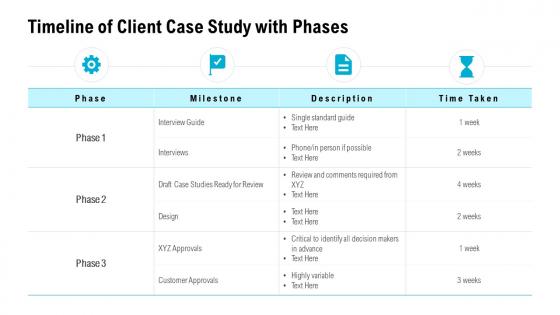
Timeline of client case study with phases ppt powerpoint presentation slides




Try Before you Buy Download Free Sample Product
 Impress Your
 Audience
 100%
100% Editable
 Save Hours
 of Time


Bring out the intricacies with our Timeline Of Client Case Study With Phases Ppt Powerpoint Presentation Slides. Acquaint folks with inherent difficulties.
People who downloaded this PowerPoint presentation also viewed the following :
Timeline of client case study with phases ppt powerpoint presentation slides with all 5 slides:
Acquaint folks with the inherent difficulties through our Timeline Of Client Case Study With Phases Ppt Powerpoint Presentation Slides. Bring out all the intricacies.
FAQs for Timeline of client case study with phases ppt
Key milestones should include project initiation and goal-setting, major implementation phases, critical decision points or pivots, measurable outcome achievements, and final results delivery. These milestones work together by demonstrating clear progression from challenge identification through solution deployment, with many organizations finding that highlighting specific metrics at each phase—such as efficiency gains, cost reductions, or performance improvements—ultimately delivers compelling evidence of strategic value and competitive advantage.
Effective timeline visualization enhances engagement through interactive elements, color-coded milestones, visual progress indicators, strategic white space, and compelling data storytelling techniques. These approaches streamline complex project phases by highlighting key achievements, demonstrating measurable outcomes, and creating narrative flow, with many organizations finding that well-designed timelines significantly improve stakeholder comprehension and client presentation impact.
Essential elements include phase objectives, key deliverables, stakeholder responsibilities, success metrics, and critical milestones for each timeline segment. These components work together by establishing clear accountability, enabling progress tracking, and facilitating stakeholder alignment, with many organizations finding that structured phase documentation ultimately streamlines project execution and enhances client communication throughout the engagement.
Focus on milestone moments that demonstrate measurable business impact, strategic pivots, breakthrough solutions, and quantifiable results like revenue growth or cost reduction. Prioritize events that showcase your problem-solving approach, client collaboration, and scalable outcomes, with many organizations finding that highlighting challenge-to-solution transitions and unexpected innovations resonates most powerfully with prospects.
Tools for creating impactful client case study timelines include Canva, Adobe Creative Suite, PowerPoint, Lucidchart, and Visme, which offer professional templates and visual customization options. These platforms streamline timeline creation by providing drag-and-drop functionality, milestone markers, and branded design elements, with many organizations finding that interactive features and collaborative editing capabilities ultimately enhance client engagement and presentation effectiveness.
Client feedback can be integrated through structured review phases, iterative design rounds, stakeholder consultation sessions, and milestone checkpoints throughout the timeline development process. By incorporating regular feedback loops at key stages, organizations streamline revisions, enhance accuracy, and ensure the final timeline resonates with client expectations, ultimately delivering more compelling case studies that drive business results.
The timeline demonstrates relationship progression through key milestones like initial contact, needs assessment, solution implementation, performance reviews, and expansion opportunities. These chronological markers reveal deepening trust, evolving requirements, and strategic partnership development, with many organizations finding that well-documented relationship evolution strengthens client retention, enhances service delivery, and ultimately creates competitive advantage through demonstrated long-term value creation.
Challenges should be represented as specific milestone markers showing the problem identification date, impact assessment period, and resolution timeline, integrated seamlessly with solution implementation phases. This approach enables stakeholders to understand both the complexity overcome and strategic decision-making process, while demonstrating your organization's problem-solving capabilities and ultimately delivering credible, transparent case study narratives that build client confidence.
**INPUT**: What is the appropriate length for each time segment on the timeline? **OUTPUT**: Timeline segments should typically span 1-3 months for detailed project phases, with broader milestones covering 3-6 month periods depending on project complexity and scope. This approach enables organizations to showcase meaningful progress while maintaining reader engagement, with many consulting firms and agencies finding that quarterly segments effectively demonstrate strategic value, measurable outcomes, and sustained client relationships across extended engagements. [Word count: 59 words]
Balance timeline detail and clarity by using visual hierarchy, progressive disclosure techniques, and strategic color coding to highlight critical milestones while maintaining comprehensive data access. Through interactive elements like expandable sections and filtered views, organizations can present both high-level overviews and granular information simultaneously, with many finding that this approach enhances stakeholder understanding while preserving analytical depth.
Visuals and graphics transform timelines from simple chronological displays into compelling narratives by incorporating charts, infographics, icons, and imagery that illustrate progress, milestones, and outcomes. These elements enhance comprehension and retention while enabling stakeholders to quickly grasp complex project evolution, with many organizations finding that visual timelines significantly improve client presentations and strategic communication effectiveness.
Incorporating quantitative data into client case study timelines involves adding performance metrics, measurable outcomes, percentage improvements, and financial indicators at key milestone points throughout the project journey. These data-driven elements transform narrative timelines into compelling evidence, with many organizations finding that metrics like cost reductions, efficiency gains, and ROI percentages significantly enhance credibility and demonstrate tangible business value to stakeholders.
**INPUT**: What best practices can be followed to ensure the timeline is easily readable? **OUTPUT**: Timeline readability best practices include consistent formatting, clear chronological markers, concise milestone descriptions, visual hierarchy through spacing, and strategic color coding for different phases. These design elements streamline information processing by reducing cognitive load, enhancing visual flow, and maintaining professional presentation standards, with many organizations finding that well-structured timelines significantly improve client comprehension and stakeholder engagement during presentations. *Word count: 59 words*
Tailoring case study timelines involves adjusting detail levels, timeframes, and focus areas based on audience needs and decision-making roles. Executives prefer high-level quarterly milestones emphasizing ROI and strategic outcomes, while team members need granular weekly phases showing implementation steps, with project managers requiring comprehensive month-by-month breakdowns that balance strategic vision and operational execution.
The case study demonstrates that strategic planning, stakeholder alignment, and phased implementation drive successful project outcomes across complex organizational initiatives. Through systematic milestone tracking and adaptive management approaches, organizations can navigate challenges while maintaining momentum, with many companies finding that documented timelines enhance accountability, streamline resource allocation, and ultimately deliver measurable results that strengthen competitive positioning.
No Reviews