

Tips for managing small business finance





Try Before you Buy Download Free Sample Product
 Impress Your
Audience
 100%
Editable
 Save Hours
of Time


Competition in the presentation world can be brutal. Get the edge through world class Tips For Managing Small Business Finance for all of your presentation needs.
People who downloaded this PowerPoint presentation also viewed the following :
Content of this Powerpoint Presentation
Description:
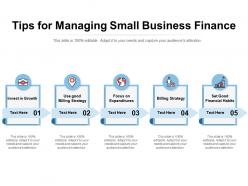
The image shows a PowerPoint slide titled "Tips for Managing Small Business Finance." It's structured to present five key tips, each accompanied by an icon and space for additional text:
1. Invest in Growth:
Depicted by a piggy bank icon, suggesting the importance of investing in areas that will contribute to business growth.
2. Use good Billing Strategy:
Marked by a location pin icon, perhaps indicating the need for strategic billing practices that can pinpoint revenue sources.
3. Focus on Expenditures:
Represented by a broken chain link icon, possibly emphasizing the need to manage and reduce unnecessary expenses.
4. Billing Strategy:
Illustrated with an icon of a person with a billing machine, indicating the need for efficient billing methods.
5. Set Good Financial Habits:
Shown with a bar chart icon, implying the establishment of consistent, healthy financial practices.
Use Cases:
These finance management tips are versatile and could be beneficial across various industries:
1. Retail:
Use: Financial strategy workshop
Presenter: Financial Advisor
Audience: Small business owners, store managers
2. Hospitality:
Use: Managing budgets in hotels and restaurants
Presenter: Account Manager
Audience: Hotel owners, restaurant managers
3. Healthcare:
Use: Seminar on financial health for small clinics
Presenter: Healthcare Consultant
Audience: Clinic owners, administrative staff
4. Education:
Use: Training on school financial management
Presenter: Education Financial Planner
Audience: School administrators, department heads
5. Construction:
Use: Budget management for small construction firms
Presenter: Construction Accountant
Audience: Contractors, project managers
6. Technology Startups:
Use: Financial planning for growth and sustainability
Presenter: Startup CFO
Audience: Tech entrepreneurs, investors
7. Creative Agencies:
Use: Workshop on financial practices for agency sustainability
Presenter: Agency Director
Audience: Creative professionals, account managers
Tips for managing small business finance with all 2 slides:
Crush the competition. Tips For Managing Small Business Finance with tailored design help you dominate your working life.

FAQs for Tips for managing
Key financial metrics every small business owner should monitor include cash flow, gross profit margin, accounts receivable turnover, debt-to-equity ratio, and customer acquisition cost. These metrics enable businesses to streamline operations, enhance financial stability, and make strategic decisions, with many retail and service companies finding that regular monitoring ultimately delivers improved profitability and competitive advantage.
Small businesses can create realistic budgets by analyzing historical expenses, setting conservative revenue projections, categorizing costs into fixed and variable components, and building contingency reserves for unexpected expenses. Through regular monthly reviews and expense tracking software, many small businesses find that adjusting budgets quarterly while maintaining strict approval processes for discretionary spending ultimately delivers better cash flow control and financial stability.
**INPUT**: What tools and software are recommended for efficient financial tracking and reporting? **OUTPUT**: Recommended financial tracking tools include QuickBooks, Xero, FreshBooks, Wave, and Sage, which streamline bookkeeping, invoicing, and expense management through automated categorization and real-time reporting. These platforms enhance operational efficiency by integrating bank feeds, generating customizable financial statements, and providing mobile accessibility, with many small businesses finding that cloud-based solutions ultimately deliver improved cash flow visibility and simplified tax preparation. **Word count: 60 words**
Small businesses can improve cash flow management by implementing automated invoicing systems, negotiating favorable payment terms with suppliers, maintaining detailed cash flow forecasts, and establishing emergency reserves. Through digital accounting platforms, businesses streamline payment processing, reduce late payments, and gain real-time financial visibility, ultimately enabling better decision-making and sustainable growth in an increasingly competitive marketplace.
Expense reduction strategies include renegotiating supplier contracts, automating routine processes, optimizing energy consumption, consolidating vendor relationships, and leveraging shared services models. These approaches streamline operations by reducing overhead costs, improving resource allocation, and enhancing operational efficiency, with many small businesses finding that strategic cost management ultimately delivers improved profit margins while maintaining service quality.
Small businesses should approach inventory management by implementing just-in-time ordering, regular cycle counting, automated reorder points, and seasonal demand forecasting to minimize carrying costs while preventing stockouts. Through inventory management software and ABC analysis, businesses can reduce working capital requirements by 15-30%, improve cash flow predictability, and redirect resources toward growth initiatives, ultimately enhancing profitability and operational efficiency.
Small businesses frequently overlook deductions for home office expenses, professional development costs, business meals, vehicle expenses, and equipment depreciation. These overlooked opportunities can significantly reduce tax liability, with many businesses finding that systematic tracking of office supplies, software subscriptions, and networking events ultimately delivers substantial savings and improved cash flow management.
Small businesses can secure funding effectively by developing comprehensive business plans, maintaining strong financial records, exploring diverse funding sources like angel investors, venture capital, crowdfunding, and SBA loans, and building relationships with potential investors. Through strategic presentation of growth potential and clear financial projections, businesses demonstrate viability while addressing investor concerns, ultimately delivering enhanced credibility and competitive positioning in increasingly crowded funding landscapes.
Financial forecasting enables small businesses to anticipate cash flow patterns, identify potential funding needs, and make informed strategic decisions about growth investments. Through accurate projections, restaurants can plan for seasonal fluctuations, retail stores can optimize inventory purchases, and service businesses can scale operations strategically, ultimately delivering better resource allocation and competitive positioning in increasingly dynamic markets.
Small businesses can prepare for unexpected financial challenges by establishing emergency funds, diversifying revenue streams, maintaining detailed cash flow forecasts, securing flexible credit lines, and implementing robust financial monitoring systems. These strategies enable companies to weather disruptions like economic downturns or supply chain issues, with many retail and service businesses finding that proactive planning ultimately delivers greater resilience and competitive advantage.
Best practices for managing business debts include prioritizing high-interest obligations, negotiating payment terms with creditors, maintaining detailed debt schedules, consolidating where beneficial, and establishing emergency reserves. These strategies enable organizations to reduce financial strain, improve cash flow predictability, and maintain vendor relationships, with many small businesses finding that proactive debt management ultimately delivers enhanced creditworthiness and operational stability.
Small businesses ensure compliance by maintaining accurate records, implementing regular financial audits, staying updated on relevant regulations, and consulting with qualified accountants or legal advisors. These practices streamline tax preparation, minimize audit risks, and protect against costly penalties, with many small enterprises finding that proactive compliance management ultimately delivers operational efficiency and enhanced credibility with lenders and investors.
Separating personal and business finances delivers clearer tax reporting, simplified bookkeeping, enhanced legal protection, and improved financial tracking for strategic decisions. This separation enables small businesses to establish credit independently, qualify for business loans more easily, and present professional financial statements to investors, while protecting personal assets from business liabilities and ultimately streamlining operational efficiency.
Small businesses leverage financial data by analyzing cash flow patterns, profit margins, expense trends, revenue forecasts, and key performance indicators to identify growth opportunities and operational inefficiencies. Through dashboard analytics and regular financial reviews, entrepreneurs can optimize resource allocation, time market expansions strategically, and adjust pricing models, ultimately delivering competitive advantage and sustainable growth in an increasingly data-driven marketplace.
Common financial pitfalls include inadequate cash flow management, mixing personal and business finances, poor expense tracking, insufficient emergency reserves, and delayed invoicing processes. These challenges particularly affect retail, service, and consulting businesses, with many entrepreneurs finding that implementing systematic bookkeeping, maintaining separate accounts, and establishing credit lines early ultimately delivers better financial stability and growth opportunities.
No Reviews