

Tools For Evaluating Market Competition Competitor Product Or Service Price Analysis Matrix MKT SS V





Try Before you Buy Download Free Sample Product
 Impress Your
Audience
 100%
Editable
 Save Hours
of Time


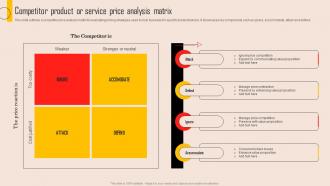
This slide outlines a competitor price analysis matrix for evaluating pricing strategies used by rival business for specific product service. It showcases key components such as ignore, accommodate, attack and defend.
People who downloaded this PowerPoint presentation also viewed the following :
Tools For Evaluating Market Competition Competitor Product Or Service Price Analysis Matrix MKT SS V with all 6 slides:
Use our Tools For Evaluating Market Competition Competitor Product Or Service Price Analysis Matrix MKT SS V to effectively help you save your valuable time. They are readymade to fit into any presentation structure.





FAQs for Tools For Evaluating Market Competition Competitor Product Or Service Price Analysis Matrix
Key metrics for evaluating market competition include market share percentages, revenue growth rates, customer acquisition costs, pricing strategies, and brand recognition levels. These indicators help organizations assess competitive positioning by analyzing financial performance, operational efficiency, and market penetration, with many companies finding that combining these metrics delivers comprehensive insights for strategic decision-making and sustainable competitive advantage.
SWOT analysis assesses competitors by evaluating their strengths, weaknesses, opportunities, and threats to reveal strategic insights and market positioning gaps. This framework enables businesses to identify competitive vulnerabilities, benchmark capabilities, and uncover market opportunities, with many organizations finding that systematic competitor SWOT analysis ultimately delivers strategic advantages and more informed competitive positioning decisions.
Market segmentation reveals competitive dynamics by identifying distinct customer groups, their specific needs, competitor positioning within each segment, and market share distributions across different demographics. Through strategic segmentation analysis, organizations can uncover underserved niches, assess competitive intensity levels, and identify segments where rivals are strongest or weakest, ultimately enabling more targeted competitive strategies and market positioning opportunities.
Emerging trends and technologies disrupt existing competitors by enabling new business models, reducing operational costs, and creating superior customer experiences through automation, data analytics, and digital transformation. Companies leveraging artificial intelligence, blockchain, or IoT can streamline processes, enhance service delivery, and capture market share, with many traditional industries finding that early adopters gain significant competitive advantages.
Brand loyalty significantly impacts market competition analysis by influencing customer retention rates, pricing power, market share stability, and competitive barriers to entry. Companies with strong brand loyalty, like Apple in technology or Coca-Cola in beverages, enjoy reduced price sensitivity and higher switching costs, ultimately delivering sustainable competitive advantages and more predictable revenue streams in increasingly crowded markets.
Companies use competitive benchmarking to inform strategic decisions by analyzing competitors' pricing strategies, product features, market positioning, operational efficiency, and customer satisfaction metrics. Through systematic comparison of performance indicators, businesses identify gaps in their offerings, discover new market opportunities, and optimize resource allocation, ultimately enabling them to enhance competitive advantage and accelerate growth in increasingly dynamic markets.
Identifying indirect competitors requires analyzing companies solving similar customer problems through different methods, examining substitute products, studying adjacent industries, and monitoring emerging technologies that could disrupt your market. This comprehensive approach involves mapping customer journey touchpoints, conducting cross-industry benchmarking, and tracking patent filings or venture capital investments, ultimately delivering strategic insights that help organizations anticipate market shifts and identify unexpected competitive threats.
Consumer behavior influences competitive strategies by revealing purchasing patterns, preference shifts, and decision-making triggers that guide product development, pricing models, and market positioning. Companies across retail, technology, and financial services leverage behavioral insights to anticipate demand, personalize offerings, and differentiate from competitors, ultimately delivering targeted customer experiences and sustainable competitive advantage.
Tools for real-time market competition analysis include competitive intelligence platforms, social media monitoring software, price tracking solutions, SEO analysis tools, and web scraping technologies. These methodologies enhance strategic decision-making by delivering instant competitor insights, automated pricing adjustments, and market trend identification, with many organizations finding that real-time data ultimately accelerates response times and maintains competitive advantage.
Companies can assess competitive advantage by analyzing market share, pricing strategies, customer satisfaction scores, operational efficiency metrics, and brand recognition compared to leaders. Through comprehensive benchmarking studies, organizations evaluate their unique value propositions, cost structures, and service delivery capabilities against top performers, ultimately identifying differentiation opportunities and strategic positioning advantages in increasingly competitive markets.
Regulatory environment significantly shapes market competition by establishing entry barriers, pricing controls, compliance requirements, and operational standards that determine competitive dynamics. These frameworks create both opportunities and challenges, with industries like telecommunications, healthcare, and financial services finding that strategic regulatory compliance enables market differentiation, while streamlined regulations often intensify competition and drive innovation.
New entrants can compete in saturated markets through strategic differentiation, niche targeting, innovative technology adoption, competitive pricing models, and superior customer experience delivery. These approaches enable startups to carve market share by addressing underserved segments, streamlining operations through automation, and delivering personalized services, with many finding that focusing on specific customer pain points ultimately creates sustainable competitive advantages.
Market share analysis reveals competitive positioning by quantifying each competitor's market presence, identifying market leaders and followers, and highlighting growth trends or declining positions. Through comprehensive market share data, businesses can assess their relative strength, identify underperforming segments requiring strategic attention, and discover market opportunities where competitors may be vulnerable, ultimately enabling more informed strategic decisions and competitive advantage.
Analyzing competition in rapidly evolving industries presents challenges including outdated data, emerging competitors, shifting market dynamics, technological disruptions, and changing customer preferences. These factors complicate traditional competitive intelligence methods, with many organizations finding that real-time monitoring, agile analytical frameworks, and predictive modeling become essential for maintaining strategic advantage in increasingly volatile markets.
Social media analytics help understand market competition by tracking competitor engagement rates, content performance, audience demographics, sentiment analysis, and share of voice metrics. Through these insights, businesses can identify competitor strengths and weaknesses, benchmark their own performance, and discover market gaps, ultimately enabling more strategic positioning and competitive advantage in increasingly crowded markets.
-
Extremely professional slides with attractive designs. I especially appreciate how easily they can be modified and come in different colors, shapes, and sizes!
-
Their products can save your time, effort and money. What else you need. All in one package for presentation needs!