


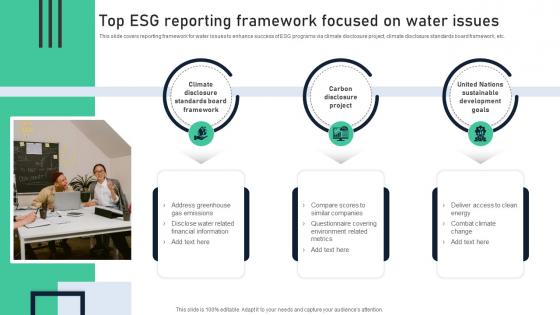
Top ESG Reporting Framework Focused On Water Issues




Try Before you Buy Download Free Sample Product
 Impress Your
Audience
 100%
Editable
 Save Hours
of Time


This slide covers reporting framework for water issues to enhance success of ESG programs via climate disclosure project, climate disclosure standards board framework, etc.
People who downloaded this PowerPoint presentation also viewed the following :
Top ESG Reporting Framework Focused On Water Issues with all 9 slides:
Use our Top ESG Reporting Framework Focused On Water Issues to effectively help you save your valuable time. They are readymade to fit into any presentation structure.








FAQs for Top ESG Reporting Framework Focused
So there's three main ones you'll run into. GRI is the big comprehensive one - covers everything from environmental to social to governance stuff with tons of detailed standards. SASB's different though, it focuses on what's financially material for your specific industry (honestly super useful when you're dealing with investors). Then TCFD is purely climate-focused - they want governance, strategy, risk management, and metrics around climate stuff. They all have their own structures but overlap in areas like governance. My take? Start with whatever matches your stakeholders' priorities best, then add the others later.
Honestly, start with solid data collection and get someone independent to verify your numbers. That's non-negotiable. You'll want clear governance too - like who actually owns which data points, because mixed-up numbers are a nightmare. Use GRI or SASB frameworks instead of making stuff up from scratch. Document absolutely everything (I know, sounds boring but trust me). Run internal audits regularly to catch problems before they blow up. External assurance for your biggest metrics is worth the cost. Basically treat this ESG data exactly like you would financial reporting - same serious controls and accountability. Makes all the difference.
Your ESG reports are only as good as the people you actually talk to first. Map out who matters - employees, customers, investors, the communities you operate in. Get their feedback regularly throughout your reporting process, not just at the end. Otherwise you'll miss the issues they actually care about and end up looking pretty out of touch. I've seen companies get roasted for obvious blind spots that five minutes of stakeholder input could've caught. Their perspectives help you figure out what's truly material. Plus it builds trust when people see you're listening. Create some structured ways to collect input - surveys, focus groups, whatever works for your situation.
Yeah, so different industries have totally different ESG priorities. Oil companies are obsessed with emissions and cleanup stuff, while tech companies care more about data privacy and how they treat workers. Financial services? All about responsible lending and governance - honestly makes sense given 2008 and all that. This matters big time for your reporting though. Use the wrong framework and investors won't get what you're talking about. You want something like SASB that matches your industry's actual risks. Otherwise your ESG data just looks irrelevant to the people judging your company's performance.
Honestly, data collection is gonna be your biggest nightmare - getting consistent info from different departments is like herding cats. Then you've got all these competing frameworks (GRI, SASB, TCFD) that don't mesh well together, which is annoying as hell. The costs add up fast too since you need new systems and training. Most companies don't have the internal know-how, so you'll probably end up hiring consultants anyway. My advice? Pick one framework that actually makes sense for your industry first. Don't try to do everything at once or you'll lose your mind.
Honestly, tech will save your sanity here. You can automate pulling data from all your different systems instead of chasing down random spreadsheets from every department. Real-time dashboards are a lifesaver - everything's in one spot. AI tools will catch errors and can draft reports for whatever framework you're using (GRI, SASB, etc). The time you'll save is insane. First step? Map out where your data currently lives and what's driving you crazy about the process. That'll show you exactly which tools to prioritize. Trust me on this one.
So the usual suspects are carbon emissions, energy use, water consumption, diversity ratios, board makeup, data breaches, and governance scores. Most companies follow GRI, SASB, or TCFD frameworks - yeah, it's total alphabet soup lol. Pick stuff that actually matters for your industry though. SASB breaks it down by sector which is super helpful. Honestly, I'd rather see companies nail 10-15 metrics consistently than half-ass a bunch of random ones. Start by seeing what your competitors report and what investors keep bugging you about. That'll give you a solid baseline without overthinking it.
So basically, governments are forcing this stuff now instead of letting companies choose. The EU's CSRD and SEC climate rules mean you can't just wing it anymore with ESG reporting. Companies have to use actual frameworks like GRI or TCFD - which honestly makes sense because before this, everyone was doing their own random thing. You'll need to figure out which regulations hit your industry first. I'd start mapping that out soon because deadlines are getting crazy tight, and nobody wants to deal with compliance penalties. It's kind of a mess but at least there's more consistency now.
Honestly, you should totally align your ESG stuff with the UN SDGs. It's like speaking a language everyone already gets - investors, customers, regulators all know what those goals mean. Way better than making up your own weird metrics that nobody understands. Benchmarking becomes so much easier when you can actually compare yourself to other companies. Shows you're serious about real impact too, not just checking boxes for compliance. My advice? Map what you're already doing to specific SDGs first, then pick maybe 3-5 where you can genuinely move the needle.
Totally doable on a shoestring budget! Start with something simple like B Impact Assessment or basic GRI modules - seriously, don't overcomplicate it. SASB and CDP have free templates that'll save you hours. Most of the data you need is probably buried in your existing systems anyway. Pick maybe 3-5 metrics that actually matter to your stakeholders. Honestly? Consistency beats perfection every time. I've seen companies stress about making these gorgeous reports when investors just want to see real progress over time. Focus on authentic improvement rather than fancy formatting and you'll be fine.
Honestly, start with what actually impacts your business - don't just report on everything under the sun. Pick GRI or SASB since they're industry-standard and people trust them. You'll want real targets with deadlines too, because nobody buys vague "we care about the planet" stuff anymore. Third-party verification is clutch for credibility if you can swing it. The data collection part is huge - do it consistently all year instead of panicking at the last minute (learned that one the hard way). Just choose one framework that fits your industry first, then expand later.
Honestly, ESG reporting is huge now - investors basically expect it. Good reports show you're managing risks and thinking long-term, which they eat up. But if your ESG game is weak or nonexistent? You'll struggle to get funding or face higher costs. I've watched companies get passed over for deals just because their sustainability story sucked. The trick isn't just filling out forms though. You need real data showing actual progress. Sounds boring, but it's kind of wild how much this stuff influences investment decisions these days.
Look, ESG frameworks are basically accountability tools that make companies actually back up their talk. You're forced to track stuff like carbon emissions and diversity numbers, then report it publicly every year. Nobody wants to look terrible compared to their competitors, so there's real pressure to improve. The standardized metrics make it ridiculously easy for investors to compare you against other companies - kind of like those old school report cards your parents could see. Honestly, the trick is finding a framework that fits your industry and then actually using that data to make decisions internally, not just treating it like some compliance checklist you have to get through.
Just be straight up about your actual numbers and what you're doing. GRI or SASB frameworks will make you look legit compared to competitors. Investors can spot BS from a mile away now, so skip the corporate fluff. Show specific metrics, your progress, and honestly - where you're still struggling. For regular people, ditch the jargon and explain what your impact actually means. Oh and consistency matters across everything you put out there. Real examples beat vague promises every time. The whole "we're committed to sustainability" thing without proof? Yeah, that doesn't fly anymore.
Honestly, mandatory disclosure is hitting everywhere - EU's already doing it, US isn't far behind. AI's finally making data collection less of a nightmare (about time). Double materiality is the new thing where you report how ESG affects your business AND how your business impacts everything else. Frameworks are actually starting to make sense together instead of being totally random. Oh, and even if you're not required yet? Start prepping now because this stuff moves fast. I learned that the hard way with a client last year - they waited too long and scrambled like crazy.
-
Out of the box and creative design.
-
It is my first time working with them and that too on a friend's recommendation. I would say, I am not expecting such a worldly service at this low price.