

Total productivity maintenance tpm pillar 1 the 5s foundation




Try Before you Buy Download Free Sample Product
 Impress Your
Audience
 100%
Editable
 Save Hours
of Time


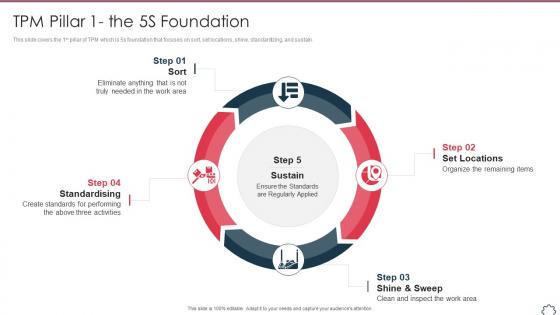
This slide covers the 1st pillar of TPM which is 5s foundation that focuses on sort, set locations, shine, standardizing, and sustain.
People who downloaded this PowerPoint presentation also viewed the following :
Total productivity maintenance tpm pillar 1 the 5s foundation with all 6 slides:
Use our Total Productivity Maintenance Tpm Pillar 1 The 5S Foundation to effectively help you save your valuable time. They are readymade to fit into any presentation structure.






FAQs for Total productivity maintenance tpm pillar 1
TPM's core principles include autonomous maintenance, planned maintenance, quality maintenance, focused improvement, early equipment management, training and education, safety and environment, and TPM in administration. These principles directly build upon 5S foundations by requiring organized, standardized workplaces where operators can effectively perform routine maintenance tasks, with many manufacturing organizations finding that strong 5S implementation accelerates TPM success rates significantly.
5S implementation enhances TPM effectiveness by creating organized, standardized workplaces that enable faster equipment inspections, easier maintenance access, and immediate identification of abnormalities or potential failures. Through systematic workplace organization, manufacturing teams can streamline preventive maintenance routines, reduce downtime from searching for tools or parts, and maintain equipment more consistently, with many facilities finding that clean, organized environments significantly improve both maintenance quality and overall equipment effectiveness.
Organizations face challenges including resistance to cultural change, inconsistent implementation across departments, inadequate training programs, and difficulty sustaining long-term discipline in workplace organization standards. Many manufacturing companies find that successful integration requires strong leadership commitment, comprehensive employee engagement strategies, and systematic monitoring processes, ultimately delivering enhanced equipment reliability and operational efficiency when properly executed.
5S practices enhance equipment reliability and uptime by creating organized workspaces that enable faster issue identification, streamlined maintenance procedures, and reduced equipment contamination through systematic cleaning and organization. These foundational practices support TPM objectives by minimizing downtime from searching for tools, preventing debris-related failures, and establishing visual management systems that help operators quickly detect abnormalities, ultimately delivering improved operational efficiency and sustained equipment performance.
Employee training serves as the cornerstone for successful 5S and TPM implementation, encompassing skills development, cultural transformation, standardization procedures, and continuous improvement methodologies. Through comprehensive training programs, organizations enable workers to identify inefficiencies, maintain equipment proactively, and sustain workplace organization standards, with manufacturing facilities finding that well-trained teams deliver significantly higher equipment reliability and operational efficiency.
Organizations measure 5S success within TPM through key performance indicators like equipment downtime reduction, defect rates, workplace accident frequency, and overall equipment effectiveness (OEE) scores. These metrics enable manufacturers to track tangible improvements in operational efficiency, safety compliance, and production quality, with many finding that sustained 5S implementation delivers measurable cost savings and enhanced competitive advantage.
Manufacturing giants like Toyota and Honda demonstrate successful TPM-5S integration through organized workstations, preventive maintenance schedules, and employee-driven continuous improvement programs. These automotive leaders achieve 30-40% reduction in downtime and significantly enhanced product quality, while pharmaceutical companies like Pfizer and food processors leverage the same integration to ensure regulatory compliance, streamline operations, and deliver consistent customer experiences.
Visual management tools support 5S principles in TPM through shadow boards for tool placement, color-coded floor markings for designated areas, digital dashboards displaying equipment status, standardized labeling systems, and visual work instructions. These tools streamline maintenance workflows by reducing search time, ensuring proper equipment positioning, and enabling immediate identification of abnormalities, ultimately delivering improved operational efficiency and enhanced equipment reliability across manufacturing environments.
Traditional maintenance practices focus on reactive repairs and scheduled servicing, while TPM emphasizes proactive equipment care, employee involvement across all levels, and continuous improvement through systematic problem-solving. TPM transforms maintenance from a specialized function into an organization-wide responsibility, with operators performing routine care and identifying potential issues early, ultimately delivering higher equipment reliability, reduced downtime, and enhanced operational efficiency.
Cultural factors significantly impact TPM and 5S effectiveness through employee engagement levels, leadership commitment, resistance to change, and communication patterns across organizational hierarchies. Organizations with collaborative cultures, strong continuous improvement mindsets, and open feedback systems typically see higher adoption rates and sustained results, while those with rigid hierarchies or change-resistant attitudes often struggle with implementation, ultimately finding that cultural alignment determines long-term program success.
Leaders can foster continuous improvement cultures through regular training programs, cross-functional improvement teams, recognition systems for employee suggestions, transparent performance metrics, and structured problem-solving methodologies. These strategies work synergistically in manufacturing environments, with companies like Toyota and General Electric finding that empowered employees, combined with systematic feedback loops and leadership commitment, ultimately deliver enhanced equipment reliability, workplace organization, and sustained operational excellence.
Sustaining 5S creates the disciplined foundation essential for TPM success by establishing standardized workflows, maintaining equipment accessibility, and fostering continuous improvement cultures across manufacturing operations. Through consistent workplace organization and employee engagement, organizations streamline maintenance procedures, reduce downtime, and enhance overall equipment effectiveness, with many manufacturing facilities finding that sustained 5S practices ultimately deliver measurable productivity gains and competitive operational advantage.
Technology enhances 5S implementation within TPM frameworks through digital checklists, IoT sensors for real-time monitoring, mobile apps for auditing, and automated scheduling systems. These digital tools streamline workplace organization by enabling instant documentation, predictive maintenance alerts, and data-driven insights, with manufacturing facilities finding that integrated platforms ultimately deliver improved equipment efficiency and reduced downtime costs.
Key performance metrics for 5S initiatives within TPM include equipment uptime, maintenance response times, workplace accidents, quality defect rates, and visual management compliance scores. These metrics enable organizations to track operational efficiency improvements, with many manufacturing facilities finding that effective 5S implementation reduces equipment downtime by 15-30% while streamlining maintenance workflows and ultimately delivering enhanced productivity and cost reduction.
Cross-functional teams enhance TPM-5S synergy by combining diverse expertise from maintenance, operations, quality, and safety departments, enabling comprehensive problem-solving and standardized practices. These collaborative teams streamline equipment reliability initiatives while maintaining workplace organization, with manufacturing and healthcare facilities finding that integrated approaches reduce downtime, improve operational efficiency, and ultimately deliver sustained productivity gains across departments.
-
Understandable and informative presentation.
-
Excellent template with unique design.