

Total Quality Management Principles For Enhancing Efficiency





Try Before you Buy Download Free Sample Product
 Impress Your
Audience
 100%
Editable
 Save Hours
of Time


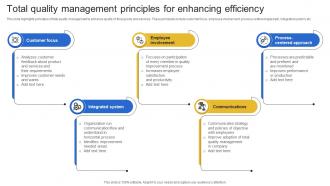
This slide highlights principles of total quality management to enhance quality of final goods and services. These principles include customer focus, employee involvement, process centered approach, integrated system, etc.
People who downloaded this PowerPoint presentation also viewed the following :
Total Quality Management Principles For Enhancing Efficiency with all 9 slides:
Use our Total Quality Management Principles For Enhancing Efficiency to effectively help you save your valuable time. They are readymade to fit into any presentation structure.








FAQs for Total Quality Management Principles
Total Quality Management core principles include customer focus, continuous improvement, employee involvement, process optimization, and data-driven decision making. These principles enhance organizational performance by streamlining operations, reducing defects, and fostering collaborative cultures, with many manufacturing and service organizations finding that strategic TQM implementation delivers competitive advantage and sustained operational excellence.
TQM differs from Six Sigma and Lean by emphasizing organization-wide cultural transformation and continuous improvement across all departments, while Six Sigma focuses on statistical process control and Lean targets waste elimination. While Six Sigma uses data-driven methodologies and Lean streamlines workflows, TQM integrates both approaches with employee empowerment and customer satisfaction, ultimately delivering comprehensive quality enhancement rather than targeted improvements.
Leadership drives TQM success by establishing quality vision, allocating necessary resources, modeling continuous improvement behaviors, and creating accountability structures throughout the organization. Through strategic commitment and consistent communication, leaders enable cultural transformation, empower employee participation, and sustain long-term quality initiatives, with many organizations finding that executive engagement directly correlates with TQM outcomes.
Employee involvement in TQM initiatives can be enhanced through cross-functional teams, suggestion systems, quality circles, regular training programs, and empowerment in decision-making processes. These approaches streamline communication, foster ownership, and enable continuous improvement, with many organizations finding that engaged employees deliver higher quality outcomes, reduced defects, and ultimately stronger competitive advantage in increasingly demanding markets.
Effective TQM metrics include customer satisfaction scores, defect rates, process cycle times, employee engagement levels, and cost of quality measurements. These indicators work together by tracking both operational efficiency and stakeholder outcomes, with manufacturing companies and service organizations finding that balanced scorecards combining financial, customer, internal process, and learning metrics deliver comprehensive insights into continuous improvement success.
TQM enhances customer satisfaction by implementing systematic quality controls, continuous improvement processes, and customer-focused feedback mechanisms throughout organizational operations. Through comprehensive quality management, companies achieve reduced defects, faster service delivery, and more consistent customer experiences, with many retail and manufacturing organizations finding that TQM initiatives ultimately deliver higher retention rates and stronger competitive positioning.
Organizations commonly face resistance to change, lack of leadership commitment, insufficient employee training, and difficulty measuring quality improvements when adopting TQM. These challenges can be overcome through comprehensive change management programs, executive sponsorship with clear accountability, systematic training across all levels, and implementing robust metrics systems, with many companies in manufacturing and healthcare finding that phased implementation ultimately delivers sustained operational excellence and competitive advantage.
Organizations ensure continuous improvement through systematic quality audits, regular performance metrics analysis, employee feedback loops, cross-functional improvement teams, and standardized process documentation. These methodologies enable companies to identify inefficiencies, streamline operations, and enhance customer satisfaction, with many manufacturing and healthcare organizations finding that structured improvement cycles ultimately deliver reduced costs and sustained competitive advantage.
**INPUT**: What are the best practices for training employees on TQM principles and practices? **OUTPUT**: Best practices for TQM training include hands-on workshops, cross-functional team exercises, continuous improvement simulations, leadership modeling, and regular progress assessments. These approaches enhance understanding by connecting quality principles to daily operations, fostering collaborative problem-solving, and embedding quality thinking across departments, with many organizations finding that sustained engagement ultimately delivers improved processes and competitive advantage. [Word count: 58 words]
Technology supports TQM efforts through data analytics platforms, automated quality monitoring systems, real-time performance dashboards, collaborative workflow tools, and predictive maintenance solutions. These technologies streamline quality processes by enabling continuous monitoring, reducing human error, and facilitating cross-departmental collaboration, with manufacturing and healthcare organizations finding that integrated systems ultimately deliver faster issue resolution and enhanced customer satisfaction.
Cross-functional teams are fundamental to TQM because they break down organizational silos, leverage diverse expertise, and enable comprehensive problem-solving across departments. These collaborative structures streamline processes by combining perspectives from production, quality control, marketing, and finance, ultimately delivering faster innovation cycles and enhanced customer satisfaction, with many organizations finding that cross-departmental integration significantly improves operational efficiency.
Small businesses can implement TQM through cost-effective approaches like employee-driven improvement teams, simple quality metrics tracking, customer feedback systems, and process standardization using existing resources. While larger corporations invest in extensive quality infrastructure, smaller organizations often achieve faster implementation and more agile responses to quality issues, with many finding that focused, employee-centered TQM delivers significant competitive advantages.
Data analysis drives TQM enhancement by identifying quality trends, measuring process performance, tracking customer satisfaction metrics, and revealing improvement opportunities through statistical insights. Through predictive analytics and real-time monitoring, organizations streamline operations, reduce defects, and accelerate decision-making, with manufacturing and healthcare sectors finding that data-driven approaches ultimately deliver measurable quality improvements and competitive advantage.
Organizations integrate TQM with sustainability initiatives by aligning quality metrics with environmental goals, embedding sustainable practices into continuous improvement processes, and training employees on eco-efficient methodologies. This strategic combination enables companies to reduce waste, minimize resource consumption, and enhance operational efficiency while meeting quality standards, ultimately delivering competitive advantage and improved stakeholder value in an increasingly environmentally-conscious marketplace.
Successful TQM implementations include Toyota's lean manufacturing system, Motorola's Six Sigma program, Ritz-Carlton's service excellence standards, General Electric's quality initiatives, and Southwest Airlines' operational consistency models. These organizations streamline processes, minimize defects, and enhance customer satisfaction through continuous improvement cultures, with many finding that sustained quality focus delivers competitive advantage, reduced costs, and improved market positioning across manufacturing, hospitality, and service sectors.
-
I discovered some really original and instructive business slides here. I found that they suited me well.
-
Their products can save your time, effort and money. What else you need. All in one package for presentation needs!
-
Wide collection of templates available. SlideTeam has made it easier to create presentations in just a few minutes.
-
Informative and engaging! I really like the design and quality of the slides.