


Tracking With Current Status Project Scoping To Meet Customers Needs For Given Product




Try Before you Buy Download Free Sample Product
 Impress Your
Audience
 100%
Editable
 Save Hours
of Time


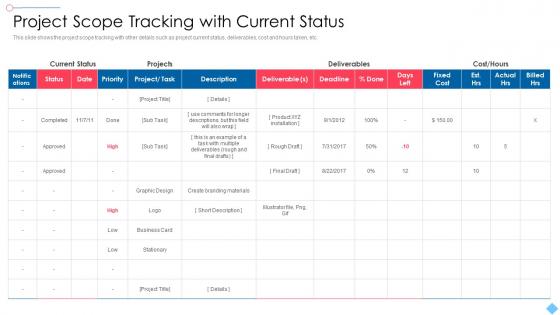
This slide shows the project scope tracking with other details such as project current status, deliverables, cost and hours taken, etc.
People who downloaded this PowerPoint presentation also viewed the following :
Tracking With Current Status Project Scoping To Meet Customers Needs For Given Product with all 6 slides:
Use our Tracking With Current Status Project Scoping To Meet Customers Needs For Given Product to effectively help you save your valuable time. They are readymade to fit into any presentation structure.






FAQs for Tracking With Current Status Project Scoping To Meet Customers Needs
Key components include project objectives, deliverables, acceptance criteria, constraints, assumptions, and exclusions. These elements work together by establishing clear boundaries, defining success metrics, and managing stakeholder expectations, with many organizations finding that comprehensive scope statements reduce scope creep by up to 40% while ensuring project alignment.
Defining project scope enables accurate resource allocation and budgeting by establishing clear deliverables, timelines, and requirements upfront, preventing scope creep and cost overruns. This structured approach allows project managers to allocate personnel, technology, and financial resources strategically, with many organizations finding that well-defined scopes reduce budget variances by up to 30% while enhancing project success rates.
Requirements gathering techniques include stakeholder interviews, workshops and brainstorming sessions, surveys and questionnaires, document analysis, and observation of current processes. These methods streamline project definition by capturing diverse perspectives, identifying hidden needs, and establishing clear boundaries, with many organizations finding that combining multiple techniques ultimately delivers more comprehensive scoping and reduces costly scope changes later.
Ensuring stakeholder alignment during project scoping involves conducting comprehensive stakeholder mapping, facilitating structured requirements gathering sessions, and establishing clear communication protocols throughout the process. These approaches streamline decision-making by creating shared understanding of objectives, deliverables, and success metrics, with many organizations finding that regular alignment checkpoints ultimately deliver faster project execution and enhanced stakeholder satisfaction.
Effective scope creep management strategies include establishing clear project boundaries, implementing formal change control processes, maintaining regular stakeholder communication, documenting all requirements thoroughly, and conducting frequent scope reviews. These approaches streamline project delivery by preventing unauthorized changes, ensuring budget adherence, and maintaining timeline integrity, with many organizations finding that proactive scope governance ultimately delivers better project outcomes and stakeholder satisfaction.
The project charter establishes the project's foundation and authority, while project scoping defines the detailed work boundaries, deliverables, and requirements needed to achieve the charter's objectives. This strategic combination enables project managers to maintain alignment between high-level business goals and tactical execution, with many organizations finding that clear charter-to-scope linkage streamlines resource allocation and minimizes scope creep throughout project lifecycles.
Boundaries and exclusions establish clear parameters for what the project will and will not deliver, preventing scope creep, resource misallocation, and stakeholder confusion. These definitions enable project managers to maintain focus, allocate resources strategically, and manage expectations effectively, with many organizations finding that well-defined boundaries ultimately deliver faster timelines and improved budget control.
Effective requirement prioritization combines stakeholder impact assessment, business value analysis, technical feasibility evaluation, and resource constraint consideration. Through methods like MoSCoW prioritization and value-versus-effort matrices, project managers can systematically rank features, ensuring critical functionalities receive attention first while maintaining project scope and budget parameters, ultimately delivering maximum stakeholder value within timeline constraints.
Inadequate project scoping leads to budget overruns, timeline delays, scope creep, stakeholder misalignment, and resource allocation issues that compromise project deliverables. These challenges result in reduced team productivity, client dissatisfaction, and diminished organizational credibility, with many companies finding that poor initial scoping ultimately undermines competitive advantage and long-term strategic objectives.
Industry best practices enhance project scoping by providing proven frameworks for stakeholder analysis, risk assessment, resource planning, and timeline estimation. Organizations in manufacturing, healthcare, and financial services increasingly adopt standardized scoping methodologies, finding that structured approaches minimize scope creep, improve budget accuracy, and ultimately deliver more predictable project outcomes.
Project scoping tools include Microsoft Project, Asana, Trello, Jira, and Smartsheet, which streamline scope definition, task allocation, and timeline management. These platforms enhance project visibility by centralizing documentation, automating progress tracking, and facilitating team collaboration, with many organizations finding that integrated project management software reduces scope creep while delivering faster project completion and improved resource allocation.
Scope changes should be documented through formal change requests that detail the modification, impact assessment, resource implications, timeline adjustments, and stakeholder approvals. These documents must be communicated immediately to all project stakeholders through structured channels like project management systems and team meetings, with many organizations finding that transparent change documentation prevents scope creep while maintaining project alignment.
Project scope directly influences risk management by defining boundaries, deliverables, resource requirements, timelines, and stakeholder expectations that determine potential vulnerabilities. Well-defined scope enables project managers to identify specific risks like budget overruns, timeline delays, and resource conflicts early, while implementing targeted mitigation strategies, ultimately delivering more predictable outcomes and stronger project success rates.
Visual aids in project scoping presentations enhance stakeholder understanding, improve information retention, facilitate clearer communication, reduce misinterpretation, and accelerate decision-making processes. These tools streamline complex project requirements through charts, diagrams, and interactive elements, with many organizations finding that visual presentations deliver faster stakeholder alignment and more accurate project definitions, ultimately reducing scope creep.
Stakeholder feedback integrates into project scope through structured interviews, surveys, workshops, and continuous review cycles that capture diverse perspectives and requirements. These engagement methods streamline scope definition by identifying critical deliverables, resource needs, and potential risks early, with many organizations finding that systematic stakeholder input ultimately delivers more accurate timelines and enhanced project outcomes.
-
Professional and unique presentations.
-
Unique research projects to present in meeting.