

Traffic stop signs powerpoint presentation slides





Try Before you Buy Download Free Sample Product
 Impress Your
Audience
 100%
Editable
 Save Hours
of Time


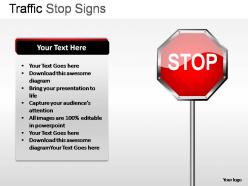
Ski along safely on our Traffic Stop Signs Powerpoint Presentation Slides. Conquer the steepest inclines with ease.
People who downloaded this PowerPoint presentation also viewed the following :
Traffic stop signs powerpoint presentation slides with all 17 slides:
Unique Traffic Stop Signs Powerpoint Presentation Slides for every need. Compelling design aimed at your presentation goals.


FAQs for Traffic stop signs
Traffic stop signs originated in 1915 in Detroit, evolving from simple black-and-white square signs to today's standardized octagonal red design established in 1971. This evolution reflects urban planning advancements, with municipalities finding that consistent visual standards, reflective materials, and strategic placement significantly enhance traffic flow, reduce accidents, and streamline enforcement, ultimately delivering safer roadways and more efficient transportation systems.
Countries adapt stop sign design through localized color schemes, multilingual text, culturally appropriate symbols, and strategic placement patterns that reflect regional driving behaviors and infrastructure constraints. Through these customizations, nations like Japan using inverted triangular shapes, European countries incorporating multiple languages, and developing nations adjusting visibility standards for diverse vehicle types, ultimately enhance road safety while respecting cultural preferences and driving norms.
Traffic stop signs create psychological anchoring effects that promote cautious decision-making, establish clear authority cues that encourage compliance, and trigger cognitive processing delays that reduce impulsive driving behaviors. Through visual prominence and universal recognition, these signs enhance driver awareness, improve reaction times, and foster more deliberate intersection approaches, with traffic engineers finding that strategic placement ultimately delivers safer driving patterns and reduced accident rates across urban environments.
Strategic stop sign placement at intersections with high visibility, clear sightlines, and proper spacing significantly reduces collision rates by 40-60%, particularly T-bone and pedestrian accidents. Transportation departments enhance safety through reflective materials, LED integration, and optimal positioning, with many municipalities finding that well-placed signage decreases emergency response calls while improving traffic flow efficiency.
Colors and symbols on stop signs significantly influence driver risk perception through psychological conditioning, immediate visual recognition, universal symbolization, cultural associations, and cognitive processing patterns. The distinctive red octagon creates automatic threat assessment and urgency responses, with traffic safety studies finding that standardized colors and shapes reduce reaction times by 30-40%, ultimately enhancing road safety and accident prevention across diverse driving populations.
Digital technology enhances traditional stop signs through smart sensors, LED illumination, connectivity features, real-time monitoring systems, and adaptive messaging capabilities. These technologies streamline traffic management by detecting vehicle approaches, improving visibility during adverse conditions, and enabling remote monitoring, with many transportation departments finding that digital integration ultimately delivers enhanced safety and more efficient traffic flow.
Traffic stop signs work hierarchically with other traffic control systems, where traffic lights typically override stop signs at intersections, while road markings like crosswalks and lane dividers complement stopping procedures. These integrated systems enhance traffic flow by providing clear precedence rules, reducing driver confusion, and ensuring pedestrian safety, with many municipalities finding that strategic combinations of stop signs, signals, and markings ultimately deliver smoother traffic management and fewer accidents.
Ignoring traffic stop signs carries significant legal consequences including fines ranging from $100-500, license points, increased insurance premiums, and potential license suspension for repeat offenses. Law enforcement agencies increasingly utilize traffic cameras, intersection monitoring systems, and patrol officers to detect violations, with many jurisdictions finding that automated enforcement combined with visible penalties effectively reduces intersection accidents and improves overall traffic compliance.
Stop signs demonstrate varying effectiveness between rural and urban environments, with rural areas often experiencing higher compliance rates due to lower traffic volumes, clearer sightlines, and less driver distraction. However, urban stop signs face greater challenges including dense pedestrian activity, frequent intersection conflicts, and driver impatience, while rural signs contend with higher approach speeds and potential visibility issues during adverse weather conditions.
Alternative traffic control measures for high-risk intersections include traffic signals, roundabouts, yield signs, flashing beacons, and speed bumps. These solutions enhance safety by reducing collision points, managing traffic flow more efficiently, and providing clearer right-of-way guidance, with many municipalities finding that roundabouts and smart signals deliver significantly lower accident rates than traditional stop signs.
Community input shapes traffic stop sign placement through resident surveys, neighborhood meetings, safety assessments, and local traffic studies that identify high-risk intersections and pedestrian concerns. This collaborative approach enables municipalities to prioritize locations based on actual usage patterns, school zones, and accident data, while incorporating resident feedback on visibility and design preferences, ultimately delivering more effective traffic management that reflects community needs and enhances neighborhood safety.
Environmental considerations for stop sign installation include materials sustainability, energy-efficient manufacturing processes, local weather resistance requirements, soil and vegetation impact assessments, and wildlife visibility factors. These considerations help municipalities balance traffic safety with ecological responsibility, while durable, weather-resistant materials ultimately reduce replacement frequency and long-term environmental costs, delivering both operational efficiency and environmental stewardship.
Stop signs create structured interaction points where vehicles, cyclists, and pedestrians share road space through clear right-of-way protocols and predictable stopping patterns. These controlled intersections enhance safety for all users by establishing consistent behavioral expectations, reducing conflict points, and enabling smoother traffic flow, with many urban planners finding that strategic stop sign placement significantly improves multimodal accessibility and pedestrian confidence.
Stop sign innovations include retroreflective sheeting materials, LED-embedded designs, solar-powered illumination systems, weather-resistant aluminum substrates, and smart sensor technologies. These advancements enhance visibility by delivering brighter nighttime reflection, active lighting capabilities, and real-time monitoring systems, with many municipalities finding that upgraded signage significantly reduces intersection accidents while minimizing long-term maintenance costs and improving overall traffic safety outcomes.
Driver education programs can enhance stop sign compliance by incorporating real-world accident statistics, interactive simulations demonstrating stopping distances, visual demonstrations of intersection visibility challenges, and comprehensive defensive driving techniques. These methods streamline learning by combining theoretical knowledge with practical scenarios, ultimately delivering safer driving habits and reduced intersection accidents, with many driving schools finding that hands-on approaches significantly improve long-term adherence.
-
Illustrative design with editable content. Exceptional value for money. Highly pleased with the product.
-
Great designs, Easily Editable.