

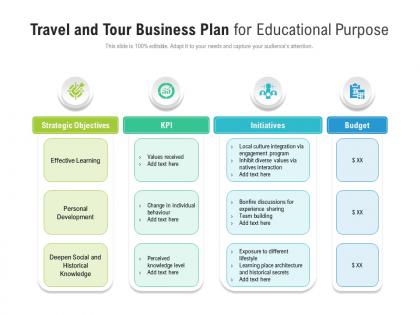
Travel and tour business plan for educational purpose




Try Before you Buy Download Free Sample Product
 Impress Your
 Audience
 100%
100% Editable
 Save Hours
 of Time


Our Travel And Tour Business Plan For Educational Purpose are topically designed to provide an attractive backdrop to any subject. Use them to look like a presentation pro.
People who downloaded this PowerPoint presentation also viewed the following :
Travel and tour business plan for educational purpose with all 2 slides:
Use our Travel And Tour Business Plan For Educational Purpose to effectively help you save your valuable time. They are readymade to fit into any presentation structure.
FAQs for Travel and tour business plan
A successful travel and tour business plan includes market analysis, target customer segments, service offerings, operational logistics, financial projections, and marketing strategies. These components work together by identifying profitable niches, streamlining booking processes, and optimizing resource allocation, with many travel companies finding that comprehensive planning delivers enhanced customer experiences and sustainable competitive advantage.
Market research influences travel and tour business strategies by identifying customer preferences, seasonal demand patterns, competitor pricing structures, and emerging destination trends. Through comprehensive market analysis, travel companies can optimize their package offerings, adjust pricing strategies, and target specific demographics like adventure travelers or luxury tourists, ultimately delivering more personalized experiences and competitive positioning.
**INPUT**: What financial projections should be included in a comprehensive travel and tour business proposal? **OUTPUT**: Financial projections should include revenue forecasts, operating expenses, cash flow analysis, break-even calculations, and seasonal adjustment models. These components enable tour operators to demonstrate viability through detailed booking projections, accommodation costs, and transportation expenses, while seasonal models help investors understand peak travel periods, ultimately delivering strategic insights for sustainable growth and competitive positioning. **Word count**: 55 words
Digital marketing integrates into travel business plans through social media engagement, search engine optimization, content marketing, email campaigns, and influencer partnerships. These strategies streamline customer acquisition by showcasing destinations through visual storytelling, targeting specific traveler demographics, and automating booking processes, with many travel companies finding that integrated digital approaches ultimately deliver higher conversion rates and enhanced customer experiences.
Customer segmentation enables travel businesses to tailor services, pricing, and marketing strategies to distinct groups like adventure travelers, luxury vacationers, business tourists, and family groups. Through targeted approaches, tour operators can develop specialized packages, optimize resource allocation, and enhance customer experiences across different demographics, ultimately delivering higher satisfaction rates and competitive advantage in an increasingly diverse tourism market.
A travel and tour business plan addresses sustainability through eco-friendly accommodations, carbon offset programs, local community partnerships, waste reduction initiatives, and responsible wildlife tourism practices. These strategies enable tour operators to minimize environmental impact, support local economies, and attract increasingly conscious travelers, while delivering competitive advantage through authentic experiences and enhanced brand reputation in today's sustainability-focused tourism market.
Key regulatory considerations include licensing requirements, consumer protection laws, data privacy regulations, insurance mandates, and international travel compliance standards. These regulations vary significantly by jurisdiction, with travel businesses needing proper tour operator licenses, financial bonding for customer protection, and adherence to booking platform requirements, ultimately ensuring legal operation while building customer trust and competitive credibility.
A travel and tour business should differentiate through specialized niche targeting, unique experience packages, strategic technology integration, personalized customer service approaches, and competitive pricing models. By focusing on specific markets like eco-tourism, adventure travel, or cultural immersion, companies can streamline operations while delivering enhanced customer experiences, ultimately establishing sustainable competitive advantage in an increasingly crowded marketplace.
Travel and tour businesses should prioritize partnerships with local accommodation providers, transportation companies, destination management organizations, technology platforms, and cultural attraction operators. These strategic collaborations streamline operations by reducing booking complexities, enhancing customer experiences, and expanding service offerings, with many tour operators finding that integrated partnerships ultimately deliver cost efficiencies and competitive market positioning.
Technology enhances travel operations by automating booking systems, enabling real-time inventory management, streamlining customer communications, and facilitating mobile check-ins and digital payments. These solutions deliver faster service delivery, reduced operational costs, and enhanced customer experiences, with many travel companies finding that integrated platforms ultimately provide competitive advantage in an increasingly digital marketplace.
Travel and tour businesses should prepare contingency plans including emergency evacuation protocols, alternative accommodation arrangements, travel insurance coverage, supplier backup options, and flexible booking policies. These strategies enable companies to manage disruptions like natural disasters, political unrest, or health crises while maintaining customer safety and satisfaction, ultimately protecting revenue streams and preserving brand reputation in an increasingly unpredictable industry.
Customer feedback refines travel and tour business plans by identifying service gaps, revealing preferred destinations, highlighting pricing concerns, and uncovering operational inefficiencies. Through systematic review analysis, survey data, and social media monitoring, tour operators enhance itinerary design, streamline booking processes, and adjust pricing strategies, ultimately delivering improved customer experiences and competitive positioning in an increasingly crowded marketplace.
Digital marketing channels dominate travel industry customer acquisition, including social media advertising, search engine optimization, influencer partnerships, email marketing, and content marketing through travel blogs. These channels streamline customer targeting by showcasing visual destinations, enabling personalized recommendations, and facilitating instant bookings, with many travel companies finding that strategic combinations of Instagram marketing and Google Ads ultimately deliver higher conversion rates and broader market reach.
A travel and tour business plan can leverage social media through visual storytelling, user-generated content campaigns, influencer partnerships, targeted advertising, and real-time customer engagement across platforms like Instagram, Facebook, and TikTok. These strategies enhance brand visibility by showcasing authentic travel experiences, building community trust, and enabling direct customer interaction, with many tour operators finding that consistent social media presence significantly increases bookings and customer loyalty.
Travel startup challenges include securing funding, establishing supplier relationships, navigating regulatory requirements, building customer trust, and managing seasonal demand fluctuations. These obstacles can be addressed through detailed financial projections showing multiple revenue streams, strategic partnerships with established vendors, comprehensive compliance frameworks, robust marketing strategies emphasizing customer testimonials and certifications, and diversified service offerings that capitalize on year-round opportunities, ultimately delivering sustainable growth and competitive positioning.
-
Unique and attractive product design.
-
Nice and innovative design.
-
Excellent work done on template design and graphics.
-
Helpful product design for delivering presentation.