

Trojan Horses In Cybersecurity Training Ppt





Try Before you Buy Download Free Sample Product
 Impress Your
Audience
 100%
Editable
 Save Hours
of Time


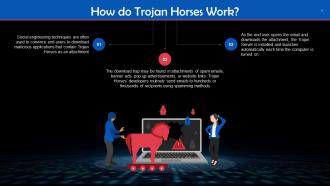
This slide gives an overview of Trojan Horses. A Trojan Horse is a form of malware that poses as legitimate code or software.
People who downloaded this PowerPoint presentation also viewed the following :
Trojan Horses In Cybersecurity Training Ppt with all 20 slides:
Use our Trojan Horses In Cybersecurity Training Ppt to effectively help you save your valuable time. They are readymade to fit into any presentation structure.










FAQs for Trojan Horses In
Trojan horse malware typically disguises itself as legitimate software, requires user interaction for installation, lacks self-replication capabilities, and operates stealthily to avoid detection. These malicious programs infiltrate systems through email attachments, software downloads, and compromised websites, ultimately delivering backdoor access, data theft, and system control to cybercriminals while appearing harmless to users.
Trojan horses typically gain access through email attachments, malicious downloads, infected software updates, social engineering tactics, and compromised websites that exploit browser vulnerabilities. These deceptive programs infiltrate systems by masquerading as legitimate applications, with many organizations finding that employee education and multi-layered security protocols significantly reduce successful infiltration attempts.
Trojan horses include backdoor Trojans, banking Trojans, rootkit Trojans, ransomware Trojans, and remote access Trojans, each designed with distinct malicious purposes and attack vectors. These variants differ by targeting financial institutions through credential theft, establishing persistent network access, or encrypting critical business data, with many organizations finding that understanding these differences enables more strategic cybersecurity investments and targeted defense mechanisms.
Organizations can protect themselves from Trojan horse attacks through comprehensive security awareness training, robust email filtering systems, regular software updates, endpoint detection solutions, and network segmentation protocols. These layered defenses work by identifying suspicious attachments, monitoring unusual system behavior, and restricting unauthorized access, with many financial institutions and healthcare organizations finding that combining employee education with advanced threat detection significantly reduces successful infiltrations.
Social engineering serves as the primary delivery mechanism for Trojan horses, exploiting human psychology through phishing emails, fake software updates, malicious attachments, and deceptive social media links. These manipulation tactics enable cybercriminals to bypass technical security measures by convincing users to voluntarily install malware, with many organizations finding that employee training and awareness programs significantly reduce successful Trojan infections.
Key indicators of Trojan horse infection include unexplained system slowdowns, unusual network activity, unauthorized data transfers, suspicious pop-ups, and unexpected software installations or modifications. Organizations across sectors like banking, healthcare, and retail monitor these warning signs through comprehensive security protocols, enabling rapid threat detection and response that minimizes operational disruptions while protecting sensitive customer data and maintaining business continuity.
EDR solutions combat Trojan horses by providing real-time monitoring, behavioral analysis, automated threat detection, and rapid incident response across all network endpoints. These systems enable organizations to identify suspicious activities, isolate infected devices, and remediate threats before significant damage occurs, with many financial institutions and healthcare providers finding that EDR significantly reduces dwell time and enhances overall security posture.
Successful Trojan horse attacks can devastate businesses through prolonged data theft, financial losses, regulatory penalties, compromised customer trust, and damaged brand reputation that persists for years. These breaches often result in costly system rebuilds, legal settlements, and lost competitive advantage, with many organizations finding that recovery requires significant investment in enhanced cybersecurity infrastructure and ongoing monitoring systems.
Trojan horses exploit software vulnerabilities by masquerading as legitimate applications, targeting unpatched security flaws, and leveraging social engineering tactics to bypass system defenses. These malicious programs infiltrate networks through email attachments, infected downloads, and compromised websites, with many financial institutions and healthcare organizations finding that multi-layered security protocols significantly reduce successful penetration attempts.
Effective employee education strategies include interactive cybersecurity workshops, simulated phishing exercises, regular security awareness training, real-world case study analysis, and comprehensive email security protocols. These approaches enhance organizational defenses by building threat recognition skills, promoting cautious digital behavior, and establishing security-first mindsets, with many companies finding that consistent education significantly reduces successful Trojan infiltrations and strengthens overall cybersecurity posture.
Trojan horses differ from viruses and worms by disguising themselves as legitimate software while requiring user installation, whereas viruses attach to existing files and worms self-replicate across networks automatically. While viruses and worms spread independently through system vulnerabilities, Trojans rely on social engineering and user deception, with many organizations finding that comprehensive security awareness training alongside traditional antivirus solutions delivers stronger protection against these diverse threat vectors.
Trojan horse attacks trigger compliance obligations under data protection laws like GDPR and CCPA, breach notification requirements, and potential liability for compromised customer information. Organizations face regulatory scrutiny from industry bodies, possible fines for inadequate security measures, and legal exposure through customer lawsuits, while insurance claims and forensic investigations become necessary for regulatory compliance and business continuity.
Trojan horse detection and removal tools include antivirus software, anti-malware programs, network monitoring systems, behavioral analysis tools, and endpoint detection solutions. These technologies enhance cybersecurity by identifying suspicious activities, scanning for malicious code, and providing real-time threat intelligence, with many organizations finding that strategic combinations ultimately deliver comprehensive protection and faster incident response capabilities.
Data backup solutions mitigate Trojan horse damage by enabling rapid data recovery, maintaining multiple restore points, and preserving business continuity during attacks. Through automated backup systems and version control, organizations in banking, healthcare, and retail can quickly restore clean data before infection occurred, minimizing downtime and operational disruption while maintaining customer trust.
Emerging cybersecurity trends include AI-powered threat detection, zero-trust architecture, behavioral analytics, advanced endpoint protection, and automated incident response systems. These technologies streamline Trojan horse prevention by enabling real-time pattern recognition, continuous network monitoring, and predictive threat analysis, with many organizations finding that strategic combinations of these approaches ultimately deliver enhanced security postures and significantly reduced attack surfaces.
-
It's always a delight to see new templates from you! I am extremely pleased with the fact that they are easy to modify and fit any presentation layout in seconds!
-
The pricing page of this website is very sorted. I felt no pain while buying the PPTs.